

Tree Roots Under Concrete: Why Cutting Them Yourself Can Kill the Tree (or Drop It)
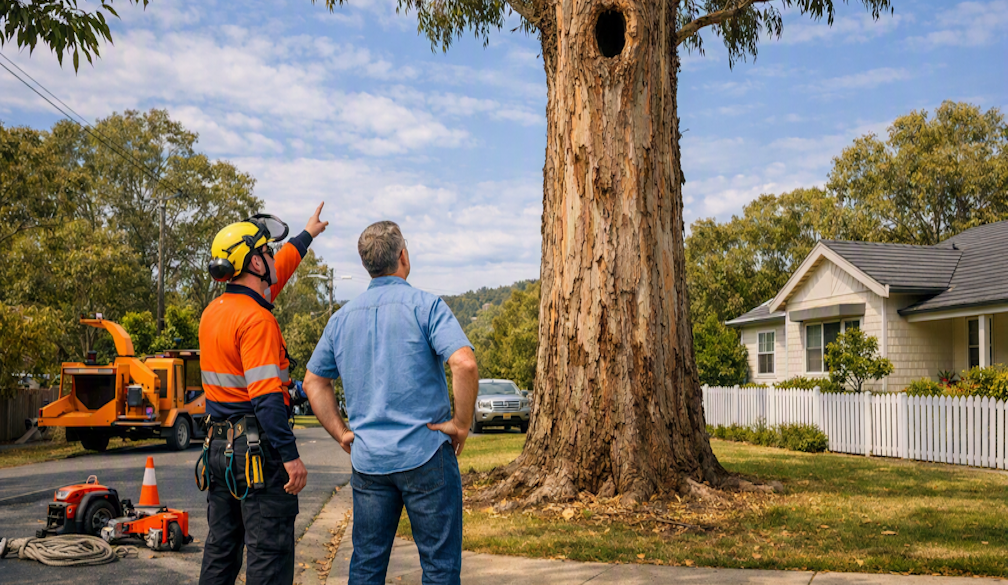
The roots under your slab are usually holding the tree up. Cut them with a mattock or an excavator bucket and you remove part of the tree's anchorage and open a clean path for rot. The tree rarely dies that week. It dies, or falls, one to five years later. Tree root removal under concrete starts with working out which roots are there, not with a saw.
The temptation makes sense. The driveway cracked along one line, there is a root right there, and the job looks like a Saturday morning. It usually is. The bill arrives later.
Why do roots grow under concrete?
Roots are not attacking your slab. They go where conditions are best, and a slab creates very good ones. Soil under concrete stays cooler and damper, escapes compaction from cars and mowers, and often sits beside a leaking irrigation line. In Perth, where sand drains fast and summers are long and dry, that damp strip can be the most reliable water in the yard.
Roots get in through the easy gaps: the sand bedding layer, an expansion joint, or a loosely backfilled service trench. Once in, a root thickens every year. Concrete handles weight from above well and pressure from below badly, so the slab lifts and cracks.
Common culprits: figs, London plane, liquidambar, Chinese elm, jacaranda, and older peppermints, mostly planted close to hard surfaces decades ago.
What happens when you cut a big root?
Three problems start at once.
1. The tree loses its grip
A tree stands up because of a plate of thick woody roots spreading from the trunk base, mostly in the top 600 mm of soil. Wind on the canopy is transferred to that plate. Cut the big roots on one side and the tree loses part of its resistance to being levered over in one direction. Root-cut trees tend to fall toward the cut side, in a wind they had handled fine for twenty years.
2. You open a wound that never closes
Trees do not heal damage, they seal around it. Cut roots are an easy way in for rot fungi, and the rot travels back along the root toward the trunk base, where it does the most harm. A root torn by a bucket is far worse than a clean saw cut, because crushed bark gives the fungi a wider entry.
3. You cut the water supply
The fine feeder roots hang off the thick roots you just removed. Losing them in a Perth summer means drought stress at the worst time. Watch for smaller leaves, early leaf drop, thinning at the top of the canopy, and shoots sprouting from the trunk. That last one is stress, not recovery.
A common arborist rule of thumb: lose more than about 20 percent of the root system and decline is likely. Under a driveway, three cuts can pass that mark.
How close to the trunk is too close?
Australian Standard AS 4970 gives a usable reference. The tree protection zone is a circle around the trunk with a radius of 12 times the trunk diameter at chest height, capped at 15 metres. Inside it, cutting roots needs a reason and supervision.
|
Trunk diameter at chest height |
Protection zone radius |
At the slab |
|
200 mm |
2.4 m |
Concrete inside 2.4 m sits over significant roots |
|
300 mm |
3.6 m |
Most suburban driveways fall inside this circle |
|
500 mm |
6.0 m |
Get an arborist before cutting near the slab edge |
|
800 mm |
9.6 m |
Assume the whole hard surface is in the root zone |
Treat it as a screening tool, not a permit.
Why doesn't the tree die straight away?
Rot works slowly. Fungi take months to establish on a cut root face and years to reach the trunk base. Meanwhile, the canopy keeps growing, so wind load rises while anchorage falls. Eventually, the two lines cross, and the storm gets the blame.
That delay is why the practice survives. The tree looks fine all season, so word gets around that it was no big deal.
Warning signs on any tree with roots cut in the last decade:
- Mushrooms or fungal brackets at the trunk base or over the root zone
- Soil cracking, doming or a gap opening on one side of the base
- A lean that has changed, even slightly
- A trunk base that no longer looks flared at ground level
- Dead branches up high while lower branches stay healthy
Is tree root removal under concrete ever safe?
Yes, when it is planned instead of improvised. Root pruning is a real technique. What separates it from DIY cutting is the order of work.
- Look before you cut. Roots are exposed first, usually with an air spade or water jet, so bark is not damaged and the real size of each root can be seen.
- Decide what can go. Only then choose which roots to cut, always as far from the trunk as the job allows.
- Cut clean. Sharp saw, square cuts. No bucket, no grinder, no axe.
- Pick the season. Outside peak summer heat where possible.
- Support the tree. Deep watering, mulch over the root zone, no other stress for a season or two.
Before anyone digs: under a slab you may hit water mains, sewer, gas, conduit or footings. A free Before You Dig Australia enquiry takes a few minutes.
What can you do instead of cutting?
Usually, the concrete is the easier thing to change.
|
Option |
How it works |
Best for |
|
Supervised root pruning |
Roots exposed and assessed, then cut clear of the structural zone |
Smaller outer roots |
|
Flexible paving |
Slab replaced with permeable pavers or brick on a sand bed |
Paths, courtyards, pool surrounds |
|
Bridging or floating slab |
New concrete spans the roots on a thicker base, or sits on piers |
Driveways that cannot move |
|
Removal and stump grinding |
Whole tree out, stump ground below the slab line |
Wrong tree, wrong spot |
One habit worth changing: if irrigation only reaches the lawn and beds, roots keep heading for the damp sand under the slab. Deep, less frequent watering away from hard surfaces gives them a reason to stay put.
Do you need council approval?
Often, yes. Check first if the tree is a street or verge tree, is listed as significant, was kept as a condition of a development approval, or sits on strata common property. Protection usually covers root damage, not just pruning and felling.
Neighbour's tree? You generally have some right to deal with roots crossing the boundary, but not to kill or destabilise the tree. If it falls, liability can follow whoever cut. Agree the work in writing first.
What to ask before the work starts
- Qualifications. AQF Level 3 for hands-on work, AQF Level 5 for a report or stability assessment.
- Method. Will the roots be exposed and assessed before anything is cut?
- Insurance. Current public liability cover, and who carries the risk if the tree declines.
- The concrete plan. A contractor who only removes trees will recommend removal.
It pays to read tree loppers reviews from other Perth homeowners before you commit. Look for comments on cleanup, quoted price versus final invoice, and whether the crew explained their reasoning.
For root work near a slab, a team like Lakeside Trees and Stumps that handles assessment, pruning, and stump grinding in-house avoids the situation where three contractors blame each other.
Bottom line
Concrete can be lifted, replaced, bridged or rerouted. A mature tree cannot.
Work out which roots are under there and what they are holding up before anyone cuts. In most suburban yards, the surface is the cheaper thing to change.
FAQ
Can I cut tree roots that are lifting my driveway?
Small roots at the outer edge of the root zone, sometimes. Thick roots, or anything within a few metres of the trunk, need an arborist to check stability first. A root's size where you can see it does not tell you what it is holding up.
How far from the trunk can roots be cut safely?
There is no single distance. Use 12 times the trunk diameter as a screening figure, then get eyes on the roots themselves.
Will cutting roots on one side make the tree fall?
It can, and falling toward the cut side is a known pattern. The tree usually stays up until a strong wind loads it, which is why the link gets missed.
How long after root cutting does a tree decline?
Drought stress can show within one summer. Rot-related structural problems usually take one to five years to appear, and longer to become dangerous.
Do I need council approval to cut roots under my own concrete?
Sometimes. Street trees, significant trees and trees kept under a development condition are commonly protected, and that can include root damage.
Can I cut roots from my neighbour's tree under my slab?
You can usually deal with encroachment at the boundary, but not kill or destabilise the tree. Get it in writing, and bring in an arborist for thick roots.
 "Pin It")