

Why ‘The West Wing’ went from a bipartisan hit to a polarized streaming comfort watch over 2 decades, reflecting profound shifts in media and politics
- Written by Karrin Vasby Anderson, Professor of Communication Studies, Colorado State University
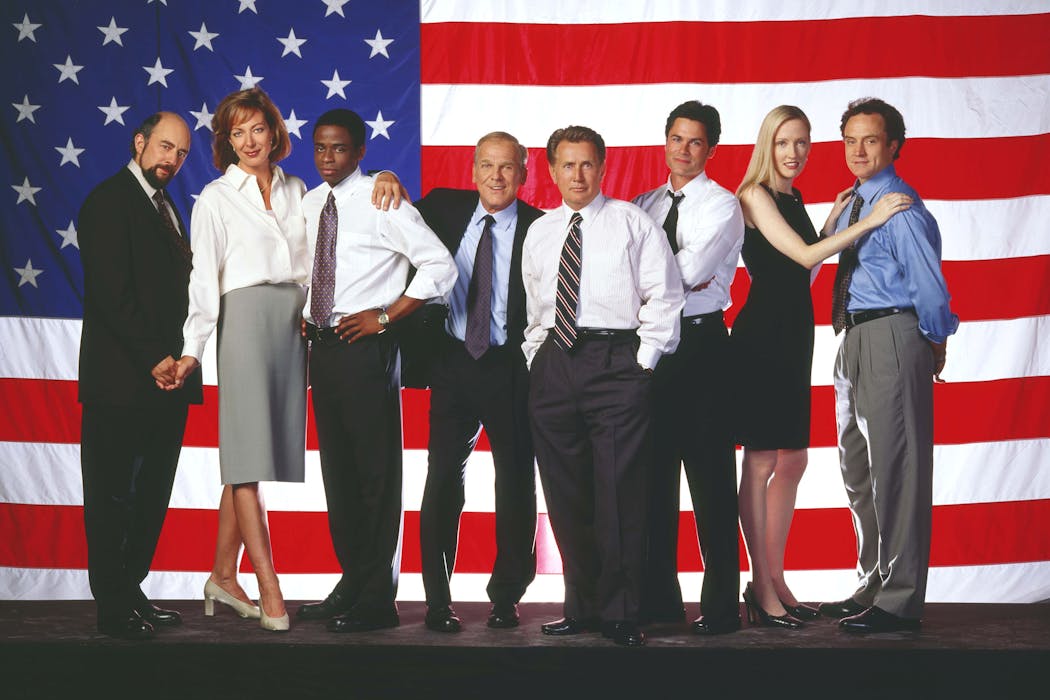 If you're like the many viewers who have binge-watched the series multiple times, you know who all these cast members of 'The West Wing' are.James Sorensen/NBC/Newsmakers, Hulton Archive
When the early 2000s hit series “The West Wing” returned on Netflix in December 2025, it spurred conversation about how the idealistic political drama would play in Donald Trump’s second term.
The series features a Democratic presidential administration led by President Josiah “Jed” Bartlet, played by Martin Sheen, and his loyal White House staff negotiating political challenges with character, competence and a fair bit of humor.
It sparked cultural commentary long after it ceased its original run in 2005.
In 2016, The Guardian’s Brian Moylan asserted that the “The West Wing” was appealing because it portrayed “a world where the political system works. It reminds us of a time, not too long ago, when people in political office took their jobs very seriously and wanted to actually govern this country rather than settle scores and appeal to their respective bases.”
In 2025, Vanity Fair’s Savannah Walsh mused that “The West Wing” might be dismissed by younger audiences as a “form of science fiction” or lauded by the demographic currently watching “Jed Bartlet fancams scored to Taylor Swift’s ‘Father Figure’” on TikTok.
Audiences have been comfort-streaming the “The West Wing” since Trump’s first term. Interest in the series spiked after Trump’s election in 2016, and it served as an escape from the contentious 2020 campaign.
When the cast reunited at the 2024 Emmy awards, the Daily Beast’s Catherine L. Hensley remarked that the series’ “sense of optimism about how American government actually functions … rang hollow, almost like watching a show from another planet.”
Nonetheless, Collider’s Rachel LaBonte hailed its Netflix return in late 2025 as a “balm for these confusing times.”
“The West Wing’s” transition from broadcast television behemoth to “bittersweet comfort watch” in today’s streaming era reveals a lot about how much our media and political landscapes have changed in the past 25 years.
As professors of media studies and political communication, we study the fracturing of our media and political environments.
The shifting appeal of “The West Wing” during the past quarter century raises a sobering question: Is political competence and an idealized respect for democratic norms losing popularity in 2026? Or does the new political reality demand engagement with the seamier side of politics?
The ethic of political cooperation presented in “The West Wing” included putting a die-hard Republican lawyer on the president’s staff.‘The West Wing’s’ optimistic big tent
“The West Wing” premiered on NBC in the fall of 1999, blending political intrigue with workplace drama in a formula audiences found irresistible. The show surged in viewership in its second and third seasons, as it imagined responses from a Democratic administration to the values and ideology of the newly installed Republican President George W. Bush.
But the series was undergirded by an ethic of political cooperation, reinforcing the idea that, according to Walsh, “we’re all a lot more aligned than we realize.” In 2020, Sheen observed in an interview that writer “Aaron Sorkin never trashed the opposition,” choosing instead to depict “people with differences of opinion trying to serve.”
In 2019, The New York Times observed that the “The West Wing” presented “opposition Republicans, for the most part, as equally honorable,” and noted that the show earned fan mail from viewers across the political spectrum.
At its height of popularity, episodes of “The West Wing” garnered 25 million viewers. Such numbers are reserved today only for live, mass culture events like Sunday night football.
Of course, “The West Wing” aired in a radically different television environment from today.
Despite competition from cable, that era’s free, over-the-airwaves broadcasters like NBC accounted for roughly half of all television viewing in the 2001-02 season. Currently, they account for only about 20%.
Gone are the days of television’s ability to create the “big tents” of diverse audiences. Instead, since “The West Wing’s” original airing, television gathers smaller segments of viewers based on political ideology and ultraspecific demographic markers.
Darker, more polarized media environment
 Allison Janney, ‘The West Wing’s’ earnest and scrupulous press secretary C.J. Cregg, now plays a duplicitous president in ‘The Diplomat.’Jason Mendez/Stringer, Getty
The fracturing of the television audience parallels the schisms in America’s political culture, with viewers and voters increasingly sheltering in partisan echo chambers. Taylor Sheridan has replaced Sorkin as this decade’s showrunner, pumping out conservatively aligned hits such as “Yellowstone” and “Landman.”
Liberals, conversely, now see “West Wing” alumni recast in dystopian critiques of contemporary conservatism. Bradley Whitford morphed from President Bartlet’s political strategist to a calculating racist in Jordan Peele’s “Get Out,” and a commander in “The Handmaid’s Tale’s” misogynist army.
Allison Janney, who played “The West Wing’s” earnest and scrupulous press secretary, is now a duplicitous and potentially treasonous U.S. president in “The Diplomat,” whose creator in fact got her start on “The West Wing.”
Even Sheen has been demoted from serving as America’s favorite fictional president to playing J. Edgar Hoover in the film “Judas and the Black Messiah,” whom Sheen described as “a wretched man” and “one of the worst villains imaginable.”
Television as equipment for living
Philosopher Kenneth Burke argued that stories function as “equipment for living.” Novels, films, songs, video games and television series are important because they not only reveal our cultural predilections, they shape them, providing us with strategies for navigating the world around us.
Films and series like “Get Out,” “The Handmaid’s Tale,” “The Diplomat” and “Judas and the Black Messiah” urge audiences to confront the racism and sexism ever-present in media and politics. That includes, as some scholars and viewers have noted, the often casual misogyny and second-string roles for some women and Black men in “The West Wing.”
As U.S. citizens protest authoritarianism in the streets from Portland, Oregon, to Portland, Maine, a comfort binge of a series in which the White House press secretary, as Vanity Fair said, “dorkily performs ‘The Jackal’ and doesn’t dream of restricting West Wing access – even on the administration’s worst press days” is appealing.
But indulging an appetite for what one critic has called “junk-food nostalgia for a time that maybe never even existed” may leave audience members less equipped to build the healthy democracy for which the characters on “The West Wing” always strived. Or it may invigorate them.
The authors do not work for, consult, own shares in or receive funding from any company or organization that would benefit from this article, and have disclosed no relevant affiliations beyond their academic appointment.
Authors: Karrin Vasby Anderson, Professor of Communication Studies, Colorado State University