

NewsPronto

 
The Times


.

USA Conversation

The Conversation USA

The Conversation USA

Microbes in deep-sea volcanoes can help scientists learn about early life on Earth, or even life beyond our planet

  • Written by James F. Holden, Professor of Microbiology, UMass Amherst
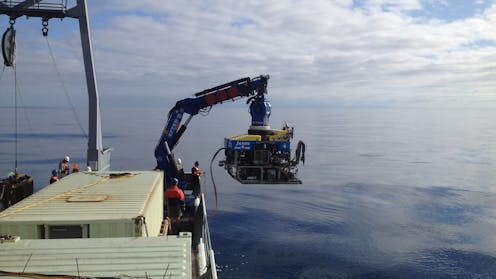
imageA submersible, which travels to the seafloor to collect rock and microbe samples, is lifted by the arm of a research vessel. James F. Holden

People have long wondered what life was first like on Earth, and if there is life in our solar system beyond our planet. Scientists have reason to believe that some of the moons in our solar system – like...

Read more: Microbes in deep-sea volcanoes can help scientists learn about early life on Earth, or even life...

More Articles ...

  1. Comparing ICE to the Gestapo reveals people’s fears for the US – a Holocaust scholar explains why Nazi analogies remain common, yet risky
  2. ‘Democratizing space’ is more than just adding new players – it comes with questions around sustainability and sovereignty
  3. Filipino sailors dock in Mexico … and help invent tequila?
  4. Why is heart cancer so rare? A biologist explains
  5. How the world’s nuclear watchdog monitors facilities around the world – and what it means that Iran kicked it out
  6. How the QAnon movement entered mainstream politics – and why the silence on Epstein files matters
  7. How the ‘big, beautiful bill’ will deepen the racial wealth gap – a law scholar explains how it reduces poor families’ ability to afford food and health care
  8. ‘I just couldn’t stop crying’: How prison affects Black men’s mental health long after they’ve been released
  9. Leaders in India, Hungary and the US are using appeals to nostalgia and nationalism to attack higher education
  10. Florida plan to deputize National Guard officers as immigration judges at Alligator Alcatraz would likely violate constitutional rights
  11. About a third of pregnant women in the US lack sufficient vitamin D to support healthy pregnancies − new research
  12. Can AI think – and should it? What it means to think, from Plato to ChatGPT
  13. Idi Amin made himself out to be the ‘liberator’ of an oppressed majority – a demagogic trick that endures today
  14. Clawback of $1.1B for PBS and NPR puts rural stations at risk – and threatens a vital source of journalism
  15. Why male corporate leaders and billionaires may need financial therapy more than anyone
  16. Poll finds bipartisan agreement on a key issue: Regulating AI
  17. When grief involves trauma − a social worker explains how to support survivors of the recent floods and other devastating losses
  18. Supreme Court news coverage has talked a lot more about politics ever since the 2016 death of Scalia and GOP blocking of Obama’s proposed nominee
  19. Children living near oil and gas wells face higher risk of rare leukemia, studies show
  20. Research replication can determine how well science is working – but how do scientists replicate studies?
  21. Philly’s City Council turned down a new rental inspection program − studies show that might harm tenants’ health
  22. Data can show if government programs work or not, but the Trump administration is suppressing the necessary information
  23. College ‘general education’ requirements help prepare students for citizenship − but critics say it’s learning time taken away from useful studies
  24. Catholic clergy are speaking out on immigration − more than any other political issue except abortion
  25. Why drones and AI can’t quickly find missing flood victims, yet
  26. The golden oyster mushroom craze unleashed an invasive species – and a worrying new study shows it’s harming native fungi
  27. What is peer review? The role anonymous experts play in scrutinizing research before it gets published
  28. University students feel ‘anxious, confused and distrustful’ about AI in the classroom and among their peers
  29. Examining mushrooms under microscopes can help engineers design stronger materials
  30. What makes ‘great powers’ great? And how will they adapt to a multipolar world?
  31. California farmers identify a hot new cash crop: Solar power
  32. Angels, witches, crystals and black cats: How supernatural beliefs vary across different groups in the US
  33. China’s insertion into India-Pakistan waters dispute adds a further ripple in South Asia
  34. Trump free to begin gutting Department of Education after Supreme Court ‘shadow’ ruling − 5 essential reads
  35. Florida is fronting the $450M cost of Alligator Alcatraz – a legal scholar explains what we still don’t know about the detainees
  36. Rethinking the MBA: Character as the educational foundation for future business leaders
  37. Weird space weather seems to have influenced human behavior on Earth 41,000 years ago – our unusual scientific collaboration explores how
  38. Sculptor galaxy image provides brilliant details that will help astronomers study how stars form
  39. Many Texas communities are dangerously unprepared for floods − lack of funding plays a big role
  40. How universities can keep protests from turning violent: 3 lessons from the 2024 pro-Palestinian encampments
  41. Europe is stuck in a bystander role over Iran’s nuclear program after US, Israeli bombs establish facts on the ground
  42. How 17M Americans enrolled in Medicaid and ACA plans could lose their health insurance by 2034
  43. A law from the era of Red Scares is supercharging Trump administration’s power over immigrants and noncitizens
  44. News quiz text reminders
  45. ABC’s and CBS’s settlements with Trump are a dangerous step toward the commander in chief becoming the editor-in-chief
  46. Is there any hope for the internet?
  47. 2026 FIFA World Cup expansion will have a big climate footprint, with matches from Mexico to Canada – here’s what fans can do
  48. When big sports events like FIFA World Cup expand, their climate footprint expands too
  49. When big sports events expand, like FIFA’s 2026 World Cup matches across North America, their climate footprint expands too
  50. Listening to nonhumans: What music can teach about humanity’s relationships with nature and the divine