

NewsPronto

 
The Times


.

USA Conversation

The Conversation USA

The Conversation USA

Dismal ticket sales, grumblings from fans and clubs – is FIFA’s latest attempt to establish a global club game doomed before it starts?

  • Written by Stefan Szymanski, Professor of Sport Management, University of Michigan
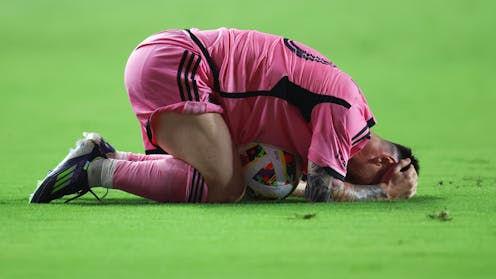
imageFIFA is hoping that Lionel Messi can draw the crowds.Megan Briggs/Getty Images

The FIFA World Club Cup, which kicks off in the U.S. on June 14, 2025, may seem like a new competition.

Certainly, soccer’s governing body, FIFA, is promoting it as is it were, marketing the monthlong competition between 32 of the world’s biggest soccer teams...

Read more: Dismal ticket sales, grumblings from fans and clubs – is FIFA’s latest attempt to establish a...

More Articles ...

  1. Ancient fossils show how the last mass extinction forever scrambled the ocean’s biodiversity
  2. Trump orders Marines to Los Angeles as protests escalate over immigration raids, demonstrating the president’s power to deploy troops on US soil
  3. ‘Who controls the present controls the past’: What Orwell’s ‘1984’ explains about the twisting of history to control the public
  4. Americans still have faith in local news − but few are willing to pay for it
  5. How school choice policies evolved from supporting Black students to subsidizing middle-class families
  6. Your brain learns from rejection − here’s how it becomes your compass for connection
  7. NCAA will pay its current and former athletes in an agreement that will transform college sports
  8. Lafayette helped Americans turn the tide in their fight for independence – and 50 years later, he helped forge the growing nation’s sense of identity
  9. If people stopped having babies, how long would it be before humans were all gone?
  10. From Kent State to Los Angeles, using armed forces to police civilians is a high-risk strategy
  11. Coral reefs face an uncertain recovery from the 4th global mass bleaching event – can climate refuges help?
  12. Was the Boulder attack terrorism or a hate crime? 2 experts unpack the complexities
  13. Beyond de-extinction and dire wolves, gene editing can help today’s endangered species
  14. ‘The Eternal Queen of Asian Pop’ sings one last encore from beyond the grave
  15. US health care is rife with high costs and deep inequities, and that’s no accident – a public health historian explains how the system was shaped to serve profit and politicians
  16. Debates over presidential power to suspend habeas corpus resurface in Trump administration
  17. Early visions of Mars: Meet the 19th-century astronomer who used science fiction to imagine the red planet
  18. Golden Dome dangers: An arms control expert explains how Trump’s missile defense threatens to make the US less safe
  19. Why Kissinger would have been a Fortnite champ − and other foreign policy lessons from the gaming world
  20. AmeriCorps is on the chopping block – despite research showing that the national service agency is making a difference in local communities
  21. 4 creative ways to engage children in STEM over the summer: Tips to foster curiosity and problem-solving at home
  22. Trump’s justifications for the latest travel ban aren’t supported by the data on immigration and terrorism
  23. How Trump’s ‘gold standard’ politicizes federal science
  24. Detroit voters have an opportunity to pick a mayor who will ease zoning, improve transit and protect long-term residents
  25. Game theory explains why reasonable parents make vaccine choices that fuel outbreaks
  26. Ukraine’s Operation Spider Web destroyed more than aircraft – it tore apart the old idea that bases far behind the front lines are safe
  27. 100 years ago, the Supreme Court made a landmark ruling on parents’ rights in education – today, another case raises new questions
  28. Stop the ‘good’ vs ‘bad’ snap judgments and watch your world become more interesting
  29. How illicit markets fueled by data breaches sell your personal information to criminals
  30. Cuts to school lunch and food bank funding mean less fresh produce for children and families
  31. Reproducibility may be the key idea students need to balance trust in evidence with healthy skepticism
  32. In pardoning reality TV stars Todd and Julie Chrisley, Trump taps into a sense of persecution felt by his conservative Christian base
  33. How your electric bill may be paying for big data centers’ energy use
  34. Your left and right brain hear language differently − a neuroscientist explains how
  35. Memories of the good parts of using drugs can keep people hooked − altering the neurons that store them could help treat addiction
  36. ‘Loyal to the oil’ – how religion and striking it rich shape Canada’s hockey fandom
  37. What a sunny van Gogh painting of ‘The Sower’ tells us about Pope Leo’s message of hope
  38. 1 in 4 children suffers from chronic pain − school nurses could be key to helping them manage it
  39. What is vibe coding? A computer scientist explains what it means to have AI write computer code − and what risks that can entail
  40. Extreme weather’s true damage cost is often a mystery – that’s a problem for understanding storm risk, but it can be fixed
  41. Storm damage costs are often a mystery – that’s a problem for understanding extreme weather risk
  42. Supreme Court changes the game on federal environmental reviews
  43. Uncertainty at NASA − Trump withdraws his nominee for administrator while the agency faces a steep proposed budget cut
  44. We asked over 8,700 people in 6 countries to think about future generations in decision-making, and this is what we found
  45. Peace has long been elusive in rural Colombia – Black women’s community groups try to bring it closer each day
  46. A bottlenose dolphin? Or Tursiops truncatus? Why biologists give organisms those strange, unpronounceable names
  47. It’s miller moth season in Colorado – an entomologist explains why they’re important and where they’re headed
  48. The Michelin Guide is Eurocentric and elitist − yet it will soon be an arbiter of culinary excellence in Philly
  49. Is methylene blue really a brain booster? A pharmacologist explains the science
  50. Autocrats don’t act like Hitler or Stalin anymore − instead of governing with violence, they use manipulation