

NewsPronto

 
The Times


.

USA Conversation

The Conversation USA

The Conversation USA

Anti-trans measures don’t just target transgender men and women – a sociologist explains how ‘male’ or ‘female’ categories miss the mark for nonbinary Americans

  • Written by Barbara J. Risman, Distinguished Professor of Sociology, University of Illinois Chicago
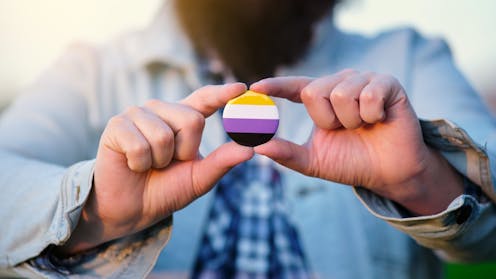
imageThe nonbinary flag, shown here on a pin, represents people who say 'man' or 'woman' does not describe their sense of self.Abraham Gonzalez Fernandez/Moment via Getty Images

Since his inauguration in January 2025, President Donald Trump has issued several executive orders that seek to limit federal recognition of transgender people. These orders...

Read more: Anti-trans measures don’t just target transgender men and women – a sociologist explains how...

More Articles ...

  1. Trump’s West Point speech brought partisanship to the home of the US military − 3 essential reads
  2. Trump’s West Point speech brought partisanship to the home of the US military − 2 essential reads
  3. Queer country: LGBTQ+ musicians are outside the spotlight as Grand Ole Opry turns 100
  4. Could a bold anti-poverty experiment from the 1960s inspire a new era in housing justice?
  5. Christianity has long revered saints who would be called ‘transgender’ today
  6. Pope Leo XIV is the first member of the Order of St. Augustine to be elected pope – but who are the Augustinians?
  7. Air traffic controller shortages in Newark and other airports partly reflect long, intense training − but university-based training programs are becoming part of the solution
  8. Mountain chickadee chatter: Scientists are decoding the songbird’s complex calls
  9. For opioid addiction, treatment underdosing can lead to fentanyl overdosing – a physician explains
  10. Managing forests and other ecosystems under rising threats requires thinking across wide-ranging scenarios
  11. Europeans are concerned that the US will withdraw support from NATO. They are right to worry − Americans should, too
  12. Why some towns lose local news − and others don’t
  13. MAHA report on children’s health highlights harms of ultraprocessed foods – a food scientist explains the research
  14. Harvard fights to keep enrolling international students – 4 essential reads about their broader impact
  15. How does a person become famous when they’re just a kid?
  16. 5 years after George Floyd’s murder: How the media narrative has changed around the killing and the protests that followed
  17. Supreme Court’s one-sentence order closes the door to Catholic charter school – but leaves it open for future challenges
  18. Can you upload a human mind into a computer? A neuroscientist ponders what’s possible
  19. Here’s how we figured the number of guns illegally trafficked from the US across the border to Mexico
  20. Gun trafficking from the US to Mexico: The drug connection
  21. US gun trafficking to Mexico: Independent gun shops supply the most dangerous weapons
  22. Split Supreme Court blocks Oklahoma’s Catholic charter school − but future cases could hinge on whether charters are, at their core, public or private
  23. US solar manufacturers lag skyrocketing market demand
  24. In 2025, Tornado Alley has become almost everything east of the Rockies − and it’s been a violent year
  25. How abortion laws focusing on fetal viability miss the mark on women’s experiences
  26. From furry friends to fish, turning up the heat helps animals fight germs − how Mother Nature’s cure offers humans a lesson on fever
  27. Like many populist leaders, Trump accuses judges of being illegitimate obstacles to safety and democracy
  28. Golden Dome: An aerospace engineer explains the proposed nationwide missile defense system
  29. Golden Dome: An aerospace engineer explains the proposed US-wide missile defense system
  30. Israelis have a skewed view on extent of Gaza’s hunger plight − driven by censorship and media that downplay humanitarian crisis
  31. NOAA’s 2025 hurricane forecast warns of a busy season – a storm scientist explains why and what meteorologists are watching
  32. WHO is finalizing a new treaty that prepares for the next pandemic − but the US isn’t signing
  33. Young food entrepreneurs are changing the face of rural America
  34. At Cannes, decency and dress codes clash with fashion’s red carpet revolution
  35. Empathy can take a toll – but 2 philosophers explain why we should see it as a strength
  36. Work requirements are better at blocking benefits for low-income people than they are at helping those folks find jobs
  37. Billions of cicadas are emerging, from Cape Cod to north Georgia – here’s how and why we map them
  38. A decade after the release of ‘The Martian’ and a decade out from the world it envisions, a planetary scientist checks in on real-life Mars exploration
  39. Lifecycle of a research grant – behind the scenes of the system that funds science
  40. FDA will approve COVID-19 vaccine only for older adults and high-risk groups – a public health expert explains the new rules
  41. What does it mean for Biden’s prostate cancer to be ‘aggressive’? A urologic surgeon explains
  42. Windows are the No. 1 human threat to birds – an ecologist shares some simple steps to reduce collisions
  43. Russia’s invasion united different parts of Ukraine against a common enemy – 3 years on, that unanimity still holds
  44. Trump treats laws as obstacles, not limits − and the only real check on his rule-breaking can come from political pressure
  45. Too much sitting increases risk of future health problems in chest pain patients – new research
  46. Why your electricity bill is so high and what Pennsylvania is doing about it
  47. Rethinking engineering education: Why focusing on learning preferences matters for diversity
  48. Israel has promised ‘basic amount’ of food into Gaza − but its policies have already created catastrophic starvation risk for millions
  49. 19th-century Catholic teachings, 21st-century tech: How concerns about AI guided Pope Leo’s choice of name
  50. Making eye contact and small talk with strangers is more than just being polite − the social benefits of psychological generosity