

NewsPronto

 
The Times


.

USA Conversation

The Conversation USA

The Conversation USA

The US military has cared about climate change since the dawn of the Cold War – for good reason

  • Written by Paul Bierman, Fellow of the Gund Institute for Environment, Professor of Natural Resources and Environmental Science, University of Vermont
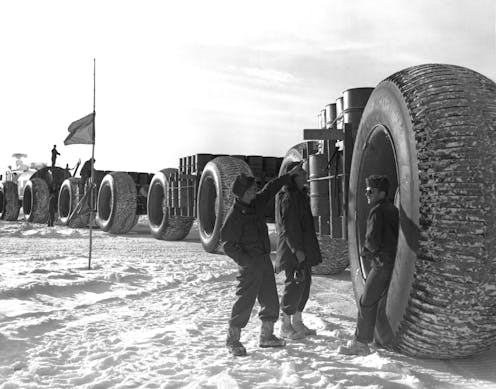
imageMilitary engineers managing supply routes in Greenland in the 1950s paid attention to the weather and climate. US Army/Pictorial Parade/Archive Photos/Getty Images

In 1957, Hollywood released “The Deadly Mantis,” a B-grade monster movie starring a praying mantis of nightmare proportions. Its premise: Melting Arctic ice has released a...

Read more: The US military has cared about climate change since the dawn of the Cold War – for good reason

More Articles ...

  1. Museums have tons of data, and AI could make it more accessible − but standardizing and organizing it across fields won’t be easy
  2. What was the first thing scientists discovered? A historian makes the case for Babylonian astronomy
  3. Trump’s first term polarized teens’ views on racism and inequality
  4. Why was it hard for the GOP – which controls Congress – to pass its spending bill?
  5. Saudi Arabia’s role as Ukraine war mediator advances Gulf nation’s diplomatic rehabilitation − and boosts its chances of a seat at the table should Iran-US talks resume
  6. See you in the funny papers: How superhero comics tell the story of Jewish America
  7. Radioisotope generators − inside the ‘nuclear batteries’ that power faraway spacecraft
  8. The psychology behind anti-trans legislation: How cognitive biases shape thoughts and policy
  9. Big cuts at the Education Department’s civil rights office will affect vulnerable students for years to come
  10. When algorithms take the field – inside MLB’s robo-umping experiment
  11. Simple strategies can boost vaccination rates for adults over 65 − new study
  12. The push to restore semiconductor manufacturing faces a labor crisis − can the US train enough workers in time?
  13. When humans use AI to earn patents, who is doing the inventing?
  14. Why parents of ‘twice-exceptional’ children choose homeschooling over public school
  15. Environmental protection laws still apply even under Trump’s national energy emergency − here’s why
  16. Are Ukrainians ready for ceasefire and concessions? Here’s what the polls say
  17. Philly Roller Derby league turns 20 - here’s how the sport skated its way to feminism, anti-racism and queer liberation
  18. How an unexpected observation, a 10th-century recipe and an explorer’s encounter with a cabbage thief upend what we know about collard greens’ journey to the American South
  19. I study refugees, and here are the facts on the history and impact of refugee resettlement in the US
  20. You’ve likely heard the Serenity Prayer − but not its backstory
  21. 3D printing will help space pioneers make homes, tools and other stuff they need to colonize the Moon and Mars
  22. Can the Trump administration legally deport Palestinian rights advocate Mahmoud Khalil? 3 things to know about green card holders’ rights
  23. America’s clean air rules have boosted health and the economy − here’s what EPA’s deregulation spree ignores
  24. America’s clean air rules boost health and the economy − here’s what EPA’s new deregulation plans ignore
  25. Mass layoffs at Education Department signal Trump’s plan to gut the agency
  26. Is the US heading for a government shutdown? 5 essential reads to occupy the mind while we wait to find out
  27. How do researchers determine how toxic a chemical is? A toxicologist explains alternatives to animal testing
  28. The fediverse promises social media without Big Tech – if it can avoid familiar pitfalls
  29. For superfans, comic-con culture is more than fun – it’s sacred, a sociologist explains
  30. Alien and Sedition Acts were reviled in their time, and John Adams was not sorry to see them go
  31. Pennsylvania’s mushroom industry faces urgent labor shortage − and latest immigration policies will likely make it worse
  32. US workers with remote-friendly jobs are still working from home nearly half the time, 5 years after the pandemic began
  33. How Jesse Jackson embodied Southern politics − and changed American elections
  34. The parallels between Kash Patel and William J. Burns, a scandal-mongering 1920s FBI director — an FBI historian explains
  35. Middle age is a time when women are vulnerable to eating disorders
  36. Arrest of ex-president Duterte will shake up dynastic politics in the Philippines – and hand initiative to rival Marcos family
  37. US-Ukraine deal highlights Ukraine’s wealth of critical minerals, but extracting them isn’t so simple
  38. The world regulated sulfur in ship fuels − and the lightning stopped
  39. 5 years of COVID-19 underscore value of coordinated efforts to manage disease – while CDC, NIH and WHO face threats to their ability to respond to a crisis
  40. What is a SLAPP suit? Legal experts explain how these lawsuits suppress free speech
  41. How Trump’s foreign aid and diplomatic cuts will make it harder for the US to wield soft power to maintain its friendships and win new ones
  42. Mission possible − parastronaut programs can make space travel more inclusive and attainable for all
  43. From TB to HIV/AIDS to cancer, disease tracking has always had a political dimension, but it’s the foundation of public health
  44. End-of-life planning can be hampered by misconceptions − but the process is easier than you might think
  45. Trump’s DOGE campaign accelerates 50-year trend of government privatization
  46. What happens when leaders have loyalists in charge of men with guns: Lessons for the US from Nicaragua, Syria and other authoritarian countries
  47. The sun is setting on government transparency in Florida – and secrecy creep is affecting the rest of the US, too
  48. How the color of St. Patrick’s Day went from blue to green
  49. George Washington, a real estate investor and successful entrepreneur, knew the difference between running a business and running the government
  50. Taking a leap of faith into imaginary numbers opens new doors in the real world through complex analysis