NewsPronto

 
Men's Weekly

.

USA Conversation

The Conversation USA

The Conversation USA

Rising oil prices, surging inflation: The Arab embargo 50 years ago weaponized oil to inflict economic trauma – sound familiar?

  • Written by Jim Krane, Fellow in Energy Studies, Baker Institute for Public Policy; Lecturer, Rice University
imageCars lined up for gasoline in New Jersey in 1973 as supplies ran low and prices shot upward.Frederic Lewis/Archive Photos/Getty Images

Fifty years ago, a secret deal among Arab governments triggered one of the most traumatic economic crises to afflict the United States and other big oil importers.

Saudi King Faisal and other Arab leaders launched...

Read more: Rising oil prices, surging inflation: The Arab embargo 50 years ago weaponized oil to inflict...

More Articles ...

  1. Rising oil prices, surging inflation: The Arab embargo 50 years ago weaponized oil to inflict economic trauma
  2. Why the crisis in Israel is putting pressure on GOP to act over vacant House speaker role
  3. Israel has no good options for dealing with Hamas' hostage-taking in Gaza
  4. Comets 101 − everything you need to know about the snow cones of space
  5. What is seawater intrusion? A hydrogeologist explains the shifting balance between fresh and salt water at the coast
  6. Listen up, ladies and gentlemen, guys and dudes: Terms of address can be a minefield, especially as their meanings change
  7. Your immune system makes its own antiviral drug − and it's likely one of the most ancient
  8. Students understand calculus better when the lessons are active
  9. The Gaza Strip − why the history of the densely populated enclave is key to understanding the current conflict
  10. America's farmers are getting older, and young people aren't rushing to join them
  11. Peace in Sudan is elusive for any would-be mediators – but a new window of opportunity has opened for outside intervention
  12. Exxon, Apple and other corporate giants will have to disclose all their emissions under California's new climate laws – that will have a global impact
  13. Supreme Court to hear arguments in key case about gerrymandering
  14. Is Taiwan a country or not?
  15. How 'nones' − the religiously unaffiliated − are finding meaning, purpose and spirituality in psychedelic churches
  16. Claudia Goldin’s Nobel Prize win is a victory for women in economics − and the field as a whole
  17. Why more school counselors and psychologists alone won't solve America's mental health crisis among students
  18. Spicy food might burn in the moment, but it likely won't harm your health in the long term
  19. Cancer in kids is different from cancer in grown-ups – figuring out how could lead to better pediatric treatments
  20. Why Al-Aqsa remains a sensitive site in Palestine-Israel conflict
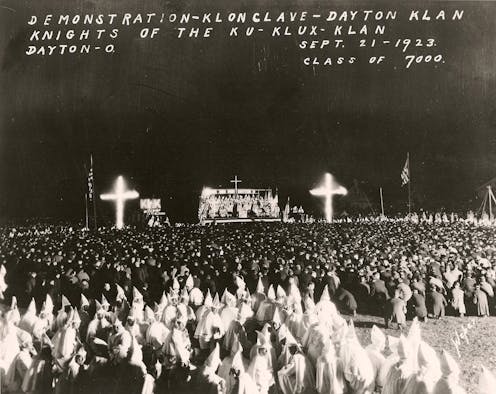
  21. Today's white working-class young men who turn to racist violence are part of a long, sad American history
  22. Glacial lake outburst floods in Alaska and the Himalayas show evolving hazards in a warming world
  23. Are people born with good balance? A physical therapist explains the systems that help keep you on your toes
  24. Hamas assault echoes 1973 Arab-Israeli war – a shock attack and questions of political, intelligence culpability
  25. The Israel-Hamas war: No matter who loses, Iran wins
  26. Iranian Nobel Peace Prize winner Narges Mohammadi, in prison for speaking up against human rights violations, has been a voice for women for almost two decades
  27. Bison are sacred to Native Americans − but each tribe has its own special relationship to them
  28. Often in error but still seductive: Why we can't quit election polls
  29. 20 years after the publication of 'Purple Hibiscus,' a generation of African writers have followed in Chimamanda Ngozi Adichie's footsteps
  30. The pope's new letter isn't just an 'exhortation' on the environment – for Francis, everything is connected, which is a source of wonder
  31. Why the UAW union's tough bargaining strategy is working
  32. Health on the ballot as Argentina poised to elect 'anarcho-capitalist' bent on slashing social protections
  33. Calling the war in Ukraine a 'tragedy' shelters its perpetrators from blame and responsibility
  34. The splendid life of Jimmy Carter – 5 essential reads
  35. Supreme Court is increasingly putting Christians' First Amendment rights ahead of others' dignity and rights to equal protection
  36. The 'Zoom effect' and the possible link between videochatting and appearance dissatisfaction
  37. How a disgruntled scientist looking to prove his food wasn't fresh discovered radioactive tracers and won a Nobel Prize 80 years ago
  38. The Green Revolution is a warning, not a blueprint for feeding a hungry planet
  39. Cell death is essential to your health − an immunologist explains when cells decide to die with a bang or take their quiet leave
  40. China's WeChat is all-encompassing but low-key − a Chinese media scholar explains the Taoist philosophy behind the everything app's design
  41. Making 'movies' at the attosecond scale helps researchers better understand electrons − and could one day lead to super-fast electronics
  42. LGBTQ+ Americans feel they are just getting by in retirement and face greater financial risks
  43. Do 'sputnik moments' spur educational reform? A rhetoric scholar weighs in
  44. Death of the Armenian dream in Nagorno-Karabakh was predictable but not inevitable
  45. Birds, worms, rabbits: Francis of Assisi was said to have loved them all – but today's pet blessings on his feast day might have seemed strange to the 13th century saint
  46. Tenacious curiosity in the lab can lead to a Nobel Prize – mRNA research exemplifies the unpredictable value of basic scientific research
  47. Being told where their blood ends up encourages donors to give again – new research
  48. Where the Supreme Court stands on banning books
  49. Navigating the risks and benefits of AI: Lessons from nanotechnology on ensuring emerging technologies are safe as well as successful
  50. How do astronomers know the age of the planets and stars?