

How to Plan a Wedding Menu Around Gourmet Finger Food
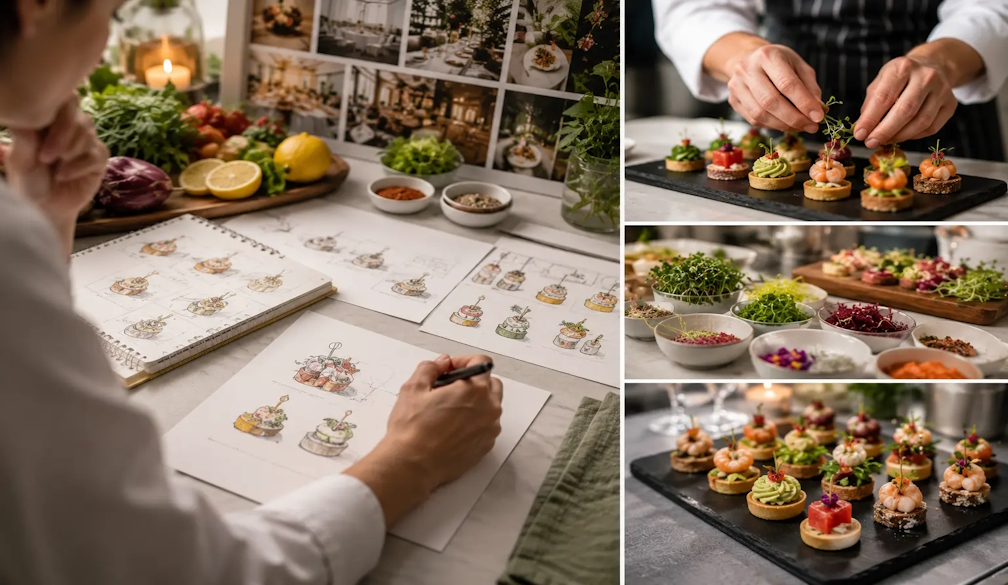
Ask any couple who's been through it, and they'll tell you the same thing: of all the decisions that go into planning a wedding, the food causes more quiet stress than almost anything else.
That's not surprising. Research shows that 56% of brides rate providing delicious food as a top priority for their wedding day, ranking it above almost every other element of the reception. And yet, so many couples default to a traditional sit-down dinner not because it's the right fit, but because it feels like the safe choice.
Gourmet finger food is increasingly becoming that other choice, and when it's planned well, it doesn't just feed your guests. It shapes the entire feel of the evening.
Here's how to do it right.
Start With the Shape of Your Day
Before you think about what food to serve, think about how your wedding will actually flow. A finger food menu isn't one-size-fits-all, and the quantities, timing, and style of what you serve need to match the structure of your event.
Are you planning a relaxed cocktail-style reception where finger food is the meal? Or are you using it to carry your guests through a cocktail hour before a more formal component later?
The answer changes your planning considerably. For a full cocktail-style reception lasting most of the evening, industry guidance suggests 14–18 pieces of finger food per guest, with more substantial options included in the mix. For a dedicated cocktail hour before a seated dinner, 4–6 well-chosen pieces per person is usually enough, enough to keep guests comfortable and the energy up, without spoiling what's ahead.
Getting this clarity early, and sharing it with your caterer, is what separates a well-fed wedding from one where guests are quietly hunting for something more substantial by 8 PM.
Think in Courses, Not Just Bites
One of the most common misconceptions about gourmet finger food menus is that they're informal or unstructured. In fact, the best ones have just as much thought behind them as a three-course plated dinner, just more freedom in how it's delivered.
Think of your finger food menu in three broad movements:
- The welcome. As guests arrive and drinks are poured, lighter bites set the tone, think delicate smoked salmon on crispy toast, tiny caprese skewers, or chilled prawn cocktail cups. These are conversation starters, not stomach-fillers. They give guests something to reach for while they find their feet in the room.
- The main act. As the evening settles in, the food should become more substantial. This is where gourmet finger food earns its name. Mini beef sliders with truffle aioli, spiced lamb kofta with yoghurt, crispy duck pancakes, or seared scallops on a spoon, bites that are genuinely memorable, not just adequate. This is the food people will talk about on the drive home.
- The sweet finish. Don't let dessert be an afterthought. Passed dessert items, tiny chocolate fondant pots, mini pavlovas with fresh berry, salted caramel profiteroles, land beautifully in a finger food format and often outperform a single-option wedding cake slice in terms of guest enjoyment.
This kind of sequencing gives your finger food menu a proper arc. It also gives your catering team a clear brief to work with.
Don't Leave Dietary Needs Until the Last Minute
Dietary restrictions used to feel like a minor consideration. They're not, anymore. Half of all catering clients now prefer menu options that accommodate specific dietary restrictions, and at any given wedding guest list, you can expect a meaningful proportion of guests with needs ranging from vegetarian and vegan to gluten-free, dairy-free, nut allergies, and religious requirements like halal or kosher.
The good news is that a gourmet finger food menu is, in many ways, easier to adapt than a plated dinner. Rather than preparing a separate "special meal" that gets carried out self-consciously while everyone else is eating something different, a well-designed finger food spread can include a generous range of options that work across different dietary needs, without making anyone feel singled out.
The key is to plan for this from the start, not patch it on at the end. Include a dietary needs question on your RSVP. Share the responses with your caterer well in advance, ideally six to eight weeks before the wedding. Ask for clear labelling at any food stations, so guests can make their own choices confidently.
A good caterer will help you build a menu where the dietary-specific options are genuinely appealing, not just technically compliant.
Quantity and Variety: Getting the Balance Right
There's a practical art to this that your caterer will guide you through, but it helps to understand the logic before you sit down together.
Variety matters as much as quantity. Industry guidance suggests offering five to eight different types of finger food at a wedding, which gives guests genuine choice without overwhelming the kitchen or the service team. Within that range, aim for a mix of protein-based and vegetable-based options, a combination of hot and cold, and at least a few options that work for guests with common dietary restrictions.
A few practical things to keep in mind:
- Time of day changes everything. Evening weddings require more food than afternoon events. Guests arriving at 6 PM are expecting to be fed a dinner-equivalent meal, even if it's not served at a table.
- Alcohol increases appetite. If you're serving an open bar, factor in extra pieces per person. A standard rule of thumb is an additional two to four pieces per guest when alcohol is flowing throughout the evening.
- Heavier bites are more filling. Sliders, skewers, arancini, and mini pies carry more weight than canapés. A menu that leans toward these more substantial items can sustain guests with slightly fewer total pieces.
Presentation Is Part of the Experience
Research from the catering industry shows that 67% of caterers cite food presentation as a key factor in client satisfaction, and in a finger food format, presentation becomes even more visible than in a plated dinner. Instead of food arriving on individual plates, it's moving through the room on platters, being set out on stations, or displayed across grazing tables. Every piece is on show.
This is an area where working with the right caterer makes a real difference. Gourmet finger food should look the part, thoughtfully garnished, elegantly plated, served at the right temperature. It should signal to your guests that care has gone into every detail, not just the flowers and the dress.
Talk to your caterer about how the food will be presented. Ask about the platter and station styling, how frequently food will be replenished, and how the service team will handle timing across the evening. These conversations produce better results than simply choosing items from a printed menu.
Work With a Caterer Who Specialises in This Format
Not every catering team approaches finger food the same way. Some treat it as a simplified version of their main offering. Others, the ones worth working with, treat it as a discipline in its own right, with genuine expertise in flavour-packed small bites, precise portioning, and seamless service in a moving crowd.
When you're meeting with potential caterers, ask to taste the finger food specifically. Ask how they handle the transition from lighter to more substantial bites across an evening. Ask how they manage dietary needs across a large guest list without compromising the quality of anyone's experience.
The answers will tell you everything.
A Final Thought
Planning a wedding menu around gourmet finger food isn't a compromise. Done well, it creates something a formal sit-down dinner rarely manages: a room where guests are genuinely mixing, the energy stays high all night, and the food is part of what people remember rather than just the backdrop to the speeches.
The planning behind it matters. The Sydney finger food caterer you choose matters. But when those pieces are in place, the result speaks for itself, one delicious bite at a time.