

First Phosphate Accelerates 30,000 Metre Drilling Program to Provide Final Geological Model for its Begin-Lamarche Igneous Phosphate Property
- Written by: Media Outreach
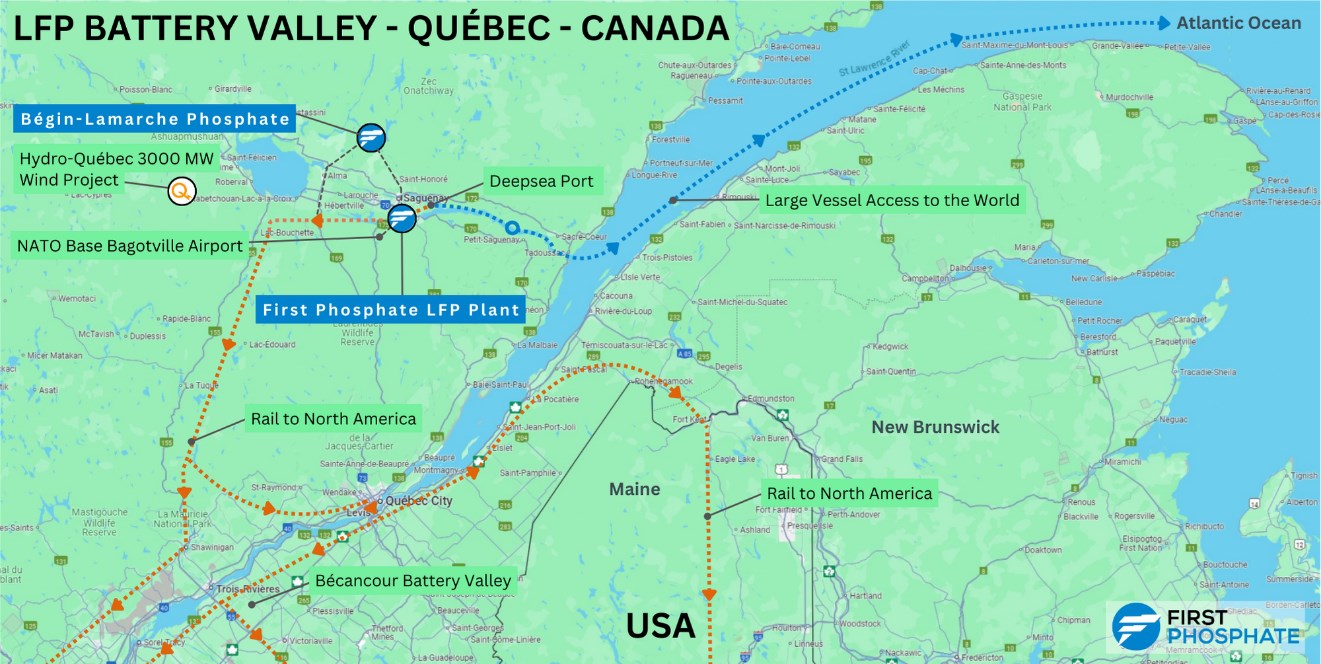
Saguenay, Quebec - Newsfile Corp. - October 21, 2025 - First Phosphate Corp. (CSE: PHOS) (OTCQX: FRSPF) (FSE: KD0) ("First Phosphate" or the "Company") is pleased to announce that it will undertake a 30,000-metre accelerated drill program at its Bégin-Lamarche property in Saguenay-Lac-St-Jean, Quebec, Canada, commencing this month. The drilling program is expected to build on the Company's initial resource estimate and to confirm the final geological model for the property. A full and comprehensive understanding of the deposit is anticipated after completion of this drill program. The Company's initial resource estimate effective September 9, 2024 is available at https://firstphosphate.com/projects/begin-lamarche/). "The Bégin-Lamarche property is located near existing infrastructure, skilled workforce and at only ~70 km driving distance from the deep-sea Port of Saguenay and our eventual secondary and tertiary phosphate processing facilities," explained John Passalacqua, CEO, of First Phosphate "We have Bégin-Lamarche on an accelerated development path to support potential full vertical integration of the Company's future lithium iron phosphate ("LFP") cathode active material ("CAM") operations in Saguenay-Lac-St-Jean, Quebec." The campaign will encompass the entire 2.5 km long known phosphate mineralization zone at 50 m x 50 m intervals (see Figure 1 below). The drill program will begin with two drill rigs in the coming weeks and increase up to four rigs by mid-November with expected completion by April 2026. The drill program is fully funded by the Company's recent financings, and all drill and work authorizations are in place. The campaign will be managed by Laurentia Exploration of Jonquière, Quebec. Drilling operations will be conducted by First Nations Drilling of Mashteuiatsh, Quebec, and Forages Diafor of Rivière-Héva, Quebec.  To view an enhanced version of this graphic, please visit: https://images.newsfilecorp.com/files/8917/271118_48097d5824b658c7_001full.jpg First Phosphate's proposed secondary phosphate processing plant is to be located at the Port of Saguenay and very close to the Company's intended LFP CAM material production plant in La Baie, Quebec. The Bégin-Lamarche igneous phosphate property is located next to major paved highway and at only ~70 km driving distance from both the deep-sea Port of Saguenay and La Baie, Quebec for eventual full vertical integration of mining and advanced processing of high purity igneous phosphate into LFP CAM to support the onshoring of the North American LFP battery industry.
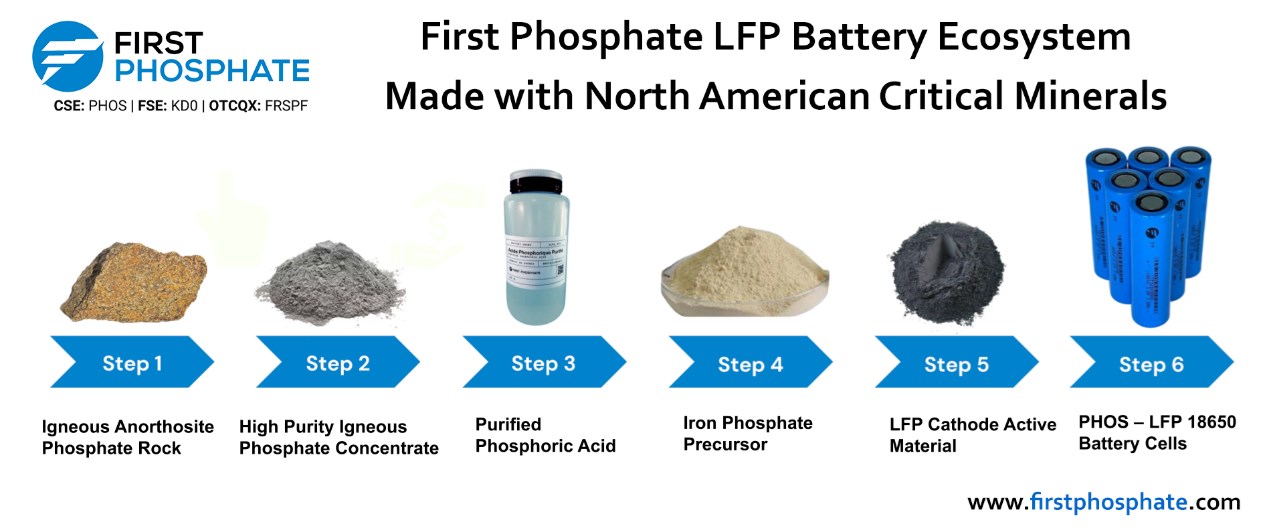
  To view an enhanced version of this graphic, please visit: https://images.newsfilecorp.com/files/8917/271118_48097d5824b658c7_002full.jpg First Phosphate has recently produced perhaps the first ever commercial-grade LFP 18650 battery cells using North American critical minerals. Please see: https://firstphosphate.com/north-american-lfp-battery-cells. The high-purity phosphoric acid and iron powder for these LFP 18650 battery cells was produced using rare igneous anorthosite rock extracted from the First Phosphate Bégin-Lamarche property in the Saguenay-Lac-Saint-Jean region of Quebec, Canada.
  To view an enhanced version of this graphic, please visit: https://images.newsfilecorp.com/files/8917/271118_48097d5824b658c7_003full.jpgQualified Person The scientific and technical information contained in this press release has been reviewed and approved by Gilles Laverdière, P.Geo. Mr. Laverdière is Chief Geologist of First Phosphate and a Qualified Person as defined under National Instrument 43-101 - Standards of Disclosure for Mineral Projects ("NI 43-101"). About First Phosphate Corp First Phosphate (CSE: PHOS) (OTCQB: FRSPF) (FSE: KD0) is a mineral development and cleantech company dedicated to building and onshoring a vertically integrated mine-to-market lithium iron phosphate (LFP) battery supply chain for North America. Target markets include energy storage, data centers, robotics, mobility and defense. First Phosphate's flagship Bégin-Lamarche Property in Saguenay-Lac-Saint-Jean, Quebec, Canada is a North American rare igneous phosphate resource yielding high-purity phosphate with minimal impurities. For additional information, please contact: Bennett Kurtz CFO, CAO bennett@firstphosphate.com Tel : +1 (416) 200-0657 Investor Relations: investor@firstphosphate.com Media Relations: media@firstphosphate.com Website: www.FirstPhosphate.comFollow First Phosphate: X: https://x.com/FirstPhosphate LinkedIn: https://www.linkedin.com/company/first-phosphateForward-Looking Information and Cautionary StatementThis release includes certain statements that may be deemed "forward-looking information". Any statement that discusses predictions, expectations, beliefs, plans, projections, objectives, assumptions, future events or performance (often but not always using phrases such as "expects", or...
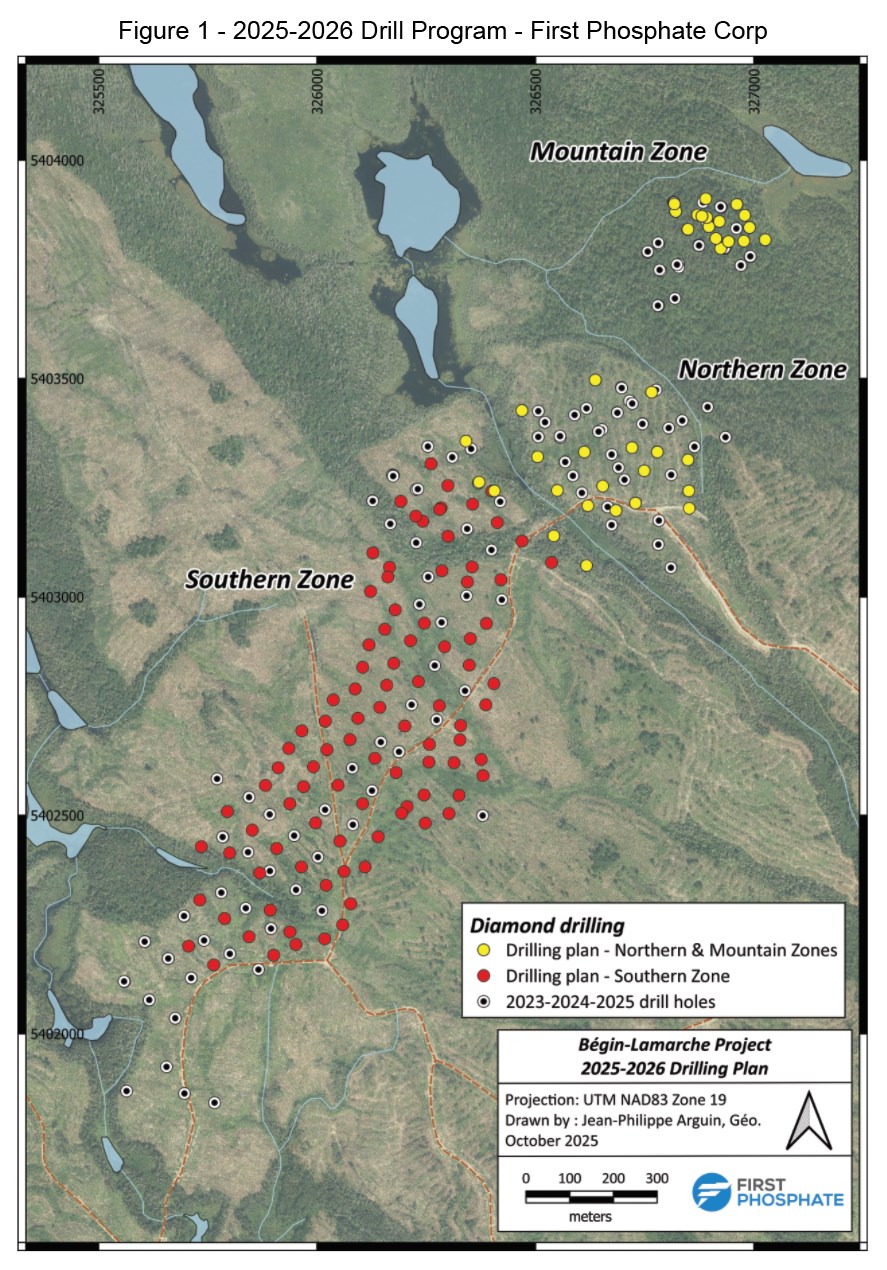 To view an enhanced version of this graphic, please visit: https://images.newsfilecorp.com/files/8917/271118_48097d5824b658c7_001full.jpg First Phosphate's proposed secondary phosphate processing plant is to be located at the Port of Saguenay and very close to the Company's intended LFP CAM material production plant in La Baie, Quebec. The Bégin-Lamarche igneous phosphate property is located next to major paved highway and at only ~70 km driving distance from both the deep-sea Port of Saguenay and La Baie, Quebec for eventual full vertical integration of mining and advanced processing of high purity igneous phosphate into LFP CAM to support the onshoring of the North American LFP battery industry.
  To view an enhanced version of this graphic, please visit: https://images.newsfilecorp.com/files/8917/271118_48097d5824b658c7_002full.jpg First Phosphate has recently produced perhaps the first ever commercial-grade LFP 18650 battery cells using North American critical minerals. Please see: https://firstphosphate.com/north-american-lfp-battery-cells. The high-purity phosphoric acid and iron powder for these LFP 18650 battery cells was produced using rare igneous anorthosite rock extracted from the First Phosphate Bégin-Lamarche property in the Saguenay-Lac-Saint-Jean region of Quebec, Canada.
  To view an enhanced version of this graphic, please visit: https://images.newsfilecorp.com/files/8917/271118_48097d5824b658c7_003full.jpgQualified Person The scientific and technical information contained in this press release has been reviewed and approved by Gilles Laverdière, P.Geo. Mr. Laverdière is Chief Geologist of First Phosphate and a Qualified Person as defined under National Instrument 43-101 - Standards of Disclosure for Mineral Projects ("NI 43-101"). About First Phosphate Corp First Phosphate (CSE: PHOS) (OTCQB: FRSPF) (FSE: KD0) is a mineral development and cleantech company dedicated to building and onshoring a vertically integrated mine-to-market lithium iron phosphate (LFP) battery supply chain for North America. Target markets include energy storage, data centers, robotics, mobility and defense. First Phosphate's flagship Bégin-Lamarche Property in Saguenay-Lac-Saint-Jean, Quebec, Canada is a North American rare igneous phosphate resource yielding high-purity phosphate with minimal impurities. For additional information, please contact: Bennett Kurtz CFO, CAO bennett@firstphosphate.com Tel : +1 (416) 200-0657 Investor Relations: investor@firstphosphate.com Media Relations: media@firstphosphate.com Website: www.FirstPhosphate.comFollow First Phosphate: X: https://x.com/FirstPhosphate LinkedIn: https://www.linkedin.com/company/first-phosphateForward-Looking Information and Cautionary StatementThis release includes certain statements that may be deemed "forward-looking information". Any statement that discusses predictions, expectations, beliefs, plans, projections, objectives, assumptions, future events or performance (often but not always using phrases such as "expects", or...