

Iran’s protests have spread across provinces, despite skepticism and concern among ethnic groups
- Written by Shukriya Bradost, Ph.D. Researcher, International Security and Foreign Policy, Virginia Tech
 Protester in Punak, Tehran on Jan. 10, 2026.Author-obtained image., CC BY
When Iran’s ongoing protests began in Tehran’s Grand Bazaar on Dec. 28 2025, the government initially treated them as manageable and temporary.
Bazaar merchants have historically been among the most conservative social groups in Iran, deeply embedded in the state’s economic structure and closely connected to political authority. Within the Iranian government itself, there was apparent confidence that their protests were not revolutionary in nature but transactional – a short-lived pressure campaign aimed at stabilizing the collapsing currency and curbing inflation that directly threatened merchants’ livelihoods.
This perception led to an unprecedented development. In his first public response, Iran’s supreme leader Ali Khamenei openly acknowledged the merchants’ protests – the first time he had ever accepted the legitimacy of any demonstration.
He characterized them as part of the traditional alliance between the state and the bazaar, indicating that the government still viewed the unrest as controllable.
But authorities did not anticipate what happened next: The protests spread to over 25 provinces and developed into a nationwide challenge to the government’s survival, met by a violent crackdown in which more than 6,000 protesters have reportedly been killed.
As an expert on Iran’s ethnic groups, I have watched as the unrest has expanded to include minority groups – despite skepticism among these communities over the possible outcome of the unrest and concerns over the plans of some central opposition figures.
As reports emerge of government forces killing thousands, the central question has now shifted from whether the state can suppress the protests to how different regions of Iran interpreted the concept of change – whether it is something achievable within the government or necessitates regime change itself.
Ethnic minorities join the protest
Iran is a country of about 93 million people whose modern state was built around a centralized national identity rather than ethnic pluralism.
But that masks a large and politically significant ethnic minority population. While 51% form the Persian majority, 24% of the country identify as Azeri. Kurds number some 7 million to 15 million, composing roughly 8% to 17% of the total population. And Arabs and Baluch minorities represent 3% and 2% of the population, respectively.
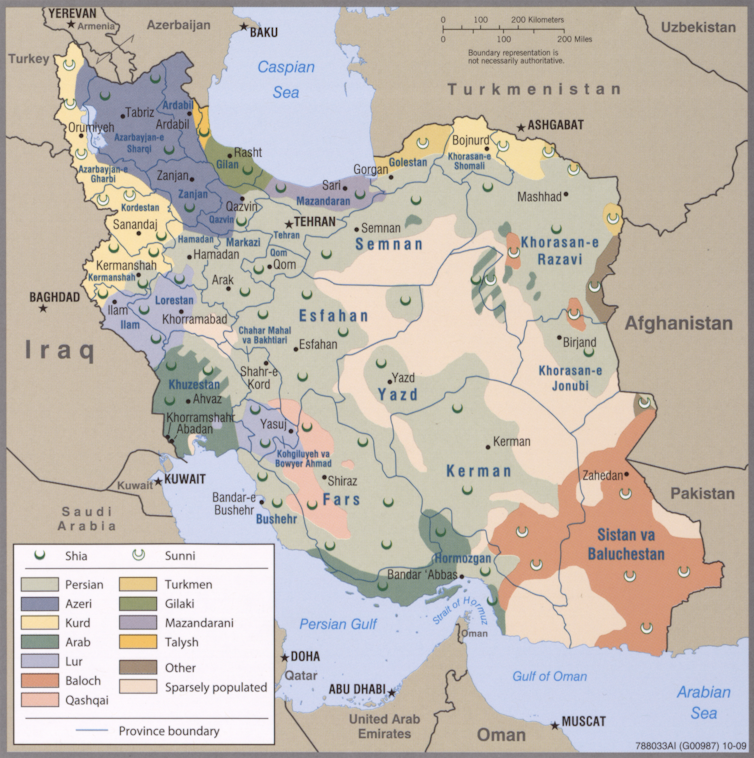 A map of the distribution of Iran’s ethnic groups.Wikimedia Commons
Since the Pahlavi monarchy’s nation-building project began in 1925, successive governments, both monarchical and then the Islamic Republic, have treated ethnic diversity as a security challenge and repeatedly suppressed demands for political inclusion, language rights and local governance.
The role of Iran’s ethnic minority groups in the current protests has evolved. Initially, minority regions were less prominent than in the last serious wave of protests: the 2022–23 “Women, Life, Freedom” uprising sparked by the death of a Kurdish-Iranian woman named Jina Mahsa Amini.
The Kurdish involvement in the current protests began in the small city of Malekshahi in Ilam province on Jan. 3. A subsequent violent raid by security forces on wounded protesters inside Ilam hospital provoked outrage beyond the local community and attracted international attention.
Protests continued in Ilam, while in nearby Kermanshah province, particularly the impoverished area of Daradrezh, they erupted over economic deprivation and political discrimination.
A strategic approach to protest
Shiite Kurdish communities in Ilam and Kermanshah continue to experience exclusion rooted in their Kurdish identity. That’s despite sharing a Shiite identity with Iran’s ruling establishment in Tehran – a factor that has historically afforded greater access to government than for the Sunni Kurdish population.
Following the killing of protesters in Ilam and Kermanshah, Kurdish political parties issued a joint statement calling for a region-wide strike.
Notably, Kurdish leaders did not call for protests but for strikes alone. During the “Women, Life, Freedom” uprising, the government treated Kurdish cities as security zones – framing the protests as a threat to Iran’s territorial integrity and using that justification to carry out mass killings and executions.
By opting for strikes this time, Kurdish leaders sought to demonstrate solidarity while reducing the risk of large-scale violence and another massacre.
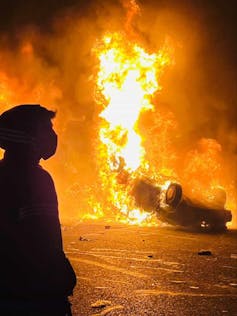 A protester in Tehran on Jan. 10, 2026.Author-obtained image., CC BY
The result was decisive: Nearly all Kurdish cities shut down.
Baluchestan, in Iran’s southeast, followed Kurdistan a day after. Beginning with Friday prayers on Jan. 9, protests erupted, also driven by long-standing ethnic and religious marginalization there.
Iranian Azerbaijan, an area in the country’s northwest, joined later and more cautiously. This delayed, small protest reflects Azerbaijanis’ current favorable position within Iran’s political, military and economic institutions.
Historically, from the 16th century to 1925, Shiite Azari-Turks dominated the Iranian state, with Azerbaijani functioning as a court language.
The Pahlavi monarchy marked a rupture, banning the Azerbaijani language and curtailing local autonomy. But since 1979, the Islamic Republic has partially restored Azerbaijani influence, allowing clerics to address constituents in their native language and reintegrating Azerbaijan into central government in Tehran. The current supreme leader, Ali Khamenei, is of Azerbaijani descent.
A history of repression
Ethnically based political movements emerged across Iran immediately after the 1979 revolution, which many minority groups had supported in hopes of greater inclusion and rights.
But these movements were quickly suppressed as the Islamic Republic crushed uprisings across Iranian Azerbaijan, Baluchestan, Khuzestan and other peripheral regions.
Kurdistan was the exception, where resistance, military confrontation and state violence, including massacres, continued for several years.
This repression and the impact of the Iran–Iraq War, during which wartime mobilization overshadowed internal grievances, muted ethnic minority demands throughout the 1980s.
But these demands resurfaced in the 1990s, especially sparked by a sense of cultural revival and cross-border identity formation after the Soviet Union’s collapse. In Iranian Kurdistan, a large part of the armed struggle was transformed into a civil struggle, while Peshmerga forces maintained arms and military training across the border in the Kurdistan region of Iraq.
The Iranian government has increasingly viewed this awakening as a strategic threat and has responded by decentralizing security and military authority to enable rapid crackdowns on protests without awaiting approval from Tehran.
Diverging protest demands
This history of repression explains why the protests in Iran now were at least initially more centralized than previous uprisings. Ethnic minority regions are not indifferent to change; they are skeptical of its outcome.
Many Persian-majority urban protesters seek social freedoms, economic recovery and normalization with the West, particularly the United States. But ethnic communities carry additional demands: decentralization of power, recognition of linguistic and cultural rights, and genuine power-sharing within the state.
For over four decades, ethnic minority demands have been labeled as separatist or “terrorist” and met with arrests and executions by the Islamic Republic.
This rhetoric has also influenced major Persian-dominated opposition groups – spanning the ideological spectrum from left to right and operating largely in exile – that perceive ethnic minority demands as a threat to Iran’s territorial integrity.
Fears of the shah’s return
Reza Pahlavi, the exiled son of the last shah of Iran, is positioning himself as the leader of the opposition and a transitional figure. But ethnic communities have reason for concern.
Pahlavi’s office has published a road map for a transitional government that sharply contrasts with his public claims of not seeking to monopolize power. The document envisions Pahlavi as a leader with extraordinary authority. In practice, the concentration of power he proposes under his leadership closely resembles the authority currently exercised by Iran’s supreme leader.
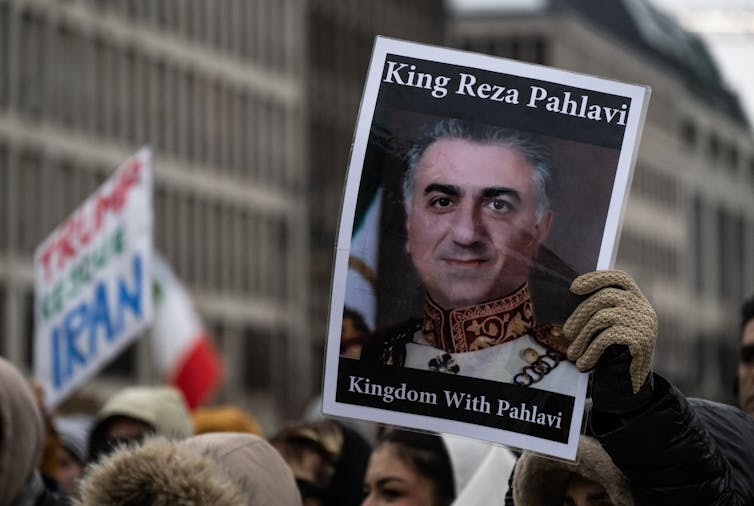 Reza Pahlavi, the son of Iran’s late ruler Mohammad Reza Pahlavi, has seen his support surge among protesters, such as those seen here in Germany on Jan. 12, 2026.John MAcDougall/AFP via Getty Images
For ethnic communities, these implications are particularly troubling. The road map characterizes ethnic-based demands and parties as threats to national security, reinforcing long-standing state narratives rather than departing from them. This explicit stance has deepened skepticism in peripheral regions.
In contrast to Ayatollah Khomeini in 1979, whose revolutionary vision was deliberately vague regarding the future status of ethnic groups, the current opposition leadership project articulates a centralized political order that excludes ethnic inclusion and power-sharing.
For communities whose languages were banned and whose regions were systematically underdeveloped during the Pahlavi monarchy, the resurgence of monarchist slogans in central cities only reinforces fears that any transition driven by centralized narratives will again marginalize Iran’s peripheral regions.
The risk of ignoring provinces
Iran’s protests, therefore, reveal more than resistance to authoritarian rule. They expose a fundamental divide over what political change means – and for whom.
In a country as ethnically diverse as Iran, where millions belong to non-Persian ethnic communities, a durable political order cannot, I believe, be built on centralized power dominated by a single ethnic identity.
Any future transition, whether through reform within the current system or through regime change, will have a better chance of success if it incorporates a political framework that acknowledges and incorporates the demands of all regions and communities. Without such inclusion, trust in the process of change will remain elusive – and hopes for a better future dimmed.
Shukriya Bradost is affiliated with the Middle East Institute.
Authors: Shukriya Bradost, Ph.D. Researcher, International Security and Foreign Policy, Virginia Tech