

Even when people’s rights are ignored, understanding the law can keep protesters engaged
- Written by Heidi Reynolds-Stenson, Associate Professor of Sociology, Criminology and Anthropology, Colorado State University Pueblo
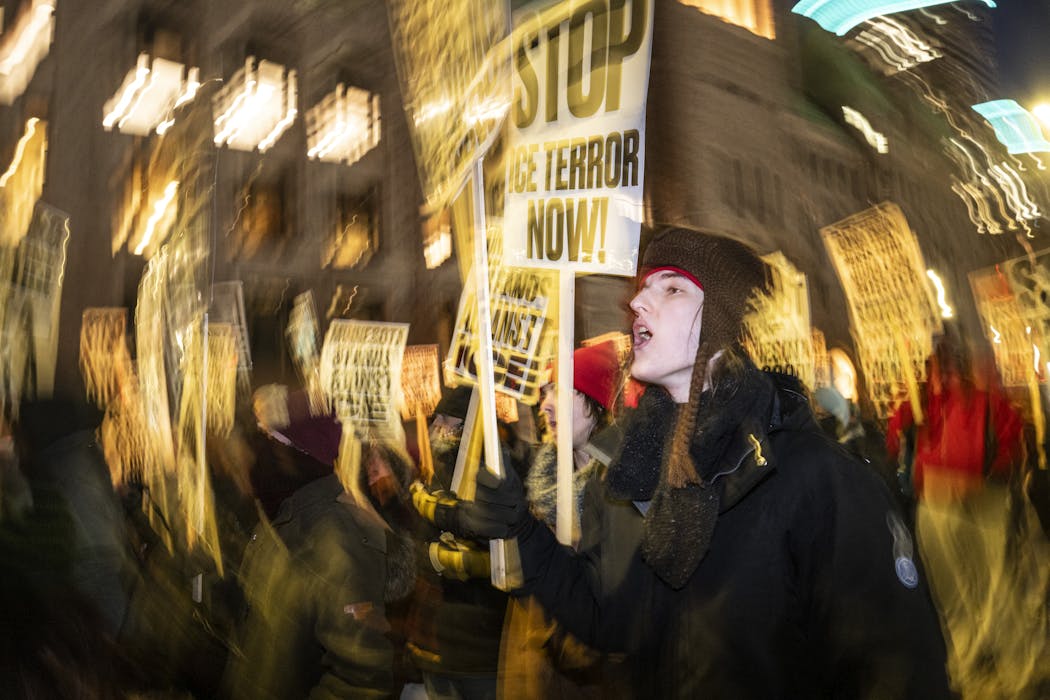 A group of anti-Immigration and Customs Enforcement protesters march in downtown Minneapolis on Jan. 27, 2026. Roberto Schmidt/AFP via Getty Images
There’s been a rise of know-your-rightstraining sessions in response to the Trump administration’s aggressive immigration enforcement tactics. This has included local public officials and organizations sharing online information over the past few months about what to do if Immigration and Customs Enforcement or other federal agents knock on your door, among other scenarios that involve immigration law enforcement.
Knowledge is power, the adage goes. But learning the letter of the law has its limits, legal rights experts have noted, if law enforcement officers do not follow the law. The Associated Press reported on Jan. 21, 2026, that ICE distributed an internal memo authorizing ICE officers to forcibly enter someone’s private home with only an administrative warrant – not one signed by a judge, as the Fourth Amendment requires.
Amy Lieberman, education editor for The Conversation U.S., spoke with Heidi Reynolds-Stenson, a scholar of social movements and protest policing, to understand the role education can play in Minnesota’s ongoing anti-ICE protests and how legal training’s limits are becoming clear.
 A ‘know your rights’ sign in Spanish is posted outside of a cafe in Chicago in November 2025.Erin Hooley/Associated Press
What role is education playing in fueling Minnesota’s anti-ICE protests?
I think it is a really unique moment. There is discussionin the news nationwide about legal observing and know-your-rights training sessions. This kind of legal support and education has been part of social movements for a long time, but have never, perhaps, been in the spotlight on the level that they are right now after the January killings of ICE observers Renee Nicole Good and Alex Pretti.
A coordinated way of offering legal support to protesters grew out of 1960s and ‘70s civil rights protests. Legal support for protesters became even more organized during the student-led anti-Vietnam War movement around this same time. The first time there was an organized, mass legal defense of protesters was for the Stop the Draft Week in 1967, when a group of lawyers and law students began working in coordination with activists.
Since then, community organizers, lawyers, law students and others have developed strategies for offering legal support to protesters. That includes legal observers. Legal observers can be lawyers, law students or others trained not to protest, but to independently observe, take notes on and photograph or video incidents at protests, like law enforcement arresting or assaulting someone.
We see, over time, that the way people organize and offer legal support to protesters has become more and more sophisticated. More and more people have knowledge about their civic and legal rights. Other forms of legal support, such as jail and court solidarity, in which individual people who are arrested make collective decisions to support one another, have become more common.
Now, people are also learning about more than their First Amendment rights – they are learning about the rights of immigrants and of anyone who is interacting with ICE and Border Patrol officers. That intensifies the complexity of what people need to know.
Altogether, there is a complex system of legal support in place that has been shown to be very effective at preventing activists from disengaging after experiences of state repression.
What does your own research show regarding how education can shape protests?
In my own research, when activists had experiences of repression – when they were arrested at protests, as has happened in Minneapolis, or experienced police violence, like being sprayed with chemical irritants – legal education was a major determining factor on whether they continued to be involved in the protest movement.
Another deciding issue was whether or not protesters were being helped by pro bono lawyers or there were legal observers present to make protesters feel more confident going into a certain situation.
As people become more educated about their rights and more prepared for the potential risks of protesting, that can make them more confident about going to a protest in the first place and more likely to continue in that work.
We know that, in reality, the rights people learn about are not always respected, at protests or in other situations. So, it is one thing to say that you have a right to do something, like to protest, or not let ICE or Border Patrol agents into your home without a judicial warrant.
It is another thing in practice, especially in the current moment that we are in, in which immigration enforcement officers have increasingly shown disregard for people’s rights. But it is still important for people to be aware that those rights exist.
What role do legal observers play in influencing protest movements?
Legal observers can play a critical role in collecting independent, neutral information about law enforcement actions at protests that can be used if there is a civil suit or a criminal case coming out of a protest.
Legal observing can also, in theory, deter officers who are policing protests, since they know they are being watched and data is being collected on their actions, including potential rights violations.
 People on Jan. 28, 2026, gather at a makeshift memorial where Alex Pretti was shot dead by federal immigration agents in Minneapolis.Roberto Schmidt/AFP via Getty Images
How can education serve as a means of self-defense at protests?
Education is the most powerful weapon for people involved in protest movements – that is, knowledge and understanding of what their rights are as well as the risks. Equally important is collecting bail fund money before someone is actually arrested, having a network of people ready to do the work after a protest to defend arrested activists, and holding law enforcement officers accountable for violating people’s rights. Protesters or observers can then know that if they are arrested or injured by law enforcement officers, that people are already there ready to help them.
In my view, the level of disrespect that federal immigration officers are currently showing to people exercising their rights to protest and to film and otherwise monitor public officials is unprecedented. But it has always been the case that just because a legal right exists, it does not mean that it is followed by law enforcement or the government more broadly. Then, and now, it has always been organized groups of individuals who make those rights real through exercising them and working to hold those accountable who violate them.
Heidi Reynolds-Stenson receives funding from the William T. Grant Foundation.
Authors: Heidi Reynolds-Stenson, Associate Professor of Sociology, Criminology and Anthropology, Colorado State University Pueblo