

How the Supreme Court might protect the Fed’s independence by using employment law in Trump v. Cook
- Written by Elizabeth C. Tippett, Associate Professor of Law, University of Oregon
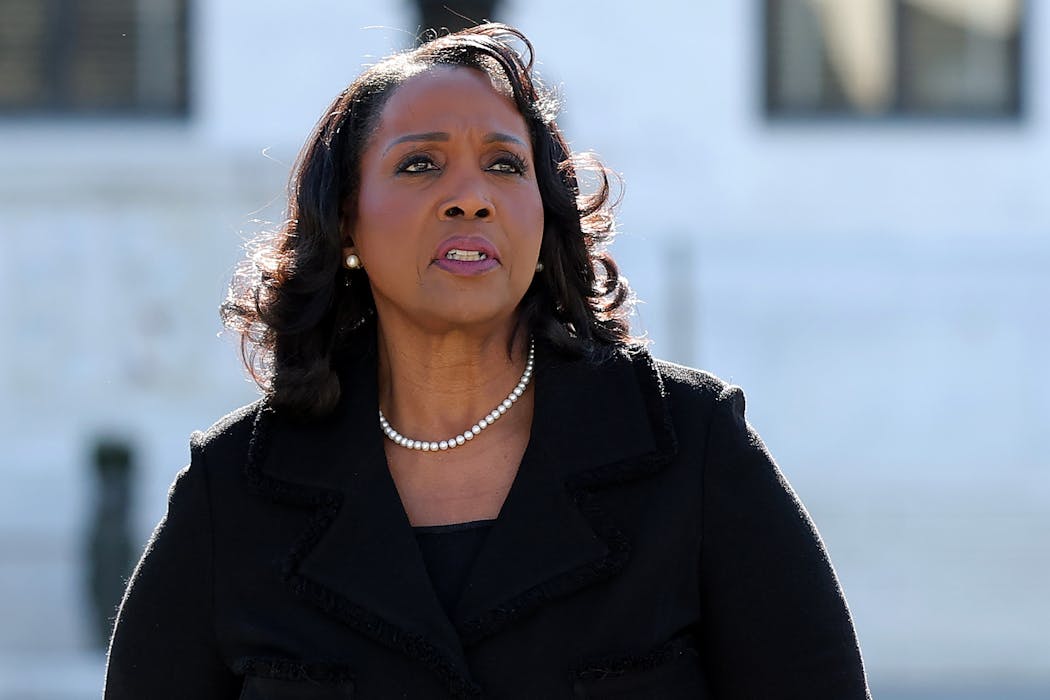 Federal Reserve Board member Lisa Cook leaves the U.S. Supreme Court on Jan. 21, 2026, after oral arguments in Trump v. Cook.Kevin Dietsch/Getty Images
Most of the Trump administration’s legal disputes involving the firing of high-level officials deal with the scope of presidential power.
On Jan. 21, 2026, the U.S. Supreme Court heard oral arguments in one of the most significant cases of this kind to date. It was brought by Lisa Cook, a member of the Board of Governors of the Federal Reserve. The Fed serves as the U.S. central bank and sets monetary policy – including a key interest rate that influences borrowing costs.
President Joe Biden nominated Cook in 2022, and she was sworn in in May of that year.
President Donald Trump fired her on Aug. 25, 2025, but a lower court temporarily reinstated Cook to her roleon Sept. 9.
Based on the oral arguments, a majority of the court’s justices seem inclined to protect the Fed’s independence by treating this case as an employment dispute. As a law professor who specializes in employment lawand follows the Supreme Court, I can explain how that might play out.
Why Cook’s case matters
To be sure, this is not a typical employment law case because Cook has far more legal rights to her job than most American workers.
The vast majority of U.S. workers are employed “at-will” – meaning they can be fired for any reason and severed from their jobs with no advance notice. Cook’s position is covered by the Federal Reserve Act, which states that board members will be appointed by the president to 14-year terms and can be terminated by the president, but only for “cause.”
A federal judge presiding over the case in the District of Columbia also ruled that Cook was entitled to “due process” before her termination – meaning some notice, an explanation of the evidence against her and an opportunity to respond.
Cook’s lawsuit has outsized importance because the Fed’s board oversees the Federal Reserve.
As former Fed governors explained in a friend-of-the-court brief, “effective monetary policy requires a commitment to long-term goals,” and the lengthy 14-year terms of board members “are designed to insulate” them “from short-term political pressures.”
In another brief to the court, economists also expressed concern that a loss of independence could undermine the dollar’s status as a global reserve currency, which tends to protect the U.S. during global shocks.
These concerns appear to be shared by the Supreme Court. During oral argument, for example, Justice Brett Kavanaugh repeatedly pressed the government’s lawyer to concede – and articulate – the importance of Fed independence, grilling him as if he were a first-year law student.
In a 2009 law review article, Kavanaugh wrote that it “may be worthwhile to insulate” the Federal Reserve Board “from direct presidential oversight.”
 President Trump has sought to fire Lisa Cook, a member of the Federal Reserve’s Board of Governors, sitting to Fed chair Jerome Powell’s left.Saul Loeb/AFP via Getty Images
What can count as cause for firing someone?
The Department of Justice announced in September 2025 that it was investigating Cook for allegedly making false statements on mortgage applications in 2021. Cook has denied those allegations.
As law professor Jed Shugarman has observed, it’s possible that the court will not rule on Cook’s case beyond allowing the lower court to proceed to a final decision. This would be the most cautious approach, since multiple justices pointed out that the facts about Cook’s alleged wrongdoing were not fully developed.
If the Supreme Court offers legal guidance to the lower court, the question of what counts as cause under the Federal Reserve Act is far from clear. The statute does not define the term, which lacks a clear meaning.
Modern American employment law starts from the baseline assumption of at-will status, where cause doesn’t matter because workers can be terminated for any reason. The rare employment contracts that promise termination for cause – like for executives, football coaches or workers who belong to unions – spell out what cause means in the contract.
When must an offense occur if an official is to be fired over it?
The reference to termination for cause appeared in the original 1913 Federal Reserve Act. But it was taken out in 1933 and then added back in 1935 after a series of lengthy Senate hearings on Fed independence. To decide what the cause provision means for Cook today, the justices may delve into what cause meant back in 1935.
As I note in “The Master-Servant Doctrine: How Old Legal Rules Haunt the Modern Workplace,” my 2025 book, standards for conduct justifying termination have changed over time.
According to an influential study by law professors Jane Manners and Lev Menand, the historical meaning of cause for federal agency heads was based on “inefficiency, neglect of duty, or malfeasance in office.”
The U.S. District Court applied this definition to Cook’s case, and inferred that cause only meant acts committed after she was appointed to the Fed’s Board of Governors. An act that predates the official’s Senate confirmation, the court explained, “has never been a basis for removal.”
At oral argument, the Supreme Court’s justices also focused on Congress’ purpose in enacting the firing-for-cause rule: to protect Fed independence from other branches of government.
This interpretation would, at minimum, protect Cook and other Fed governors from being fired due to policy differences with a president, such as Trump’s repeated complaints over the frequency and size of the Fed’s interest rate cuts.
An interpretation of this sort could be similar to antidiscrimination law or whistleblower law, which make it illegal for employers to fire someone for a fake or a flimsy reason to cover up their true motive – such as discrimination or retaliation.
What counts as due process?
As a matter of constitutional law, government workers who can only be terminated for cause have the right to receive “due process” from their employer prior to termination.
This process is known as a “Loudermill” hearing – named after the leading case on point – which generally consists of a presentation of the evidence against the worker and the opportunity to respond.
The lower court ruled that Cook had not been provided due process. At the Supreme Court, the government’s attorney tried to argue that Cook was given the equivalent of a Loudermill hearing, based on a Truth Social post that Trump made on Aug. 20, 2025, calling for her to resign. It was linked to apparent evidence in a news report about mortgage applications Cook filed in 2021.
The attorney argued that the five-day delay between Trump’s first post and Cook’s firing gave her an opportunity to respond.
Some Supreme Court justices expressed skepticism that social media posts can satisfy the Loudermill standard. Justice Amy Coney Barrett, for example, pointedly asked, “Why couldn’t those resources (used to litigate the case) have been put into a hearing?”
Yet I also got the sense that some justices, especially Kavanaugh, seemed reluctant to hang their hat on due process alone.
A hearing and an opportunity to respond – without a meaningful definition of “cause” – wouldn’t limit the reasons a member of the Fed could be terminated. It would only require a president to go through the motions of showing how he or she reached a foregone conclusion.
And, in my view, that is no substitute for independence.
Elizabeth C. Tippett does not work for, consult, own shares in or receive funding from any company or organization that would benefit from this article, and has disclosed no relevant affiliations beyond their academic appointment.
Authors: Elizabeth C. Tippett, Associate Professor of Law, University of Oregon