

NewsPronto

 
The Times


.

USA Conversation

The Conversation USA

The Conversation USA

To better detect chemical weapons, materials scientists are exploring new technologies

  • Written by Olamilekan Joseph Ibukun, Postdoctoral Research Associate in Chemistry, Washington University in St. Louis
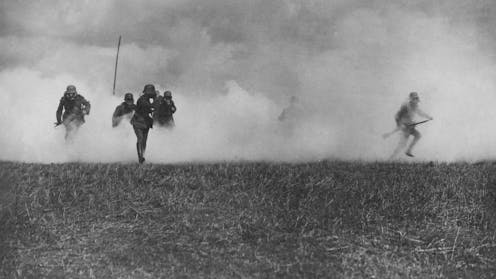
imageGerman troops make their way through a cloud of smoke or gas during a gas training drill, circa 1916.Henry Guttmann/Hulton Archive via Getty Images

Chemical warfare is one of the most devastating forms of conflict. It leverages toxic chemicals to disable, harm or kill without any physical confrontation. Across various conflicts, it has caused tens...

Read more: To better detect chemical weapons, materials scientists are exploring new technologies

More Articles ...

  1. China’s arrests of boys’ love authors does not equate to a ‘gay erotica’ crackdown
  2. Too many em dashes? Weird words like ‘delves’? Spotting text written by ChatGPT is still more art than science
  3. Great Lakes offshore wind could power the region and beyond
  4. Parents don’t need to try harder – to ease parenting stress, forget self-reliance and look for ways to share the care
  5. ‘AI veganism’: Some people’s issues with AI parallel vegans’ concerns about diet
  6. When socialists win Democratic primaries: Will Zohran Mamdani be haunted by the Upton Sinclair effect?
  7. Unpacking Florida’s immigration trends − demographers take a closer look at the legal and undocumented population
  8. Sanctioning ghosts: Why US plans to hit Russia with fresh economic penalties will have little effect
  9. Light pollution is encroaching on observatories around the globe – making it harder for astronomers to study the cosmos
  10. It is becoming easier to create AI avatars of the deceased − here is why Buddhism would caution against it
  11. How wind and solar power helps keep America’s farms alive
  12. Why government support for religion doesn’t necessarily make people more religious
  13. Colorado’s Marshall Fire survivors find healing and meaning through oral history project
  14. Due process: What it means in US law and its implications for migrant rights
  15. School shootings leave lasting scars on local economies, research shows
  16. Do you really need to read to learn? What neuroscience says about reading versus listening
  17. The beach wasn’t always a vacation destination - for the ancient Greeks, it was a scary place
  18. Which wildfire smoke plumes are hazardous? New satellite tech can map them in 3D for air quality alerts at neighborhood scale
  19. Is that wildfire smoke plume hazardous? New satellite tech can map smoke plumes in 3D for better air quality alerts at neighborhood scale
  20. Neanderthals likely ate fermented meat with a side of maggots
  21. The 3 worst things you can say after a pet dies, and what to say instead
  22. Fears that falling birth rates in US could lead to population collapse are based on faulty assumptions
  23. Trump’s push for more deportations could boost demand for foreign farmworkers with ‘guest worker’ visas
  24. Deportation tactics from 4 US presidents have done little to reduce the undocumented immigrant population
  25. How bachata rose from Dominican Republic’s brothels and shantytowns to become a global sensation
  26. Columbia’s $200M deal with Trump administration sets a precedent for other universities to bend to the government’s will
  27. We tracked illegal fishing in marine protected areas – satellites and AI show most bans are respected, and could help enforce future ones
  28. Why 2025 became the summer of flash flooding in America
  29. Is ChatGPT making us stupid?
  30. As Mexico’s LGBTQ+ community battles for inclusion, two drag performers have become internet stars – with more than 2 million TikTok followers
  31. Why do MAGA faithful support Trump if his ‘big beautiful bill’ will likely hurt many of them?
  32. Yellowstone has been a ‘sacred wonderland’ of spiritual power and religious activity for centuries – and for different faith groups
  33. Immigration courts hiding the names of ICE lawyers goes against centuries of precedent and legal ethics requiring transparency in courts
  34. Caution in the C-suite: How business leaders are navigating Trump 2.0
  35. How germy is the public pool? An infectious disease expert weighs in on poop, pee and perspiration – and the deceptive smell of chlorine
  36. 2 ways cities can beat the heat: Which is best, urban trees or cool roofs?
  37. Urban trees vs. cool roofs: What’s the best way for cities to beat the heat?
  38. Understanding the violence against Alawites and Druze in Syria after Assad
  39. Binary star systems are complex astronomical objects − a new AI approach could pin down their properties quickly
  40. I teach college and report on Colorado media — there should be more professors doing the same in other states
  41. Trump has fired the head of the Library of Congress, but the 225-year-old institution remains a ‘library for all’ – so far
  42. How the nature of environmental law is changing in defense of the planet and the climate
  43. Beijing’s ‘plausible deniability’ on arms supply is quickly becoming implausible – and could soon extend to Iran
  44. Imaginary athletes: Creating make-believe teammates, competitors and coaches during play
  45. Bangladesh sees small glimmers of economic hope a year after longtime autocrat ousted in people’s revolt
  46. One of the biggest microplastic pollution sources isn’t straws or grocery bags – it’s your tires
  47. What the world can learn from Uruguay as the global housing crisis deepens
  48. Generative AI is coming to the workplace, so I designed a business technology class with AI baked in
  49. Methane leaks from gas pipelines are a hidden source of widespread air pollution
  50. Emil Bove’s appeals court nomination echoes earlier controversies, but with a key difference