

NewsPronto

 
The Times


.

USA Conversation

The Conversation USA

The Conversation USA

Due process: What it means in US law and its implications for migrant rights

  • Written by Ray Brescia, Associate Dean for Research and Intellectual Life, Albany Law School
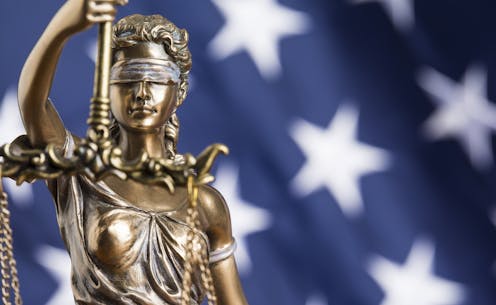
imageA core principle of the U.S. justice system is that the government must act in accordance with the rule of law.arsenisspyros, iStock Getty Images

As the United States edges up to the 250th anniversary of the Declaration of Independence in 2026, one of the core principles the founders sought to advance – that the government must act with...

Read more: Due process: What it means in US law and its implications for migrant rights

More Articles ...

  1. School shootings leave lasting scars on local economies, research shows
  2. Do you really need to read to learn? What neuroscience says about reading versus listening
  3. The beach wasn’t always a vacation destination - for the ancient Greeks, it was a scary place
  4. Which wildfire smoke plumes are hazardous? New satellite tech can map them in 3D for air quality alerts at neighborhood scale
  5. Is that wildfire smoke plume hazardous? New satellite tech can map smoke plumes in 3D for better air quality alerts at neighborhood scale
  6. Neanderthals likely ate fermented meat with a side of maggots
  7. The 3 worst things you can say after a pet dies, and what to say instead
  8. Fears that falling birth rates in US could lead to population collapse are based on faulty assumptions
  9. Trump’s push for more deportations could boost demand for foreign farmworkers with ‘guest worker’ visas
  10. Deportation tactics from 4 US presidents have done little to reduce the undocumented immigrant population
  11. How bachata rose from Dominican Republic’s brothels and shantytowns to become a global sensation
  12. Columbia’s $200M deal with Trump administration sets a precedent for other universities to bend to the government’s will
  13. We tracked illegal fishing in marine protected areas – satellites and AI show most bans are respected, and could help enforce future ones
  14. Why 2025 became the summer of flash flooding in America
  15. Is ChatGPT making us stupid?
  16. As Mexico’s LGBTQ+ community battles for inclusion, two drag performers have become internet stars – with more than 2 million TikTok followers
  17. Why do MAGA faithful support Trump if his ‘big beautiful bill’ will likely hurt many of them?
  18. Yellowstone has been a ‘sacred wonderland’ of spiritual power and religious activity for centuries – and for different faith groups
  19. Immigration courts hiding the names of ICE lawyers goes against centuries of precedent and legal ethics requiring transparency in courts
  20. Caution in the C-suite: How business leaders are navigating Trump 2.0
  21. How germy is the public pool? An infectious disease expert weighs in on poop, pee and perspiration – and the deceptive smell of chlorine
  22. 2 ways cities can beat the heat: Which is best, urban trees or cool roofs?
  23. Urban trees vs. cool roofs: What’s the best way for cities to beat the heat?
  24. Understanding the violence against Alawites and Druze in Syria after Assad
  25. Binary star systems are complex astronomical objects − a new AI approach could pin down their properties quickly
  26. I teach college and report on Colorado media — there should be more professors doing the same in other states
  27. Trump has fired the head of the Library of Congress, but the 225-year-old institution remains a ‘library for all’ – so far
  28. How the nature of environmental law is changing in defense of the planet and the climate
  29. Beijing’s ‘plausible deniability’ on arms supply is quickly becoming implausible – and could soon extend to Iran
  30. Imaginary athletes: Creating make-believe teammates, competitors and coaches during play
  31. Bangladesh sees small glimmers of economic hope a year after longtime autocrat ousted in people’s revolt
  32. One of the biggest microplastic pollution sources isn’t straws or grocery bags – it’s your tires
  33. What the world can learn from Uruguay as the global housing crisis deepens
  34. Generative AI is coming to the workplace, so I designed a business technology class with AI baked in
  35. Methane leaks from gas pipelines are a hidden source of widespread air pollution
  36. Emil Bove’s appeals court nomination echoes earlier controversies, but with a key difference
  37. PBS and NPR are generally unbiased, independent of government propaganda and provide key benefits to US democracy
  38. Dogs are helping people regulate stress even more than expected, research shows
  39. Amid fragile ceasefire, violence in southern Syria brings Druze communities’ complex cross-border ties to the fore
  40. How mothers supporting mothers can help fill the health care worker shortage gap and other barriers to care
  41. Microbes in deep-sea volcanoes can help scientists learn about early life on Earth, or even life beyond our planet
  42. Comparing ICE to the Gestapo reveals people’s fears for the US – a Holocaust scholar explains why Nazi analogies remain common, yet risky
  43. ‘Democratizing space’ is more than just adding new players – it comes with questions around sustainability and sovereignty
  44. Filipino sailors dock in Mexico … and help invent tequila?
  45. Why is heart cancer so rare? A biologist explains
  46. How the world’s nuclear watchdog monitors facilities around the world – and what it means that Iran kicked it out
  47. How the QAnon movement entered mainstream politics – and why the silence on Epstein files matters
  48. How the ‘big, beautiful bill’ will deepen the racial wealth gap – a law scholar explains how it reduces poor families’ ability to afford food and health care
  49. ‘I just couldn’t stop crying’: How prison affects Black men’s mental health long after they’ve been released
  50. Leaders in India, Hungary and the US are using appeals to nostalgia and nationalism to attack higher education