

NewsPronto

 
The Times


.

USA Conversation

The Conversation USA

The Conversation USA

Controlled burns reduce wildfire risk, but they require trained staff and funding − this could be a rough year

  • Written by Laura Dee, Associate Professor of Ecology, University of Colorado Boulder
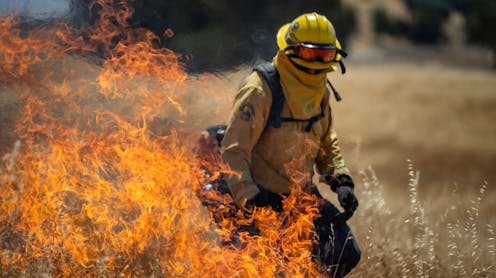
imagePrescribed burns like this one are intentional, controlled fires used to clear out dry grass and underbrush that could fuel more destructive wildfires.Ethan Swope/Getty Images

Red skies in August, longer fire seasons and checking air quality before taking my toddler to the park. This has become the new norm in the western United States as wildfires...

Read more: Controlled burns reduce wildfire risk, but they require trained staff and funding − this could be...

More Articles ...

  1. Stripping federal protection for clean water harms just about everyone, especially already vulnerable communities
  2. I study local government and Hurricane Helene forced me from my home − here’s how rural towns and counties in North Carolina and beyond cooperate to rebuild
  3. A warning for Democrats from the Gilded Age and the 1896 election
  4. Habeas corpus: A thousand-year-old legal principle for defending rights that’s getting a workout under the Trump administration
  5. Reducing diversity, equity and inclusion to a catchphrase undermines its true purpose
  6. Perfect brownies baked at high altitude are possible thanks to Colorado’s home economics pioneer Inga Allison
  7. Some politicians who share harmful information are rewarded with more clicks, study finds
  8. Make Russia Medieval Again! How Putin is seeking to remold society, with a little help from Ivan the Terrible
  9. Francis, a pope of many firsts: 5 essential reads
  10. Lawful permanent residents like Mahmoud Khalil have a right to freedom of speech – but does that protect them from deportation?
  11. Federal laws don’t ban rollbacks of environmental protection, but they don’t make it easy
  12. Why don’t humans have hair all over their bodies? A biologist explains our lack of fur
  13. Endowments aren’t blank checks – but universities can rely on them more heavily in turbulent times
  14. Exposure to perceptible temperature rise increases concern about climate change, higher education adds to understanding
  15. What will happen at the funeral of Pope Francis
  16. How the next pope will be elected – what goes on at the conclave
  17. Scientists found a potential sign of life on a distant planet – an astronomer explains why many are still skeptical
  18. ‘I never issued a criminal contempt citation in 19 ½ years on the bench’ – a former federal judge looks at the ‘relentless bad behavior’ of the Trump administration in court
  19. As views on spanking shift worldwide, most US adults support it, and 19 states allow physical punishment in schools
  20. Crime is nonpartisan and the blame game on crime in cities is wrong – on both sides
  21. With federal funding in question, artists can navigate a perilous future by looking to the past
  22. Lawsuits seeking to address climate change have promise but face uncertain future
  23. All models are wrong − a computational modeling expert explains how engineers make them useful
  24. Trump’s attacks on central bank threaten its independence − and that isn’t good news for sound economic stewardship (or battling inflation)
  25. Claims of ‘anti-Christian bias’ sound to some voters like a message about race, not just religion
  26. How does your brain create new memories? Neuroscientists discover ‘rules’ for how neurons encode new information
  27. Patriots’ Day: How far-right groups hijack history and patriotic symbols to advance their cause, according to an expert on extremism
  28. International students infuse tens of millions of dollars into local economies across the US. What happens if they stay home?
  29. Popular AIs head-to-head: OpenAI beats DeepSeek on sentence-level reasoning
  30. Why people with autism struggle to get hired − and how businesses can help by changing how they look at job interviews
  31. Appliance efficiency standards save consumers billions, reduce pollution and fight climate change
  32. Why deregulating online platforms is actually bad for free speech
  33. Ethical leadership can boost well-being and performance in remote work environments
  34. Is a ‘friend-apist’ what we really want from therapy?
  35. Federal judge finds ‘probable cause’ to hold Trump administration in contempt – a legal scholar explains what this means
  36. How single-stream recycling works − your choices can make it better
  37. The sudden dismissal of public records staff at health agencies threatens government accountability
  38. Wide variety of old-growth ecosystems across the US makes their conservation a complex challenge
  39. Railways were essential to carrying out the Holocaust – decades later, corporate reckoning continues
  40. 200 years ago, France extorted Haiti in one of history’s greatest heists – and Haitians want reparations
  41. Cory Booker’s long speech offers a strategy for Trump opponents in a fragmented media landscape
  42. Miami researchers are testing a textured seawall designed to hold back water and create a home for marine organisms
  43. Dark energy may have once been ‘springier’ than it is today − DESI cosmologists explain what their collaboration’s new measurement says about the universe’s history
  44. Giving cash to families in poor, rural communities can help bring down child marriage rates – new research
  45. Des Moines food pantries face spiking demand as the Iowa region’s SNAP enrollment declines
  46. Beggar thy neighbor, harm thyself: Tariffs like Trump’s come with pitfalls, history shows
  47. 25 years of Everglades restoration has improved drinking water for millions in Florida, but a new risk is rising
  48. A need for chaos powers some Americans’ support for Elon Musk taking a chainsaw to the US government
  49. Preventive care may no longer be free in 2026 because of HIV stigma − unless the Trump administration successfully defends the ACA
  50. How bird flu differs from seasonal flu − an infectious disease researcher explains