

NewsPronto

 
The Times


.

USA Conversation

The Conversation USA

The Conversation USA

America the secular? What a changing religious landscape means for US politics

  • Written by David Campbell, Packey J. Dee Professor of American Democracy, University of Notre Dame
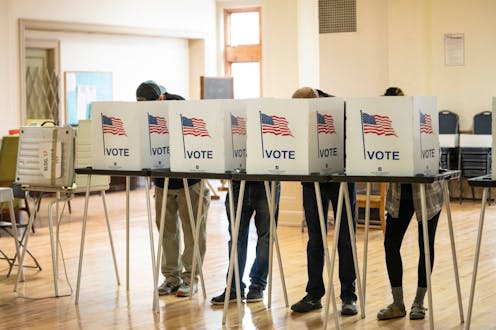
imageConventional wisdom about nonreligious Americans' voting misses some important distinctions.Sarah Rice/Getty Images

After climbing for decades, the percentage of Americans with no religion has leveled off. For the past few years, the share of adults who identify as atheist, agnostic or “nothing in particular” has stood at about 29%,...

Read more: America the secular? What a changing religious landscape means for US politics

More Articles ...

  1. Land reparations are possible − and over 225 US communities are already working to make amends for slavery and colonization
  2. Planned blackouts are becoming more common − and not having cash on hand could cost you
  3. GOP lawmakers eye SNAP cuts, which would scale back benefits that help low-income people buy food at a time of high food prices
  4. US earthquake safety relies on federal employees’ expertise
  5. Stone tool discovery in China shows people in East Asia were innovating during the Middle Paleolithic, like in Europe and Middle East
  6. Trump’s use of the Alien Enemies Act to deport Venezuelans to El Salvador sparks legal questions likely to reach the Supreme Court
  7. Doctor shortages have hobbled health care for decades − and the trend could be worsening
  8. Bird flu could be on the cusp of transmitting between humans − but there are ways to slow down viral evolution
  9. Measles can ravage the immune system and brain, causing long-term damage – a virologist explains
  10. Massive cuts to Health and Human Services’ workforce signal a dramatic shift in US health policy
  11. Jets from powerful black holes can point astronomers toward where − and where not − to look for life in the universe
  12. Why do dogs love to play with trash?
  13. What is a ‘revisionist’ state, and what are they trying to revise?
  14. As ‘right to die’ gains more acceptance, a scholar of Catholicism explains the position of the Catholic Church
  15. The Panama Canal’s other conflict: Water security for the population and the global economy
  16. How is classified information typically shared and can officials declassify secrets whenever they want? A national security expert explains
  17. ‘Everyday discrimination’ linked to increased anxiety and depression across all groups of Americans
  18. From censorship to curiosity: Pope Francis’ appreciation for the power of history and books
  19. Cuts to science research funding cut American lives short − federal support is essential for medical breakthroughs
  20. Chronic kidney disease often goes undiagnosed, but early detection can prevent severe outcomes
  21. As federal environmental priorities shift, sovereign Native American nations have their own plans
  22. Want to stay healthier and fulfilled later in life? Try volunteering
  23. We analyzed racial justice statements from the 500 largest US companies and found that DEI officials really did have an influence
  24. First year of Georgia’s ‘foreign agent’ law shows how autocracies are replicating Russian model − and speeding up the time frame
  25. Myanmar’s civil war: How shifting US-Russia ties could tip balance and hand China a greater role
  26. What ‘The White Lotus’ gets wrong about the meaning and goals of common Buddhist practices
  27. Women are reclaiming their place in baseball
  28. Ecological disruptions are a risk to national security
  29. Wild marmots’ social networks reveal controversial evolutionary theory in action
  30. Signal is not the place for top secret communications, but it might be the right choice for you – a cybersecurity expert on what to look for in a secure messaging app
  31. Losing your job is bad for your health, but there are things you can do to minimize the harm
  32. From Greenland to Fort Bragg, America is caught in a name game where place names become political tools
  33. US swing toward autocracy doesn’t have to be permanent – but swinging back to democracy requires vigilance, stamina and elections
  34. Trump’s tariffs on Canada and Mexico could spell trouble for distilled spirits
  35. With Hooters on the verge of bankruptcy, a psychologist reflects on her time spent studying the servers who work there
  36. Mississippi’s education miracle: A model for global literacy reform
  37. Medetomidine is replacing xylazine in Philly street fentanyl − creating new hurdles for health care providers and drug users
  38. Maritime truce would end a sorry war on the waves for Russia that set back its naval power ambitions
  39. Sudan’s civil war: What military advances mean, and where the country could be heading next
  40. Deep-sea mining threatens sea life in a way no one is thinking about − by dumping debris into the thriving midwater zone
  41. The solution to workplace isolation might be in the gap − the generation gap
  42. Trump is not a king – but that doesn’t stop him from reveling in his job’s most ceremonial and exciting parts
  43. Trump’s desire to ‘un-unite’ Russia and China is unlikely to work – in fact, it could well backfire
  44. Engineering students explore how to ethically design and locate nuclear facilities in this college course
  45. Amid a tropical paradise known as ‘Lizard Island,’ researchers are cracking open evolution’s black box – scientist at work
  46. Mae Reeves used showstopping hats to fuel voter engagement and Black entrepreneurship
  47. Rethinking repression − why memory researchers reject the idea of recovered memories of trauma
  48. Ukraine will need major rebuilding when war ends − here’s why the US isn’t likely to invest in its recovery with a new Marshall Plan
  49. How many types of insects are there in the world?
  50. Genomic sequencing reveals previously unknown genes that make microbes resistant to drugs and hard to kill