

NewsPronto

 
The Times


.

USA Conversation

The Conversation USA

The Conversation USA

The Gaza ceasefire is dead − Israeli domestic politics killed it

  • Written by Asher Kaufman, Professor of History and Peace Studies, University of Notre Dame
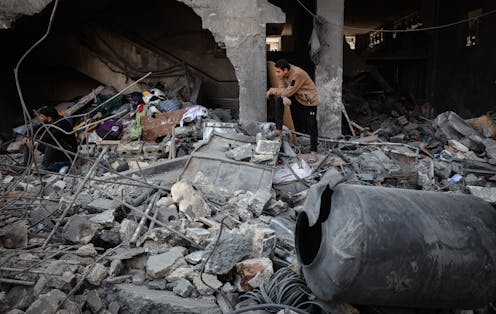
imageBuildings and a ceasefire left in ruins after airstrikes on March 18, 2025. Majdi Fathi/NurPhoto via Getty Images

The ceasefire in Gaza appears to be over.

And while Israeli Prime Minister Benjamin Netanyahu has sought to blame Hamas for the resumption of fighting that killed more than 400 Palestinians on March 18, 2025 – “only the...

Read more: The Gaza ceasefire is dead − Israeli domestic politics killed it

More Articles ...

  1. Measles cases are on the rise − here’s how to make sure you’re protected
  2. Humans aren’t the only animals with complex culture − but researchers point to one feature that makes ours unique
  3. Fires, wars and bureaucracy: The tumultuous journey to establish the US National Archives
  4. Can animals make art?
  5. Shaken baby syndrome can cause permanent brain damage, long-term disabilities or death – a pediatrician examines the preventable tragedy
  6. Donald Trump’s nonstop news-making can be exhausting, making it harder for people to scrutinize his presidential actions
  7. The story of the Great Migration often overlooks Black businesses that built Detroit
  8. As mountain glaciers melt, risk of catastrophic flash floods rises for millions − World Day for Glaciers carries a reminder
  9. Social media design is key to protecting kids online
  10. As mountain glaciers melt, risk of catastrophic flash floods rises for millions
  11. High school sports are losing athletes to private clubs, but schools can keep them by focusing on character development
  12. Why history instruction is critical for combating online misinformation
  13. An artist traces her choices under Putin’s Russia – from resistance to retreat to exile – one mural at a time
  14. A brief history of Medicaid and America’s long struggle to establish a health care safety net
  15. People say they prefer stories written by humans over AI-generated works, yet new study suggests that’s not quite true
  16. Plastic pyrolysis − chemists explain a technique attempting to tackle plastic waste by bringing the heat
  17. Social movements constrained Trump in his first term – more than people realize
  18. Water cooperation is essential when countries share lakes and rivers – yet it’s been deteriorating in many places, with serious consequences
  19. Spanish speakers in Philadelphia break traditional rules of formal and informal speech in signs around town
  20. Beatings, overcrowding and food deprivation: US deportees face distressing human rights conditions in El Salvador’s mega-prison
  21. Trump is using the Alien Enemies Act to deport immigrants – but the 18th-century law has been invoked only during times of war
  22. Cells lining your skin and organs can generate electricity when injured − potentially opening new doors to treating wounds
  23. Researchers created sound that can bend itself through space, reaching only your ear in a crowd
  24. Washington Post’s turnaround on its opinion pages is returning journalism to its partisan roots − but without the principles
  25. What is the rules-based order? How this global system has shifted from ‘liberal’ origins − and where it could be heading next
  26. Colorado and other states have expanded access to abortion, but not for adolescents
  27. Fewer deaths, new substances and evolving treatments in Philly’s opioid epidemic − 4 essential reads
  28. Remembering China’s Empress Dowager Ling, a Buddhist who paved the way for future female rulers
  29. From pulpits to protest, the surprising history of the phrase ‘pride and prejudice’
  30. The US military has cared about climate change since the dawn of the Cold War – for good reason
  31. Museums have tons of data, and AI could make it more accessible − but standardizing and organizing it across fields won’t be easy
  32. What was the first thing scientists discovered? A historian makes the case for Babylonian astronomy
  33. Trump’s first term polarized teens’ views on racism and inequality
  34. Why was it hard for the GOP – which controls Congress – to pass its spending bill?
  35. Saudi Arabia’s role as Ukraine war mediator advances Gulf nation’s diplomatic rehabilitation − and boosts its chances of a seat at the table should Iran-US talks resume
  36. See you in the funny papers: How superhero comics tell the story of Jewish America
  37. Radioisotope generators − inside the ‘nuclear batteries’ that power faraway spacecraft
  38. The psychology behind anti-trans legislation: How cognitive biases shape thoughts and policy
  39. Big cuts at the Education Department’s civil rights office will affect vulnerable students for years to come
  40. When algorithms take the field – inside MLB’s robo-umping experiment
  41. Simple strategies can boost vaccination rates for adults over 65 − new study
  42. The push to restore semiconductor manufacturing faces a labor crisis − can the US train enough workers in time?
  43. When humans use AI to earn patents, who is doing the inventing?
  44. Why parents of ‘twice-exceptional’ children choose homeschooling over public school
  45. Environmental protection laws still apply even under Trump’s national energy emergency − here’s why
  46. Are Ukrainians ready for ceasefire and concessions? Here’s what the polls say
  47. Philly Roller Derby league turns 20 - here’s how the sport skated its way to feminism, anti-racism and queer liberation
  48. How an unexpected observation, a 10th-century recipe and an explorer’s encounter with a cabbage thief upend what we know about collard greens’ journey to the American South
  49. I study refugees, and here are the facts on the history and impact of refugee resettlement in the US
  50. You’ve likely heard the Serenity Prayer − but not its backstory