

NewsPronto

 
The Times


.

USA Conversation

The Conversation USA

The Conversation USA

Taking a leap of faith into imaginary numbers opens new doors in the real world through complex analysis

  • Written by William Ross, Professor of Mathematics, University of Richmond
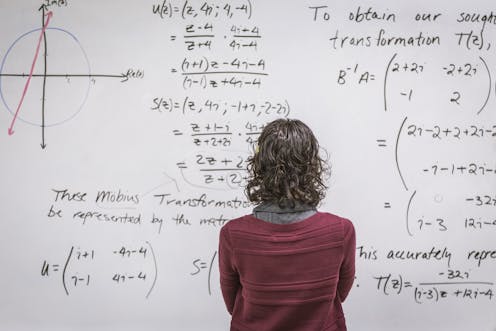
imageImaginary numbers push the boundaries of calculus and other branches of math.Hill Street Studios/DigitalVision via Getty Images

To a nonmathematician, having the letter “i” represent a number that does not quite exist and is “imaginary” can be hard to wrap your head around. If you open your mind to this way of thinking,...

Read more: Taking a leap of faith into imaginary numbers opens new doors in the real world through complex...

More Articles ...

  1. DEI initiatives removed from federal agencies that fund science, but scientific research continues
  2. The dark parallels between 1920s America and today’s political climate
  3. The fear of deportation hangs over unauthorized workers trying to fight exploitation, but all workers in the US have rights
  4. The FACE Act was enacted to protect reproductive health clinics − here’s why its history matters today
  5. Ann Arbor’s sustainable energy utility aims to build the electric power grid of the future − alongside the old one
  6. 5 ways schools have shifted in 5 years since COVID-19
  7. Is ranch dressing a liquid or a solid? A physicist explains
  8. America is becoming a nation of homebodies
  9. 5 reasons veterans are especially hard-hit by federal cuts
  10. Daylight saving time and early school start times cost billions in lost productivity and health care expenses
  11. How Trump’s $2B court battle over foreign aid could reshape executive authority
  12. Pause in aid has introduced uncertainty into Ukraine’s military planning − forever changing its war calculus
  13. NIH funding cuts will hit red states, rural areas and underserved communities the hardest
  14. ‘Pac-Man with a ponytail’ proteins regulate everything from night vision to heartbeats – studying what GRKs look like could improve an array of drugs
  15. What Amazon MGM’s creative control over the James Bond film franchise means for the future of 007
  16. Exhausted by the news? Here are 6 strategies to stay informed without getting overwhelmed − or misled by misinformation
  17. The US has pardoned insurrectionists twice before – and both times, years of violent racism followed
  18. Beyond AI regulation: How government and industry can team up to make the technology safer without hindering innovation
  19. Knocking down abandoned buildings has a lot of benefits for Detroit − but it’s costly for cities
  20. Why getting the numbers right isn’t enough for pollsters to be credible in today’s polarized climate
  21. Butterflies declined by 22% in just 2 decades across the US – there are ways you can help save them
  22. How 18F transformed government technology − and why its elimination matters
  23. Anger is a flow of emotion like water through a hose − at work, it helps to know when to turn it up or down and how to direct it
  24. DOGE threat: How government data would give an AI company extraordinary power
  25. As tuberculosis cases rise in the US and worldwide, health officials puzzle over the resurgence of a disease once in decline
  26. What’s that microplastic? Advances in machine learning are making identifying plastics in the environment more reliable
  27. Why Muslim American nonprofits are taking steps to build trust with donors during Ramadan
  28. Death by firing squad set to resume in the US – but no matter the method, all means of execution come with a troubling history
  29. Philly’s street fentanyl contains an industrial chemical called BTMPS that’s an ingredient in plastic
  30. The US energy market has its troubles, though it may not be a ‘national emergency’
  31. Carolina wildfires followed months of weather whiplash, from drought to hurricane-fueled floods and back to drought
  32. The child boss in ‘Severance’ reveals a devastating truth about work and child-rearing in the 21st century
  33. Supreme Court sides with San Francisco, requiring EPA to set specific targets in water pollution permits
  34. COVID-19 is the latest epidemic to show biomedical breakthroughs aren’t enough to eliminate a disease
  35. Learning ethics − one Marvel movie at a time
  36. USAID’s history shows decades of good work on behalf of America’s global interests, although not all its projects succeeded
  37. Influencers have trouble figuring out their tax obligations − and with good reason
  38. Trump is the kinglike president many feared when arguing over the US Constitution in 1789 – and his address to Congress showed it
  39. A potential $110B economic hit: How Trump’s tariffs could mean rising costs for families, strain for states
  40. Extreme heat silently accelerates aging on a molecular level − new research
  41. Gifts from top 50 US philanthropists rebounded to $16B in 2024 − Mike Bloomberg; Reed Hastings and Patty Quillin; and Michael and Susan Dell lead the list of biggest givers
  42. Chairman of the Joint Chiefs advises the president on use of America’s military power
  43. How the hidden epidemic of violence against nurses affects health care
  44. How Trump’s second term might affect the market and your finances
  45. Many more Denver teens have experienced homelessness than official counts show
  46. Out-of-balance bacteria is linked to multiple sclerosis − the ratio can predict severity of disease
  47. How are clouds’ shapes made? A scientist explains the different cloud types and how they help forecast weather
  48. GOP lawmakers commit to big spending cuts, putting Medicaid under a spotlight – but trimming the low-income health insurance program would be hard
  49. Who’s who at the Vatican?
  50. What is isolationism? The history and politics of an often-maligned foreign policy concept