Illegal tobacco is messing up economic data. That won’t stop until it’s managed like alcohol
Most Australians have probably noticed the proliferation of tobacconists and “convenience stores” in the last few years. These stores aren’t making much from the limited offerings on public display. Rather, their profitability comes from under-the-counter sales of untaxed tobacco and illegal vapes.
The growth of illegal tobacco sales has reached the point where the national accounts produced by the Australian Bureau of Statistics (ABS) have been significantly distorted. The ABS has announced it is taking steps to
measure the consumption of illicit nicotine-related products to supplement existing measurement.
The extent of illicit consumption, and the associated loss of revenue is, by its nature, hard to measure. The Australian Taxation Office estimated a net loss of over A$3 billion in 2023-24, but this amount has almost certainly risen since then.
Where the - illegal - profits are
Before looking at how this decision will affect the national accounts, it’s worth asking how we got here. The short answer is that, over the past decade or so, the tobacco excise has been steadily increased to the point where there are big profits to be made from dodging the tax.
But that’s not the whole story. Taxes on spirits have also been raised substantially. At the current rate of $106/litre of alcohol plus GST, tax makes up around two-thirds of the price of a typical bottle of spirits, similar to the case with tobacco.
Yet we haven’t seen a return of the “sly grog” shops that were common in Australia until the 1960s, when the 6pm closing of pubs was abolished. And despite heavy taxes on gambling, illegal casinos seem to be a thing of the past.
What explains this difference? The sale of alcohol and gambling services is subject to licensing restrictions, managed by state authorities and enforced by police.
By contrast, until very recently, nicotine products have been treated as normal grocery items. Enforcement was limited until state governments started tightening up the law with changes that have just come into effect.
The states have begun shutting down tobacconists found to be breaching it, and even threatened jail for landlords.
The Australian Taxation Office, along with the Australian Border Force, makes serious efforts to prevent illegal importation of tobacco products, as well as seizing tobacco crops grown here. But it appears unable or unwilling to do much against retailers who sell cigarettes under the counter.
State police forces have been slow to enforce the law.
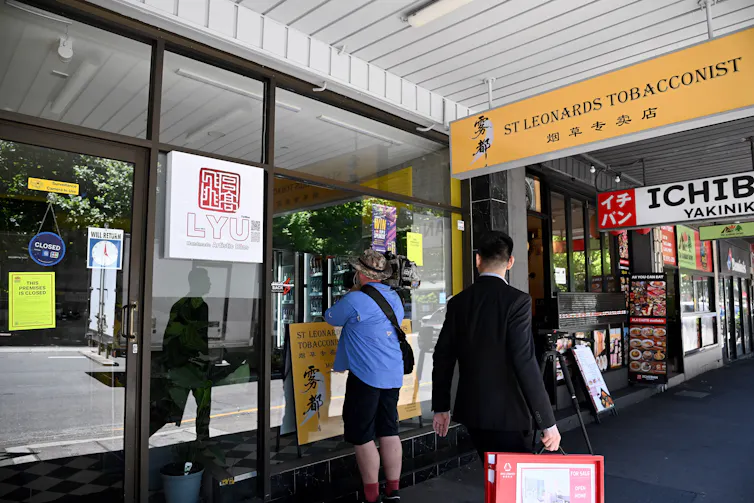
Their reluctance here contrasts with the reasonably effective licensing enforcement of alcohol and with the stringent measures taken against suspected users of drugs like ecstasy.
But the imbalance between the incentive to dodge the tax and the risks of being caught remains. Until it is resolved, the federal government would do well to defer planned further increases in taxation.
A question that remains open is whether the growth of illegal tobacco has led to an increase in smoking. Evidence here is mixed. A government survey in 2022-23 showed a continued decline in smoking, alongside an increase in vaping.
However, a more recent Roy Morgan survey suggests an increase of smoking among young people as a result of the vaping ban.
How to account for the shadow economy
Now, back to the ABS. The objective in producing national accounts statistics such as gross domestic product (GDP) is to measure economic activity, giving a guide as to whether the economy is operating at full capacity. That’s important for the Reserve Bank in setting interest rates, but it isn’t a measure of wellbeing.
As critics have often pointed out, GDP pays no attention to whether the production being measured is socially desirable, neutral or harmful. Similarly, the ABS has always been aware that not all economic activity is legally recorded.
The solution, in the past, has been to add a 1.5% adjustment to GDP to take account of unrecorded (shadow economy) activity. There hasn’t been a perceived need for anything more detailed.
But with illicit tobacco estimated to be about 25% of sales in 2023-24 and higher now, this adjustment is no longer sufficient.
Both major supermarkets have said their tobacco sales have halved just in the past 12 months, the sharpest fall on record.
The ABS estimates growth in final household consumption expenditure has been underestimated by more than 0.5 percentage points over the past year, which is a big deal given the typical annual increase in consumption spending is around 5%.
Keeping pace with a changing economy
Finally, it’s worth noting this isn’t the only issue the ABS is looking at in response to an ever-changing economy.
As more and more households meet their electricity needs through rooftop solar, the ABS has faced a conceptual issue. This might be thought of as household production, like growing your own vegetables or cooking your own meals, which isn’t counted in GDP.
But the ABS has decided it’s better to regard solar rooftops as a home-based small business, whether the electricity is self-consumed or fed back into the grid.
As distinctions between home and work, and between licit and illicit production become increasingly blurred, statisticians will need to make more and more judgements like this.
Authors: The Conversation