

Trump administration’s lawsuits against Harvard and UCLA have roots in a decades-old fight over civil rights law
- Written by Ryan Creps, Assistant Professor of Educational Leadership, University at Buffalo
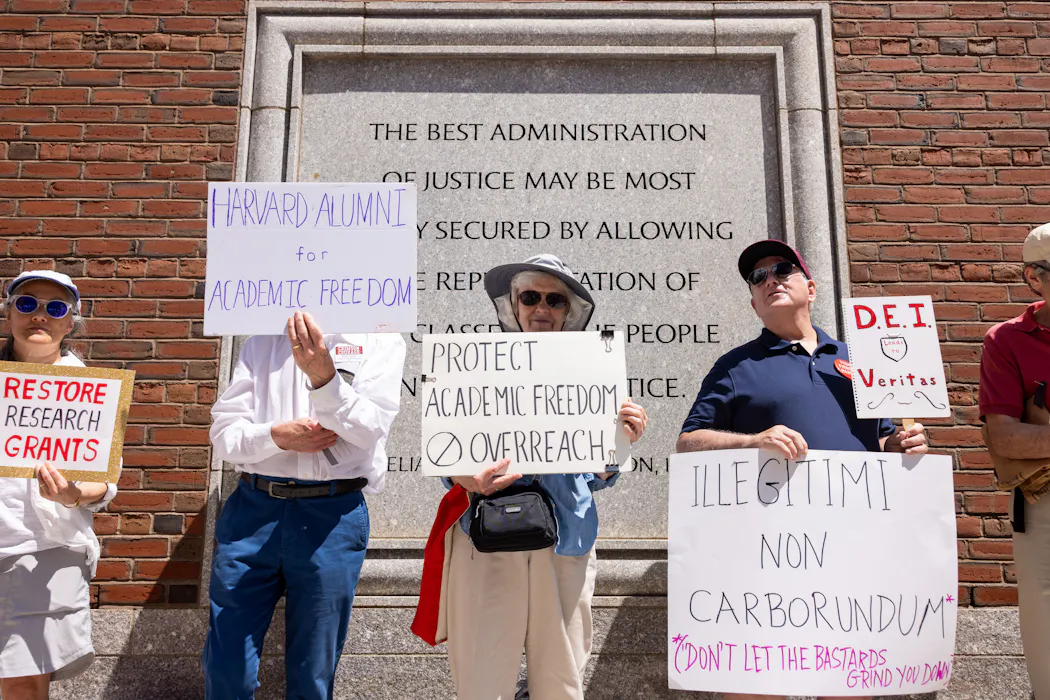 Protesters gather outside a Boston courthouse in July 2025 to rally against the Trump administration's freezing of contracts and grants to Harvard University. Scott Eisen/Getty Images
The Department of Justice announced in March 2026 that it is suing Harvard University and the University of California, Los Angeles.
The lawsuits allege that both universities failed to adequately address antisemitism on campus, violating students’ civil rights.
These cases follow earlier efforts by the Trump administration in 2025 to blockfederal funding to several major universities. The Trump administration has also – largely unsuccessfully – pushed universities to sign agreements that would give the federal government greater oversight over their day-to-day operations.
In 2025, the Trump administration launched broad Title VI investigations into 60 colleges and universities. These investigations focused on whether schools had done enough to protect Jewish students from discrimination and harassment, particularly in the wake of the Oct. 7, 2023, attacks on Israel, the subsequent war in Gaza, and widespread protests across U.S. college campuses.
Many of those investigations continue. Title VI is part of the Civil Rights Act of 1964 and prohibits discrimination on the basis of race, color or national origin in any program that receives federal funding.
These federal investigations have prompted scientific researchers, among others, across higher education to ask whether the government can invoke claims of civil rights law violations to justify cutting off federal research funding that supports their labs and projects.
As a scholar of educational leadership and policy, I think it is helpful to place the Trump administration approach to higher education within a broader understanding of how courts have interpreted civil rights laws within the past few decades and the nuanced way the Supreme Court has found they apply to universities.
 The Civil Rights Act of 1964 kick-started a legal battle over whether and how universities need to adopt civil rights law.Creattie/iStock/Getty Images Plus
Supreme Court weighs in
In 1964, Congress passed the Civil Rights Act. This law banned discrimination based on race, color, religion, sex or national origin in employment, education and public places.
Congress then passed the Higher Education Act in 1965. This law significantly increased the federal government’s investment in colleges and universities. It also created the Pell Grant program – the first federally funded need-based financial aid program for undergraduate students.
In addition, the Higher Education Act spelled out that schools that receive federal funding need to comply with civil rights laws.
Leaders of Grove City College, a small nondenominational Christian college in rural Pennsylvania, were concerned that this law would bring unwanted government oversight.
At the time, the college did not accept any direct federal funding. But some of its students received Basic Educational Opportunity Grants. These grants helped undergraduate students pay for college. Unlike loans, these grants did not have to be repaid.
In 1975, the Department of Health, Education and Welfare asked all universities and colleges with students who received federal grants to agree to comply with Title IX, a 1972 law that prohibits discrimination based on someone’s sex.
In 1976, Grove City refused to sign on to this agreement. A legal back-and-forth ensued.
Grove City College argued that the federal government’s request amounted to unwarranted government intervention, because the college did not directly receive federal funding. The Department of Health, Education and Welfare threatened to cut off the federal grants Grove City students received.
The Supreme Court eventually ruled in 1984 that Grove City’s financial aid program – but not the entire college – needed to comply with Title IX in order to receive federal aid. That’s because this specific office directly handled federal student aid.
A 1988 law clarifies the ruling
Many House Democrats perceived this Supreme Court ruling as a loophole that would let universities and colleges sidestep civil rights laws by applying them only to the specific programs that received federal funds.
In 1984, a group of Democrats unsuccessfully tried to pass legislation that would have extended civil rights protections across all programs within colleges and universities that receive federal aid for any program. A different version of this bill passed Congress with bipartisan support in 1988, on the brink of the presidential elections.
President Ronald Reagan vetoed the bill. Reagan stated in his explanation to the Senate that this bill “would vastly and unjustifiably expand the power of the Federal Government over the decisions and affairs of private organizations.”
However, many Republicans seeking reelection in Congress feared that rejecting the bill could alienate women and people of color in the upcoming election.
Within a week, Congress voted to override the veto and enacted the Civil Rights Restoration Act in 1988. This law clarified that any college accepting federal funds must comply with civil rights laws in all of its programs. This law also allowed the government to withhold federal research funding from colleges based on civil rights violations.
 UCLA students, researchers and demonstrators protest against the Trump administration’s funding cuts to research, health and higher education in April 2025.Robyn Beck/AFP via Getty Images
Enforcing civil rights laws today
The Trump administration is testing just how much the federal government can exert power over colleges and universities that receive federal funding. Some Trump administration supporters say they see this strategy as overdue enforcement against discrimination.
On the other hand, the Association of American Universities, an organization made up of American research universities, is among the opposition arguing that the administration is trying to weaponize civil rights laws to control how colleges and universities are run.
Antisemitic incidents are on the rise in the U.S., including on college campuses. But some observers have noted that the issue is nuanced, and that the administration is likely exploiting a controversial issue to achieve ideological goals.
Federal courts’ interpretations in the Harvard and UCLA lawsuits will further shape how civil rights protections are enforced at colleges and universities. Specifically, these cases will help determine whether the mere allegations of civil rights violations against a university can justify a sweeping freeze of federal research funding.
Ryan Creps does not work for, consult, own shares in or receive funding from any company or organization that would benefit from this article, and has disclosed no relevant affiliations beyond their academic appointment.
Authors: Ryan Creps, Assistant Professor of Educational Leadership, University at Buffalo