

How museums can help rebuild trust in a divided America
- Written by Devon Akmon, Director of the MSU Museum and CoLab Studio, Michigan State University
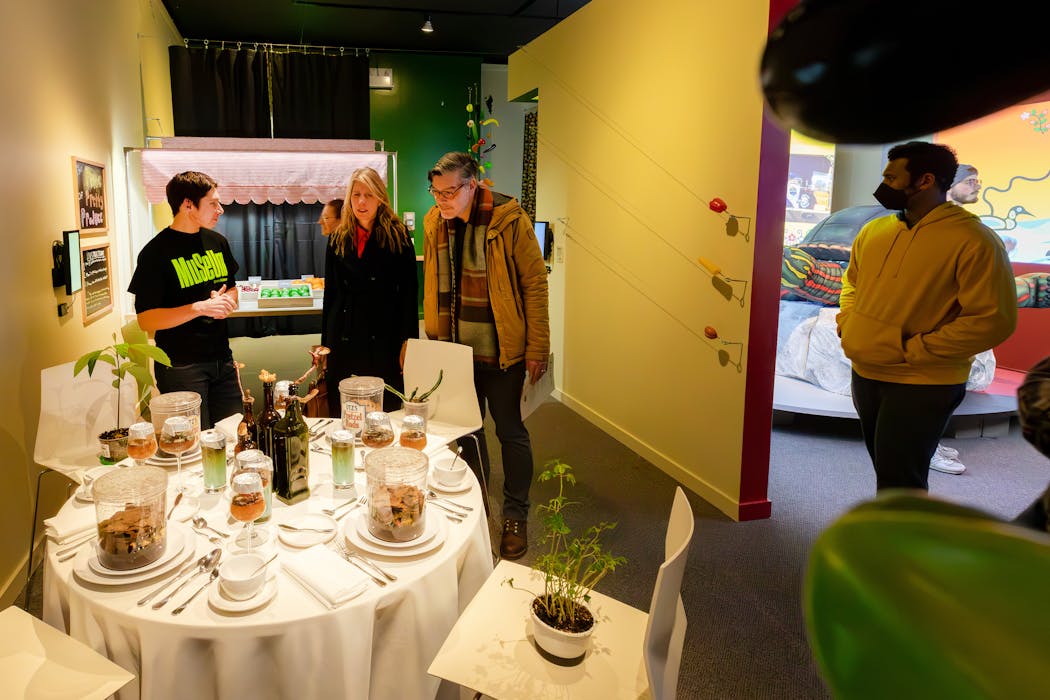 A student CoLaborator engages visitors in dialogue about food security and sustainability during a recent exhibition.MSU Museum
Across the United States, political polarization has deepened to historic levels. In a report published in May 2025, the Pew Research Center found that Americans are more divided and less trusting of one another than at any point in recent decades. Yet museums remain among the few places where curiosity still draws people across political and cultural lines.
Ninety-two percent of adults view museums as nonpartisan sources of education, according to a report from Wilkening Consulting. People also trust museums for presenting fact-based, authentic and research-driven information. Ninety-six percent of Americans say they would support lawmakers who fund museums, and 97% see museums as vital educational assets to their communities. These findings place museums among the most trusted institutions in American life, ranking just behind friends and family.
That rare level of confidence gives museums both an opportunity and a responsibility. As debates over science, history and art intensify, they are being called upon to do something more fundamental: to model how people might think and listen together.
As director of the Michigan State University Museum in East Lansing, and core faculty in the Arts, Cultural Management and Museum Studies program at MSU, I see every day how these spaces can foster understanding.
Questioning algorithms, fostering dialogue
At the MSU Museum, an upcoming exhibition titled “Blurred Realities” will ask a question that feels urgent far beyond its gallery walls: How do we decide what is true?
Opening in January 2026, “Blurred Realities” examines how information, bias and technology shape people’s understanding of the world. Rather than advancing a single authoritative narrative, the exhibition creates space for inquiry, encouraging visitors to reflect on how beliefs are formed, how digital systems influence perception, and how imagination reshapes memory and identity. In doing so, the exhibition invites thoughtful engagement with the stories, data and algorithms that shape contemporary life, and considers what it means to navigate truth in an increasingly complex information environment.
 A rendering of an interactive installation,Source: MSU Museum
Central to this effort are the museum’s “CoLaborators,” a team of college students trained to facilitate small, idea-driven conversations that encourage curiosity and exchange between museum visitors. They engage guests in open conversations that respond to their interests in the moment. This approach differs from the traditional docent model, which often centers on the transmission of information. Instead, the students’ work transforms the gallery into a living forum where questions matter more than conclusions.
In my experience, this is just one of many ways that museums are engaging the communities they serve to explore timely and relevant topics that shape contemporary life.
Michigan State University students discuss their participation in the CoLaborator program.Catalysts for civic connection
Museums have long been places to explore the natural world, cultural artifacts and scientific discovery.
History museums have hosted community storytelling projects. An excellent example is the “Your Story, Our Story” project led by the Tenement Museum in New York.
Science museums, including the Natural History Museum of Utah, have led public discussions on climate change.
Art and history museums have opened their galleries and programming spaces to conversations about identity and belonging. The Charles H. Wright Museum of African American History held an exhibition centered on Detroiters exonerated of crimes and themes of justice, identity and renewal.
The Institute of Museum and Library Services describes museums and libraries as community catalysts that support social well-being through cultural engagement, shared identity and social connection. In a time when public debate often happens online, in anger and lacking nuance, museums offer something different: a physical place where curiosity can thrive and where people can pause, reflect and listen.
The more than 35,000 museums across the United States represent a remarkably broad and diverse field, rooted in communities of every size and serving people where they live and learn. Their core work has traditionally focused on collecting, researching, preserving and interpreting objects of historical, cultural and scientific significance.
As social divisions grow, they are becoming important forms of social infrastructure where people can encounter different perspectives. In many cases, their roles are also expanding as museums help the public engage with the pressing questions of our time.
The Association of Science and Technology Centers notes that rising mistrust in institutions, the spread of misinformation and the weakening of shared public spaces are creating new challenges for organizations that engage the public. In recent years, these trends are prompting museums to think about their role in supporting connection and understanding. Across the country, institutions that once focused mainly on preservation and education are reframing their purpose to include convening civic dialogue and helping visitors navigate complex issues together.
Preserving trust in an age of discontent
As museums step more visibly into the civic sphere, they also face new pressures. Efforts to engage with difficult topics can draw criticism from across the political spectrum.
Some question why museums address issues like race, climate or misinformation at all, while others expect them to go further. The result can be a delicate balance between maintaining trust and remaining relevant. Staff and volunteers are expected to create inclusive environments while navigating limited resources, public scrutiny and, sometimes, personal attacks. Smaller institutions may lack the capacity to sustain long-term partnerships or withstand political pushback.
I believe avoiding these conversations carries its own risks. It can reinforce perceptions that museums are detached from the realities of the communities they serve. The key question we ask ourselves at the MSU Museum is not whether to engage with societal issues, but how to do so with care, humility and authenticity. That involves listening as much as leading and viewing dialogue itself as part of our educational mission.
At a moment when trust in public institutions is fragile, museums hold a rare and valuable position. They are places where people still expect to learn something new and to encounter ideas different from their own. When museums invite visitors to think together about complex issues, whether through exhibitions, conversations or community partnerships, they help nurture the habits of curiosity and empathy that democracy depend on. These interactions may not resolve polarization, but they can model a more constructive way of engaging with difference.
Within a museum’s walls, people can explore difficult ideas without the noise of argument or the demand to take sides. In doing so, museums continue their essential work, not only preserving the past but helping us imagine a shared future built on understanding, curiosity and trust.
“Blurred Realities” is on view at the Michigan State University Museum in East Lasing, Michigan, from Jan. 15 to July 18, 2026.
Read more of our stories about Michigan.
Devon Akmon is the board chair for the American Alliance of Museums.
Authors: Devon Akmon, Director of the MSU Museum and CoLab Studio, Michigan State University
Read more https://theconversation.com/how-museums-can-help-rebuild-trust-in-a-divided-america-268466