

For some Jewish women, ‘passing’ as Christian during the Holocaust could mean survival – but left scars all the same
- Written by Hana Green, Postdoctoral Fellow in Holocaust Studies, Zucker/Goldberg Center for Holocaust Studies, College of Charleston
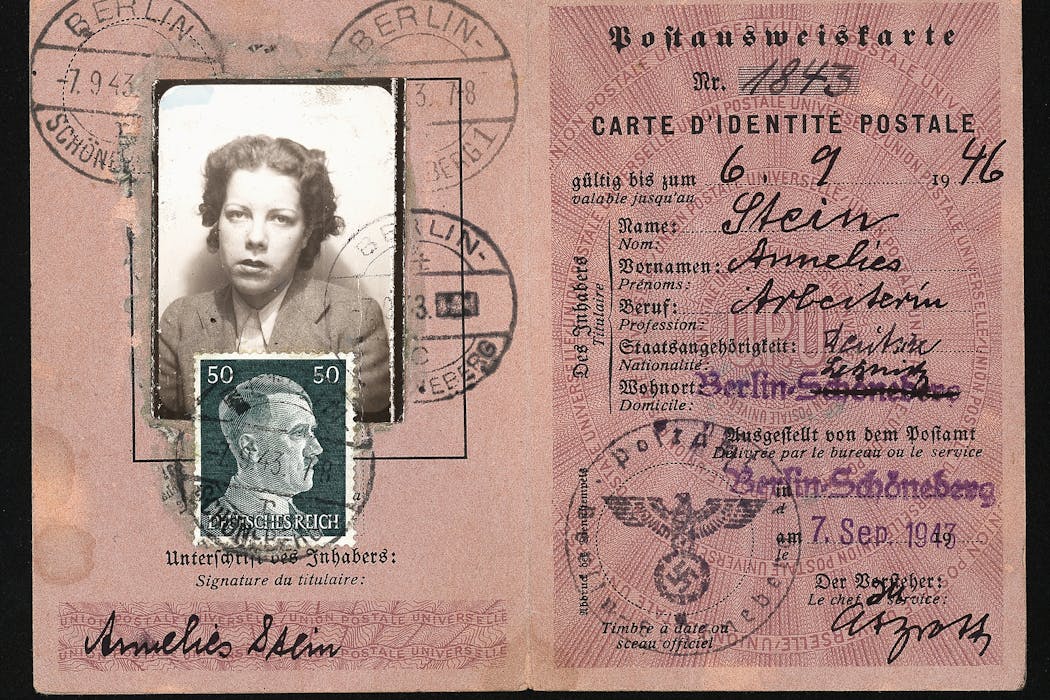 A 1943 post office identification card for Annelies Herz, a German Jewish woman who managed to survive by posing as a Christian woman with the last name 'Stein.'From the Collection of the Museum of Jewish Heritage – A Living Memorial to the Holocaust. Gift of Annelies and Helmut Herz, 393.89.
Travel case in hand, dressed in fashionable clothing and wearing a practiced, coquettish smile, Hela Schüpper Rufeisen sat aboard the train to Warsaw, Poland. No one on board would have suspected that beneath the coat of the young woman were strapped assorted handguns and several cartridge clips.
Schüpper Rufeisen, who was Jewish, relied on this dissonance between appearance and reality to ferry items into, out of and between the Warsaw and Krakow ghettos. Her carefully cultivated “Aryan” image and false papers listing her as Catholic made it possible to cross borders and survive encounters that would otherwise have ended in death.
 Hela Schüpper Rufeisen before the war.Eli Dotan/Wikimedia Commons, CC BY-SA
During the Holocaust, trying to “pass” as non-Jewish was often more feasible for women than men. Some Jewish women, like Schüpper Rufeisen, took the risk in order to join resistance efforts against the Nazis and their collaborators. Most Jews who tried to pass, however, did so simply to remain alive in a system designed to murder them.
Passing took many forms. It enabled some women to transport weapons, papers or messages, while allowing others to work as domestic servants, move between cities, secure food or sleep safely for another night. What united these experiences was the pressure of living under constant threat. Blanca Rosenberg escaped the Kolomyja ghetto – then Polish, now part of Ukraine – in 1942. As she recalled afterward, “I tried to force myself into the mind of the woman I was to impersonate … I was now an Aryan, with a right to life, and no longer a Jewess, hunted like prey.”
Over years of research on Jews who evaded capture during the Holocaust, what struck me most was not the daring of these acts, but how often survivors described them as something done to get through the day alive. A central aim of my work has been to move beyond celebrated figures such as couriers and resistance agents – not to diminish their bravery, but to show how passing functioned as a strategy of survival within a system committed to Jewish annihilation.
Women’s roles
Under Nazism, “passing” meant assuming a non-Jewish identity and performing it convincingly in hostile public places, whereas going into hiding meant concealing one’s physical existence. This required constructing an entirely new self: adopting new names and speech patterns, demonstrating fluency in Christian rituals, and sustaining backstories capable of withstanding scrutiny.
Passing relied on constantly negotiating visibility and concealment, safety and exposure. The stakes were immense. Exposure often meant immediate death, and those who helped risked execution themselves.
Jewish men and women who passed navigated unique dangers. Yet women, often perceived as less of a threat, also had distinct possibilities.
 Duplicate copy of Christine Denner’s birth records issued in July 1942 and given to her Jewish friend Edith Hahn as false identification.United States Holocaust Memorial Museum Collections Photo Archive #23179. Courtesy of Edith Hahn. Copyright of United States Holocaust Memorial Museum.
Their mobility was less strictly policed than men’s, and they could assume roles such as domestic workers or caretakers, providing credible explanations for their presence in public spaces. Women could adapt hairstyles, clothing and mannerisms to try to blend in. Men’s circumcisions, on the other hand, might expose them as Jewish, and in some circumstances, being a military-aged man out of uniform could arouse suspicion.
Testimonies from survivors show how many women relied on intuition and social awareness to navigate danger, crafting performances that balanced vulnerability and confidence. These were not advantages born of privilege, but survival strategies shaped by patriarchal and Nazi stereotypes, in which women’s perceived docility became a precarious form of cover.
The experience of Adina Blady-Szwajger reflects this precarious calculus. Traveling under a false Polish passport, the young physician moved between the Warsaw Ghetto and the so-called “Aryan side,” concealing ammunition beneath ordinary goods. When stopped by a gendarme on Żelazna Street, she opened her bag, revealing a heap of potatoes masking ammunition, smiled broadly, and waited. The patrolman glanced inside and ordered only “Los” – “Go.”
At the same time, Jewish women were doubly vulnerable. Living without legal protection, they faced heightened risks of sexual violence and coercion, as well as the potentially fatal consequences of pregnancy. Gender shaped not only how women passed, but the dangers they faced while doing so.
Emotional weight
Passing exacted a heavy psychological toll. Women lived with the constant fear that a single mistake could reveal their true identity. Rosenberg’s account of suppressing her sense of self after escaping the Kolomyja ghetto illustrates how passing fractured identity, producing a self that was at once protective and deeply alien.
Isolation compounded this strain. Cut off from family, unsure whom to trust, and burdened by guilt, many women endured emotional isolation that lingered long after liberation.
Ruth Ackerman, who survived the war by working for a German family under a false name, recalled scanning newly arrived American troops for a single “Jewish face.” The only member of her family to survive, Ackerman searched for other Jews, yearning for connection after years of concealment.
Edith Hahn-Beer, who lived in a displaced persons camp after the war, recalled feeling rejected by survivors who resented that she had emerged “intact,” without the physical suffering, imprisonment and degradation they themselves had endured. Using the false papers of a friend from Vienna, Hahn-Beer survived the war by living as an “Aryan” in Germany, marrying a Nazi officer – choices that complicated how other survivors saw her survival.
 Leah Hammerstein Silverstein, born Lodzia Hamersztajn, poses in front of the Jasna Gora monastery in Czestochowa, Poland.United States Holocaust Memorial Museum Photo Archives #17907. Courtesy of Leah Hammerstein Silverstein. Copyright of United States Holocaust Memorial Museum.
Lodzia Silverstein, a courier in Poland, described the postwar shift as “crawling out from the Polish skin and back into my Jewish skin.” This arduous psychological process was complicated by continued antisemitic violence, including the 1946 Kielce pogrom, a blood libel massacre that killed 42 Jews and wounded at least 50 others in the southeastern Polish town.
In some cases, Jews who passed for Christian retained their wartime identities for years, or even for the remainder of their lives, out of fear of continued persecution or a desire to move on.
Lasting lessons
As these women’s struggles show, passing was an ongoing negotiation of selfhood under extreme, and often violent, duress. For Jews who managed to pass, their deception was both a shield and a burden. Every gesture, word and detail of appearance carried the risk of exposure.
Their stories continue to resonate. People displaced by war, persecution or discrimination often alter aspects of their identities to remain safe. Belonging is rigorously policed – from immigration enforcement, racial discrimination and attacks on gender identity in the United States to ethnic violence across the globe. Whether through documents and checkpoints, or everyday scrutiny of language, dress, religion and appearance, people scrutinize each other, drawing lines around who belongs.
During the Holocaust, concealment was a condition of survival under persecution. Survivors’ testimony illuminates both the ingenuity required to endure such pressure and the emotional costs of erasing parts of oneself. In a moment of rising nationalism, antisemitism and mass displacement, their stories carry renewed urgency.
Hana Green has received research funding from the Central European History Society, the Leo Baeck Institute, the German Academic Exchange Service (DAAD), the German Historical Institute, the United States Holocaust Memorial Museum’s Mandel Center for Advanced Holocaust Studies, and the Conference on Jewish Material Claims Against Germany (Claims Conference).
Authors: Hana Green, Postdoctoral Fellow in Holocaust Studies, Zucker/Goldberg Center for Holocaust Studies, College of Charleston