

Valentine’s Day cards too sugary sweet for you? Return to the 19th-century custom of the spicy ‘vinegar valentine’
- Written by Melissa Chim, Scholarly Communications Librarian, Excelsior University
 A woman turns down a dapper 'snake' in a 'vinegar valentine' from the 1870s.Wikimedia Commons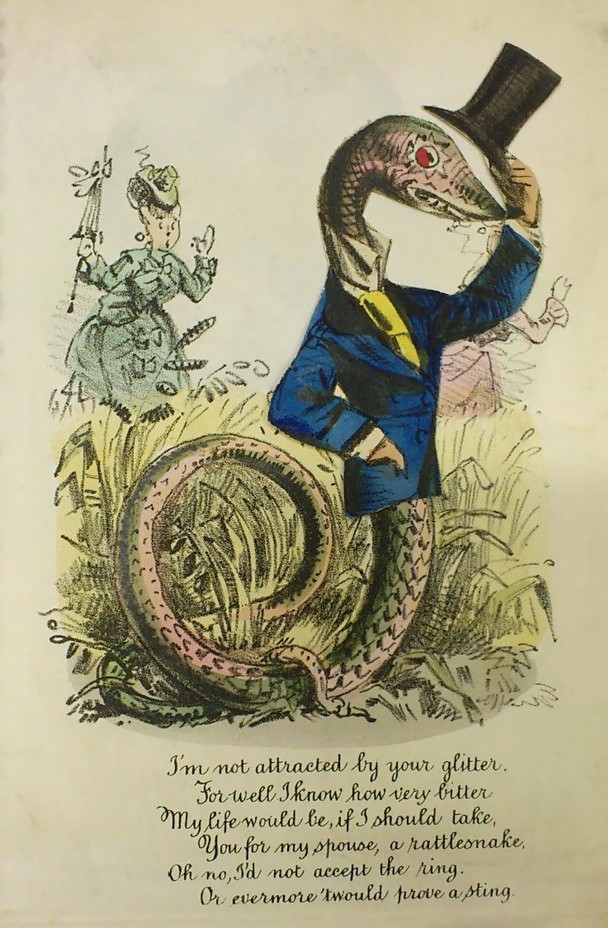
Ahh, Valentine’s Day: the perfect moment to tell your sweetheart how much you love them with a thoughtful card.
But what about people in your life you don’t like so much? Why is there no Hallmark card telling them to get lost?
The Victorians had just the thing: a cruel and mocking version of the traditional Valentine’s Day card. Later coined “vinegar valentines” by 21st-century art collectors and dealers, such cards were usually referred to as mock or mocking valentines during the Victorian era.
Such cards were meant to shock, offend and upset their recipients. Not surprisingly, as with real Valentine’s Day cards, senders often chose to remain anonymous.
Vinegar valentines are what we historians like to call ephemera, that is, materials that are usually not meant to last a long time.
It’s hard to imagine a recipient of a vinegar valentine wanting to keep it lovingly in a frame, and many have been lost to time. But luckily, some vinegar valentines have survived and have been preserved in the collections of many historical institutions, such as Brighton and Hove Museums and the New York Public Library.
One jab at obnoxious sales ladies reads:
“As you wait upon the women
With disgust upon your face
The way you snap and bark at them
One would think you owned the place”
There is even a card for the pretentious poet who pretends to make a living with his art:
“Behold this pale little poet
With a finger at forehead to show it
But the way he gets scads
Is by writing soap ads
But he wants nobody to know it!”
The anonymous nature of the vinegar valentine meant that anyone could be an unwitting recipient. Some cards could poke gentle fun, but others could have quite dangerous results.
In 1885, a resident in the U.K. city of Birmingham, William Chance, was charged with the attempted murder of his estranged wife after he received a vinegar valentine from her. He shot her in the neck, and she was sent to the hospital.
‘Pompous, vain and conceited’
But who could be disliked so much that they would receive a vinegar valentine?
The poor, old and ugly were convenient targets. Unmarried men and women might also receive a vicious rejection from potential partners.
A Feb. 9, 1877, article from the Newcastle Courant notes that “it is the pompous, the vain and conceited, the pretentious and ostentatious who are generally selected as butts for valentine wit.”
Sending such a valentine was a way for ordinary people to enforce social norms disguised as a joke. It was also a way to feel powerful over an already vulnerable person, even if the sender was vulnerable themselves.
 Vinegar valentine sheet titled ‘You are on the Road to Destruction.’Wikimedia Commons
.jpg)
Vinegar valentines emerged as a sour offshoot of the cultural ascendancy of Valentine’s Day itself. While rooted in an ancient Roman fertility ceremony, the day was turned into a celebration of love by the Victorians.
The first Valentine’s Day cards in the early 1800s were often made by hand. With the rise of industrialization, by the 1840s and 1850s most cards were produced in factories. These regular Valentine’s Day cards were often decorated with lace and romantic images.
An industry of insults
By the mid-1800s, both Britain and the United States entered into what one historian calls “Valentine’s mania.”
The earliest vinegar valentines were sheets of paper folded like a letter. And to add insult to injury, before the availability of prepaid postage, the recipient had to pay to receive their letter.
Many printers offered vinegar valentines alongside the more traditionally positive and ornate cards. Even the firm Raphael Tuck & Sons, “Publishers to Their Majesties the King and Queen of England,” joined the vinegar valentine craze.
Vinegar valentines made their way across the pond to the United States in the mid-1800s. Some American printers made their own vinegar valentines; others, such as A.S Jordan, imported them from Britain.
During the American Civil War, these cards became a medium to express anger and frustration. If you supported the Union, you could send the following message to an unlucky secessionist from the South:
“You are the man who chuckles when the news
Comes o’er the wires and tells of sad disaster,
Pirates on sea succeeding-burning ships and crews,
Rebels on land marauding, thicker, aye, and faster
You are the two faced villain, though not very bold,
Who would barter your country for might or for gold.”
Votes and valentines
As vinegar valentines continued to be produced throughout the early 1900s, a new target became very popular – the suffragette.
Women fighting for the right to vote were seen by their detractors as unfeminine, and vinegar valentines were a cheap and convenient medium to enforce gender roles. In such cards, suffragettes were usually depicted as ugly spinsters or abusive, lazy wives. One card warns, “A vote from me you will not get, I don’t want a preaching suffragette.” Similarly, another card says:
“You may think it fun poor Cupid to snub,
With the hand of a Suffragette.
But he’s cunning and smart, aye, there’s the rub,
Revenge is the trap he will set.”
 A valentine for one drunk on love?Wikimedia Commons
.jpg)
There were even cards made for anti-suffragist women looking to secure a husband. One card plaintively proclaims, “In these wild days of suffragette drays, I’m sure you’d ne’er overlook a girl who can’t be militant, but simply loves to cook.”
There were also pro-suffrage Valentine’s Day cards. One card defiantly asks, “And you think you can keep women silent politically? It can’t be did!”
Cupid as a troll
Vinegar valentines continued to be popular through the Golden Age of picture postcards in the early 1900s. They declined in popularity after World War I. This may be due to a decline in card giving overall, or a cultural shift away from “lowbrow” humor. But they never fully went away.
The spirit of the vinegar valentine saw a second revival in the 1950s with the rise of the comic postcard.
And the effects of vinegar valentines can still be seen, and felt, today. Anonymous internet trolls keep up the sniping spirit so prevalent in the Victorian era. Today’s vinegar valentines are extremely online. They are just as spiteful, but the difference is they are emphatically not restricted to one particular day in February.
Melissa Chim does not work for, consult, own shares in or receive funding from any company or organization that would benefit from this article, and has disclosed no relevant affiliations beyond their academic appointment.
Authors: Melissa Chim, Scholarly Communications Librarian, Excelsior University