
Artists and writers are often hesitant to disclose they’ve collaborated with AI – and those fears may be justified
- Written by: Joel Carnevale, Assistant Professor of Management, Florida International University
 In a recent survey of more than 2,500 creative professionals, 83% reported using AI in their work.EuroChild/iStock via Getty Images
Generative artificial intelligence has become a routine part of creative work.
Novelists are using it to develop plots. Musicians are experimenting with AI-generated sounds. Filmmakers are incorporating it into their editing process. And when the software company Adobe surveyed more than 2,500 creative professionals across four continents in 2024, it found that roughly 83% reported using AI in their work, with 69% saying it helped them express their creativity more effectively.
The appeal is understandable. Emerging research shows that generative AI can support the creative process and, at times, produce outputs that people prefer to work made by humans alone.
Yet there’s an important caveat that my colleagues and I have recently begun to explore in our research: Positive views of creative work often shift once people learn that AI was involved.
Because generative AI can produce original content with minimal human input, its use raises questions about quality, authorshipand authenticity. Especially for creative work closely tied to personal expression and intent, AI involvement can complicate how audiences interpret the final product.
Organizational behavior researchers Anand Benegal, Lynne Vincent and I study how people establish, maintain and defend their reputations, particularly in creative fields.
We wanted to know whether using AI carries a reputational cost – and whether established artists are shielded from the backlash.
No one is immune
When we set out to examine these questions, two competing possibilities emerged.
On one hand, individuals with strong reputations are often granted greater latitude. Their actions are interpreted more favorably and their intentions given the benefit of the doubt. So established artists who use novel technologies like AI may be seen as innovative or forward-thinking, while novices are viewed as dependent or incompetent.
On the other hand, established creators may be held to higher standards. Because their reputations are closely tied to originality and personal expression, AI use can appear inconsistent with that image, inviting greater scrutiny rather than leniency.
To test these competing possibilities, we conducted an experiment in which participants listened to the same short musical composition, which was described as part of an upcoming video game soundtrack.
For the purposes of the experiment, we misled some of the participants by telling them that the piece had been written by Academy Award–winning film composer Hans Zimmer. We told others that it had been created by a first-year college music student.
Across the experimental conditions, some participants were informed that the work was created “in collaboration with AI technology,” while others received no such information. We then measured changes in participants’ perceptions of the creator’s reputation, perceptions of the creator’s competence and how much credit they attributed to the creator versus the AI.
Our results showed that the creator’s existing reputation did not protect them: Both Zimmer’s reputation and that of the novice took a hit when AI involvement was disclosed. For creators considering whether their past success will shield them, our study suggests this might not be the case.
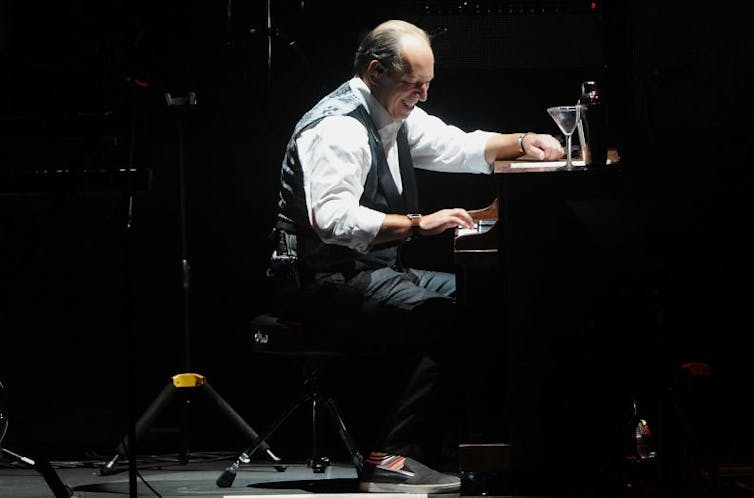 Even Hans Zimmer’s reputation was tarnished when study participants were led to believe that the Academy Award–winner had used AI in his music-writing process.Brad Barket/Getty Images
Credit where credit is due?
That said, reputation was not entirely irrelevant – it did shape how evaluators interpreted the creator’s role in the work.
The preexisting reputations of established creators did provide a limited advantage. When we asked participants to indicate how much of the work they attributed to the human creator versus the AI, evaluators were more likely to assume Zimmer had relied less on AI.
In other words, an artist’s prior reputation shaped how people judged authorship, even if it didn’t shield them from reputational damage.
This distinction points to an important implication. The backlash may not stem simply from the presence of AI but from how observers interpret the balance between human contribution and AI assistance.
At what point does collaborating with AI begin to be perceived less like assistance and more like handing over control of the creative process? In other words, when does AI’s role become substantial enough that it is seen as the primary author of the final product?
For instance, a composer might use AI to clean up background noise, adjust timing or suggest alternative harmonies – decisions that refine but do not fundamentally alter their original work. Alternatively, the composer might ask AI to generate multiple melodies, select one they like and make minor adjustments to tempo or instrumentation.
Our study did not vary the degree of AI involvement; participants were told only that AI was used or not mentioned at all.
But the findings suggest that how much AI is used – and how central it appears to the creative process – matters. For creators and organizations, the question may not be whether AI is involved but whether audiences are made aware of the extent of its involvement.
To disclose or not to disclose?
A practical question that naturally follows is whether creators should disclose their AI use.
The New York Times recently reported that some romance novelists were quietly incorporating AI tools into their writing process without disclosing it to readers. This reluctance appears to be widespread: A 2025 workplace survey found that nearly half of employees conceal their use of AI tools, often out of concern that others will view them as cutting corners or question their competence.
Is silence strategically wiser than transparency?
In our first experiment, the composer’s work either mentioned AI collaboration or didn’t mention AI at all.
But we went on to conduct a second experiment to examine disclosure more directly. This time, participants evaluated an employee at an advertising agency.
Everyone first learned that this employee had a strong reputation for creativity. Then, depending on the version of the scenario they saw, the employee either openly said they used AI to help with their creative work; said they used AI only for administrative tasks, such as scheduling meetings; explicitly said they avoided using AI because creativity should come from one’s own thoughts and experiences; or said nothing about AI at all.
This allowed us to see how both using AI and how that use was disclosed influenced judgments of the employee’s creativity and reputation.
The results were clear in one respect: Disclosing AI use harmed the employee’s reputation.
Just as importantly, explicitly stating that AI was not used did not improve evaluations. In other words, there was no reputational advantage to publicly distancing oneself from AI. Staying silent led to evaluations that were at least as favorable as explicitly saying no AI was used.
Our findings suggest that disclosure decisions are asymmetric. For creators who use AI, transparency carries costs. For those who abstain, making clear that they didn’t use AI doesn’t confer an advantage over remaining silent.
Debates over disclosure of AI use in creative fields will continue to be hotly debated. But from a reputational standpoint – at least for now – our findings suggest that disclosing AI use carries costs.
Joel Carnevale does not work for, consult, own shares in or receive funding from any company or organization that would benefit from this article, and has disclosed no relevant affiliations beyond their academic appointment.
Authors: Joel Carnevale, Assistant Professor of Management, Florida International University
