

Kansas revoked transgender people’s IDs overnight – researchers anticipate cascading health and social consequences
- Written by Jae A. Puckett, Associate Professor of Psychology, Michigan State University
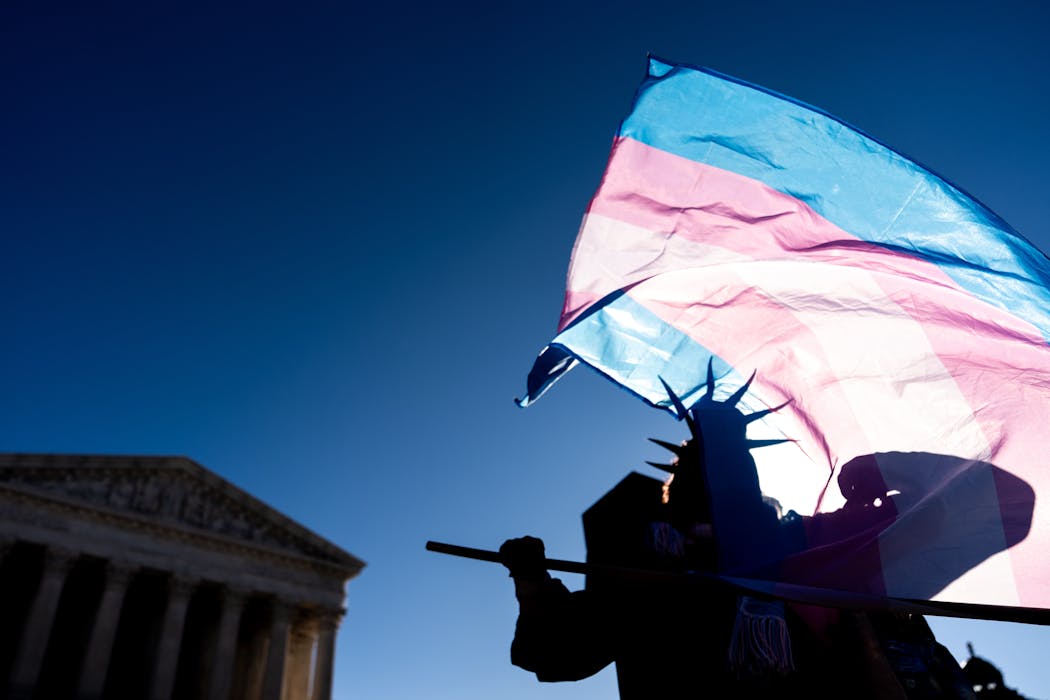 Anti-trans bills effectively restrict transgender people's ability to participate fully in society.AP Photo/Julia Demaree Nikhinson
The number of bills directly targeting and undermining the existing legal rights of transgender and nonbinary people in the U.S. has been escalating, with sharp increases since 2021 and with each consecutive year. Kansas dealt the most radical blow yet on Feb. 26, 2026, as a law that immediately invalidates state-issued driver’s licenses, identification cards and birth certificates for holders whose gender marker does not match their sex assigned at birth took effect overnight.
This new law, called the House Substitute for Senate Bill 244, passed after legislators overrode the governor’s veto to rush it through legislation.
There is no grace period for this law, meaning trans and nonbinary people will have immediately invalid documents putting them at risk of a US$1,000 fine and up to six months in jail for driving with an invalid license. The law also restricts bathroom use to assigned sex at birth, and it allows citizens to sue transgender people for up to $1,000 for not complying.
While 21 states have passed similar bathroom restrictions, Kansas is the first to invalidate state-issued identification documents that were legally obtained.
We areresearcherswho study how marginalization and resilience affect the lives of trans and nonbinary people. Our work has documented how lack of access to accurate and affirming identification documents affects the health and well-being of this community.
By mandating the use of birth-assigned sex on identity documents, Kansas denies transgender people legal recognition and curtails their freedom of movement. These laws open the door to an even wider range of discriminatory policies.
 In addition to invalidating the IDs of transgender people, the Kansas law included what some have called a bounty hunter approach to bathroom restrictions.AP Photo/John Hanna
ID is essential to participate in society
Invalidating someone’s identification documents has immediate and powerful consequences that cascade into all aspects of their life.
For example, without a valid driver’s license, many trans and nonbinary people will be unable to get to work, attend classes, pick up their children, visit the doctor, see friends or go to the grocery store. Trans and nonbinary people who need to drive with an invalid license risk fines and jail time, where they would be housed according to their sex assigned at birth.
Taking a train or bus is not a solution that would work for many people. Almost half of the U.S. population does not have access to public transportation, and for those who do, it is often poorly maintained, sparse or unreliable. The two transgender men who sued the state of Kansas to block the law noted how loss of their ability to drive makes them unable to work.
The effects of invalidating someone’s legal documents goes far beyond just transportation. Legal IDs are required to access health care, obtain housing, have a job, vote, attend college, access financial assistance or even purchase cold medicine at a pharmacy.
Health effects of incorrect ID
Not having identification documents with the correct gender marker also poses a safety and health risk.
Trans and nonbinary people who have not updated their identification documents are more likely to experience psychological distressand suicidality, in part due to increased day-to-day stress. For trans and nonbinary people whose physical appearance no longer aligns with their ID, not having updated documents puts them at increased risk for harassment and violence.
Roughly a quarter of trans and nonbinary people who have not updated their identification documents experience subsequent mistreatment when showing their IDs, including verbal harassment, assault and denial of services or access to settings. In our research, we similarly found that not having one’s gender legally affirmed is associated with greater discrimination and social rejection – one pathway to negative effects on mental and physical health.
To comply with the current law sets up an impossible situation for many trans and nonbinary people who have been using the restroom aligning with their gender identity and presentation for years. These individuals are set up to face violence, legal action or criminal penalties even when they are complying with the law, as using the restroom aligned with their sex assigned at birth will appear to others as contradicting their gender presentation.
Researchers and public health officials consider accurate and affirming identification documents an essential determinant of health. The World Health Organization, United Nations and the World Professional Association for Transgender Health have called for trans and nonbinary people to have the right to legal recognition of their gender.
 Hundreds of anti-trans bills have circulated in the courts since 2021.AP Photo/John Hanna
Another blow in a broader battle
The Kansas law is a flash point in the ongoing battle across the country for legal recognition of trans and nonbinary people’s existence.
The process for gender marker changes varies widely across states. Some require documentation of medical procedures to affirm one’s gender, while some do not allow gender marker changes at all. Some allow for gender-neutral gender markers, like the letter X.
According to the 2022 U.S. Trans Survey, which had over 92,000 participants, 59% of trans and nonbinary people have not updated their gender on any of their documents, and 23% have some of their documents updated but not others. This law and others like it will disadvantage even more trans and nonbinary people.
To us, this is about more than access to driving a car – it is a direct attack on the ability of trans and nonbinary people to live and survive. As of February 2026, 711 bills are under consideration across 41 states, with 110 at the national level. The restrictions these bills propose are far-reaching – prohibiting access to gender-affirming medical care, prohibiting students from using their chosen names and pronouns, banning trans and nonbinary youth from participating in sports, restricting access to bathroom facilities and censoring public education on issues related to gender.
In the face of these legislative efforts to control and erase trans and nonbinary people from public life, trans and nonbinary people, along with their allies, continue to stand up for each other and fight for their rights.
Jae A. Puckett co-leads the Gender Affirmation Project.
Noelle Martin is affiliated with the Gender Affirmation Project.
L. Zachary DuBois does not work for, consult, own shares in or receive funding from any company or organization that would benefit from this article, and has disclosed no relevant affiliations beyond their academic appointment.
Authors: Jae A. Puckett, Associate Professor of Psychology, Michigan State University