

Social media can draw attention to atrocities – a key factor in reducing risk of recurrence
- Written by: Arnaud Kurze, Associate Professor of Justice Studies, Montclair State University
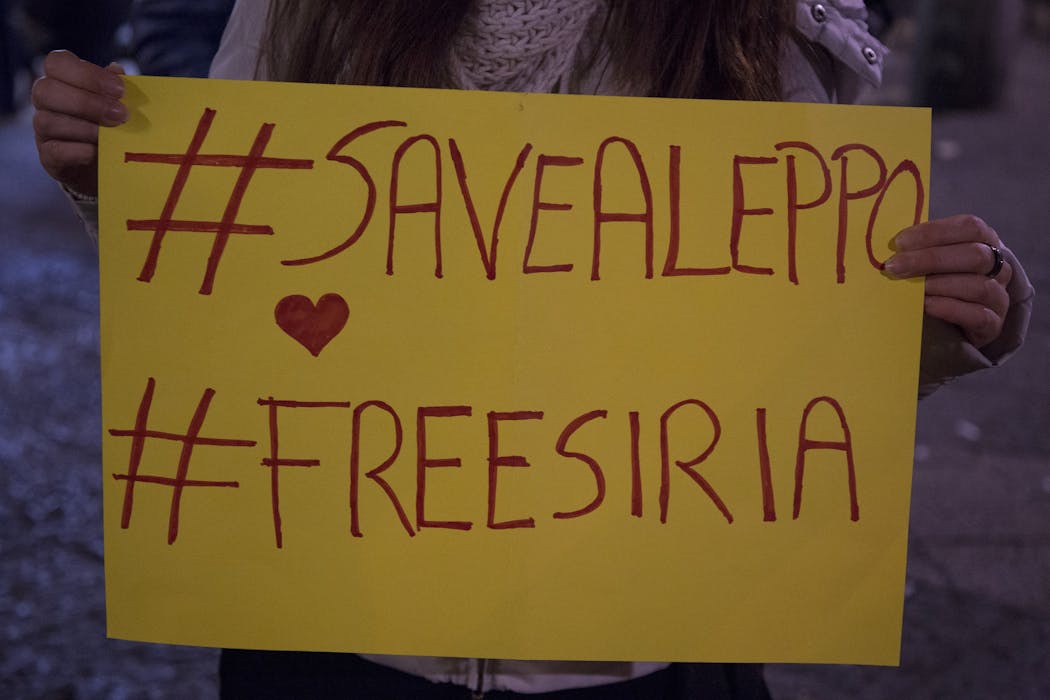 A demonstrator holds a placard reading 'Save Aleppo, Free Syria' at a protest in Italy on Dec. 18, 2016.Anadolu Agency/Getty Images
Social media is often blamedfor stoking violence. But it can play a positive role by drawing attention to atrocities – both past and present – which research suggests can make them less likely to occur.
That’s what we found when we compared the role of social media in two very different contexts: the Syrian civil war and campaigns addressing historical injustices against Indigenous peoples in Canada.
Our research examined how social media functions not simply as a space for outrage but also as a tool for truth-telling, collective memory and potentially atrocity prevention.
At first glance, Syria and Canada could not be more different. Syria endured more than a decade of mass violence, displacement and repression during a devastating civil war. Even with the ousting of the brutal Assad regime, the country is still far from stable.
Canada, by contrast, is a stable democracy. However, it is grappling with the intergenerational consequences of settler colonialism, including the legacy of residential schools and the crisis of missing and murdered Indigenous women and girls.
What these cases share is highly visible, sustained social media activism that aims to address past and ongoing atrocities.
We analyzed a dataset of 4,997 social media posts collected from curated hashtag campaigns in Canada and Syria between 2012 and 2024. The aim was to assess how digital activism supports truth-telling, collective memory and atrocity prevention mechanisms.
We found that in Syria, hashtags such as #SaveSyria emerged during the civil war as tools to document atrocities, mobilize humanitarian aid and appeal to international audiences.
In Canada, campaigns like #TruthAndReconciliation, #EveryChildMatters and #MMIWG focus on confronting historical injustice and amplifying Indigenous voices calling for systemic reform.
But on their own, such campaigns fail to sustain public attention. Our findings indicate that hashtag engagement increases markedly during moments of crisis and reckoning before tailing off.
In Syria, periods of active atrocities and humanitarian emergencies are associated with sharp spikes in hashtag use, whereas in Canada, engagement rises substantially during nationally salient moments of truth-telling and reconciliation, such as the annual National Day for Truth and Reconciliation (federally recognized since 2021), which recurrently mobilizes engagement around #TruthAndReconciliation.
While the magnitude of these surges varies by context, the temporal clustering of activity in both cases demonstrates that social media visibility is driven by discrete political and moral shocks rather than sustained baseline engagement.
Why it matters
These findings challenge two common, yet contradictory, assumptions: that social media is inherently dangerous and that it is inherently transformative.
Online hate speech and misinformation have been implicated in fueling atrocities in places like Myanmar, Ethiopia and Sri Lanka.
Yet in Syria, we found that social media frequently foregrounded humanitarian terms, such as “rescue,” “children,” “aid” and “survive,” indicating a “midstream” prevention tool – that is, it seeks to limit harm while atrocities are unfolding.
In Canada, social media activism was found to be oriented toward “downstream” prevention, meaning interventions after mass violence ends that seek to prevent future atrocities.
Digital campaigns help keep historical injustices visible long after official reports are released – a key element in long-term prevention strategies emphasized by the United Nations.
While many dismiss digital activism as “slacktivism,” we found that across both cases, use of social media is more nuanced.
Digital platforms amplify voices, but they also fragment narratives. Algorithms reward emotional intensity rather than sustained deliberation. The concentration of engagement around emotionally salient events, followed by rapid decline, is consistent with platforms privileging high-intensity content while limiting the durability of evidence and deliberation, especially in contexts marked by repression and uneven digital access.
Social media can amplify voices, but it alone cannot sustain international engagement or substitute for coordinated political action. For policymakers and practitioners, the implication is not to abandon social media, but to integrate it.
What still isn’t known
Despite growing attention to digital activism, important questions remain unanswered.
We still know relatively little about when online visibility translates into real prevention outcomes. Not every spike in attention produces policy change, and not every digital archive leads to accountability.
The durability of digital evidence is uncertain, particularly as platforms change moderation policies, restrict access or disappear altogether.
It is also unclear how algorithmic governance shapes collective memory over time. Which stories persist, which fade and which are actively suppressed are decisions increasingly made by private companies rather than public institutions. These dynamics raise questions about power, accountability and the long-term preservation of historical records.
Finally, more research is needed on intergenerational engagement. Younger generations often encounter histories of violence first through digital platforms. How this shapes political attitudes, empathy and prevention outcomes remains underexplored.
What’s next
Our next steps build on these gaps. Our future research will expand the comparative lens beyond Canada and Syria, examine the role of platform governance and artificial intelligence in shaping atrocity narratives, and explore more systematically how online mobilization connects – or fails to connect – to offline prevention and justice efforts.
The Research Brief is a short take on interesting academic work.
Eric Wiebelhaus-Brahm received funding from the University of Arkansas at Little Rock's Middle Eastern Studies Program that supported this research.
Arnaud Kurze does not work for, consult, own shares in or receive funding from any company or organization that would benefit from this article, and has disclosed no relevant affiliations beyond their academic appointment.
Authors: Arnaud Kurze, Associate Professor of Justice Studies, Montclair State University
