

The first modern rocket launched 100 years ago, beginning a century of both innovations and challenges for spaceflight
- Written by Michael Carrafiello, Professor of History, Miami University
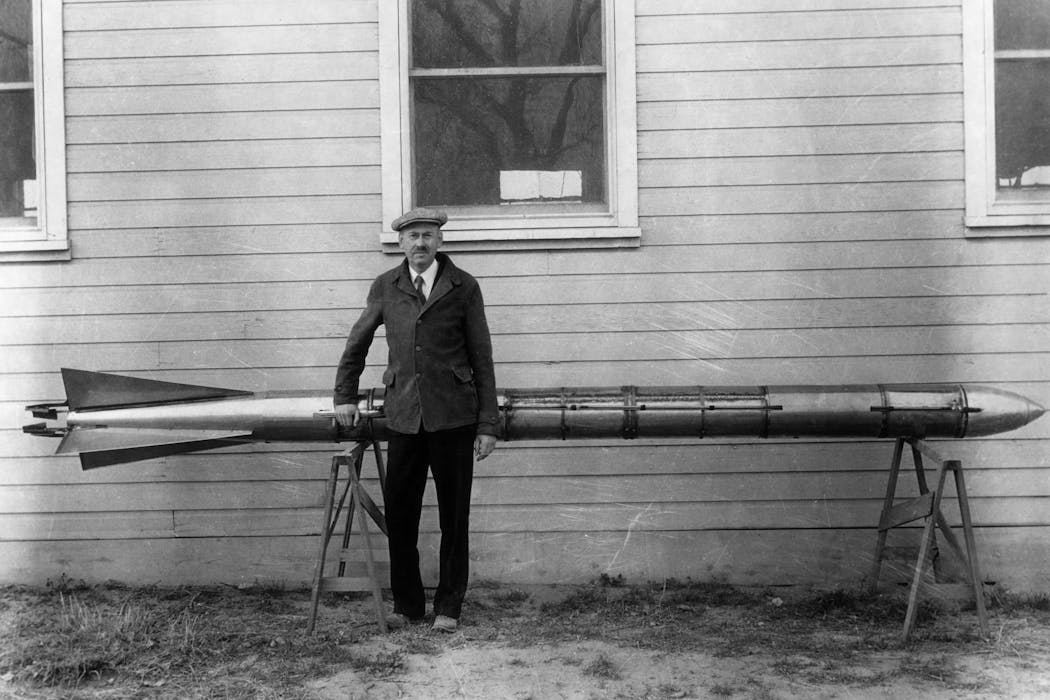 Robert Goddard, considered the father of modern rocketry, standing with a rocket in 1935. Esther Goddard/Hulton Archive/Getty Images
Apollo 11 first landed astronauts on the Moon in 1969, but the journey to the lunar surface actually began 43 years before, in snowy Massachusetts.
Exactly 100 years ago, on March 16, 1926, Robert H. Goddard launched the first liquid-fueled rocket. Liquid-fueled rockets would eventually provide the power to send humans to the Moon. Still, Goddard’s vehicle was small, flew for only 42 seconds, reached a height of a mere 184 feet and sustained damage that created more doubters than believers in the prospects for human space flight.
Despite this less-than-spectacular start to the space age, Goddard’s rocket was the beginning of a century of innovation. Today, hundreds of rockets launch each year. Giant liquid-fueled rockets combine liquid oxidizer – a substance that releases oxygen – and liquid fuel. These create chemical reactions that produce the explosive thrust necessary to propel humans to the Moon.
As a historian, I’ve spent 40 years studying the winding path that led to the development of modern rocketry. I’ve also seen how, over the past few years, private companies have played a much larger role in spaceflight than they did throughout most of its history.
Early days of spaceflight
After Goddard’s first liquid-fueled rocket launch, the development of American rocketry crept along at a snail’s pace until World War II. Nazi Germany’s invention of the V-2 missile proved that rockets could provide immense strategic and scientific value during both war and peace.
In war, the V-2 terrorized Britain and its allies. In peace, scientists looked at launching artificial satellites, or “moons” as they were originally called, to survey weather and boost intercontinental communication.
The United States government did not invest heavily in rocketry throughout most of the 1950s. Then, on Oct. 4, 1957, the Soviet Union shocked the world by launching the world’s first artificial satellite, Sputnik I. Millions of Americans feared that the USSR would soon rain nuclear missiles on them.
President Dwight D. Eisenhower and his advisers, however, displayed little anxiety at this prospect. They believed that America’s problems down on Earth were more urgent than those that might emanate from space.
Political pressure from the Senate majority leader, Lyndon B. Johnson, caused Eisenhower to reconsider. Late in 1958, the Republican president gave his consent for Congress’ establishment of the National Aeronautics and Space Administration. This new agency then went about selecting America’s first seven astronauts, introducing them to the nation in 1959.
Americans to the Moon
The arrival of a new, young chief executive, John F. Kennedy, sharpened the United States’ commitment to space. In September 1962, the president publicly challenged the nation to land an astronaut on the Moon before 1970. To Kennedy, the enormity of such a scientific and public achievement would provide unimpeachable proof to the world that the American way was superior to life behind the Iron Curtain.
JFK’s untimely death in the autumn of 1963 only served to strengthen the nation’s commitment to the late president’s lofty goal.
A mere five-and-a-half years later, astronauts Neil Armstrong and Buzz Aldrin walked on the lunar surface during the Apollo 11 mission. To get them there, NASA had spent nearly US$26 billion – $338 billion today. They had employed hundreds of scientists and engineers, and hired thousands of workers from dozens of contractors.
Yet, at almost the very moment the supreme triumph of Apollo 11 unfolded, public support for the manned space program evaporated. Preoccupation with the Vietnam War, economic inflation and nagging social and political inequality, as well as boredom with moonshots, led most Americans to turn away from the cosmos.
Richard Nixon, who followed Johnson into the Oval Office, slashed NASA’s budget. Three of the remaining lunar missions were abruptly and unceremoniously canceled. NASA had to abandon spectacular yet wasteful rockets like the Saturn V in favor of cheaper and more versatile launch vehicles.
Enter the Space Shuttle
Unlike earlier rockets, the next generation of rockets had to become almost completely reusable. The result: development of the Space Shuttle. NASA promised that the shuttle would launch no later than 1977 and that, when fully operational, it would rocket into orbit every two weeks.
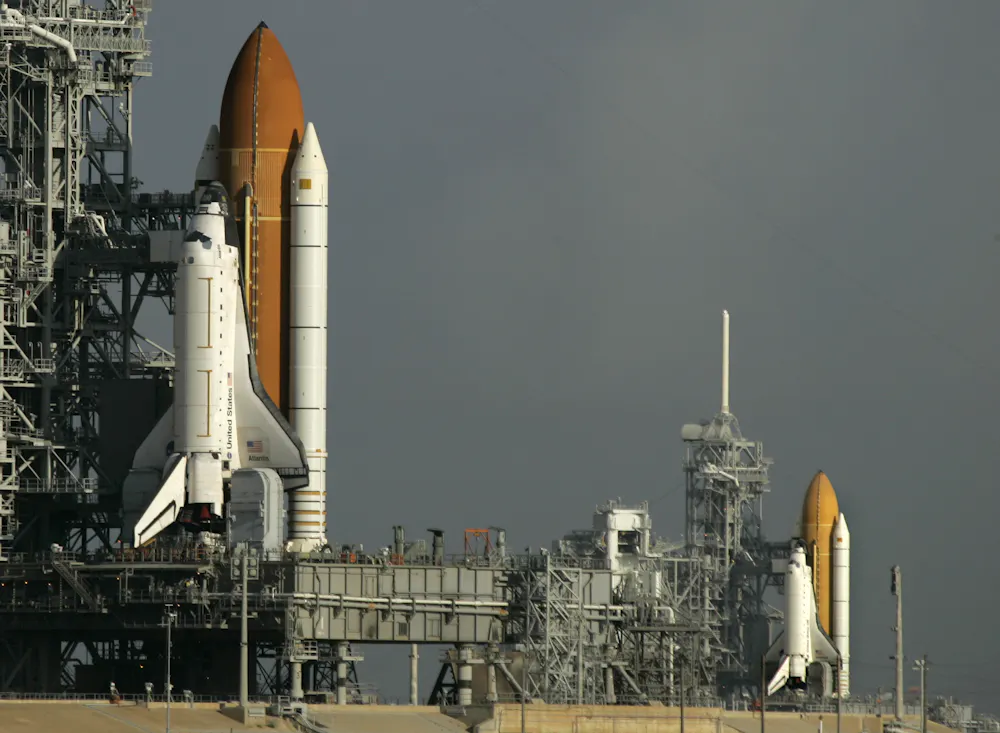 The space shuttle Atlantis on pad 39A, left, and space shuttle Endeavour on pad 39B, right, stand ready at Kennedy Space Center in Cape Canaveral, Fla., in 2008.AP Photo/John Raoux
That vision never materialized. By the time the first shuttle finally took off in 1981, it was grossly over budget. Problems with the heat tilesnecessary for reentry persisted. Ultimately, the shuttles never came close to launching biweekly. Instead, only six to eight missions per year proved feasible. Worst of all, the program would eventually sustain two heartbreaking tragedies.
In 1986, the space shuttle Challenger exploded 73 seconds after takeoff. In 2003, Columbia – the first shuttle to ever reach space – disintegrated as it reentered the atmosphere over Texas. The following year, President George W. Bush announced that the remaining shuttle fleet would retire no later than 2011.
NASA’s air of invincibility and inexhaustible stream of funding had long vanished. The final shuttle flight served as a coda to the heady days of the 1960s and ‘70s.
Subsequent presidents talked of missions to Mars and created a Space Force, but the old Apollo launchpads at Cape Canaveral were abandoned, or “mothballed,” as NASA termed it. Thousands of workers were laid off. Leadership in space passed to private corporations like Elon Musk’s SpaceX and Jeff Bezos’ Blue Origin.
Enter private companies
As early as 2006, NASA began contracting with SpaceX to launch its payloads and astronauts to the International Space Station. By 2024, SpaceX had realized the unfulfilled vision of NASA, launching on a nearly biweekly basis.
Meanwhile, while NASA’s Artemis program plans to send a crewed mission around the Moon using a launch system developed by the agency, the program remains years behind schedule. To date, it has cost at least three times more than originally budgeted.
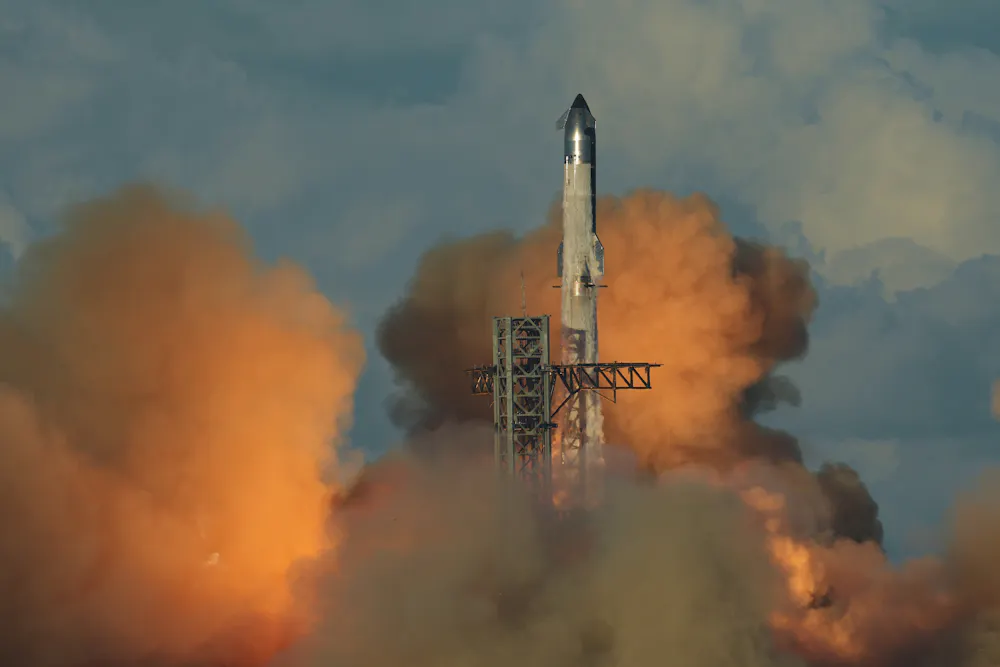 SpaceX’s Starship rocket launching in October 2025.AP Photo/Eric Gay
Across the Pacific, China has announced that it will place astronauts on the Moon by 2030, with missions to Mars planned after that. For America’s rival on the world stage, government, industry and science all move in concert. Compared with China, the United States’ future in space appears far less unified, coordinated and purposeful.
A dynamic president once galvanized the U.S. government and its people to produce a “giant leap for mankind.” But since that July day in 1969, leadership in space has steadily passed from government to private hands, with the future of American space flight appearing murky.
Michael Carrafiello does not work for, consult, own shares in or receive funding from any company or organization that would benefit from this article, and has disclosed no relevant affiliations beyond their academic appointment.
Authors: Michael Carrafiello, Professor of History, Miami University