

What an ancient devotional text means for the women of Nepal
- Written by Jessica Vantine Birkenholtz, Associate Professor of Women's, Gender, and Sexuality Studies and Asian Studies, Penn State
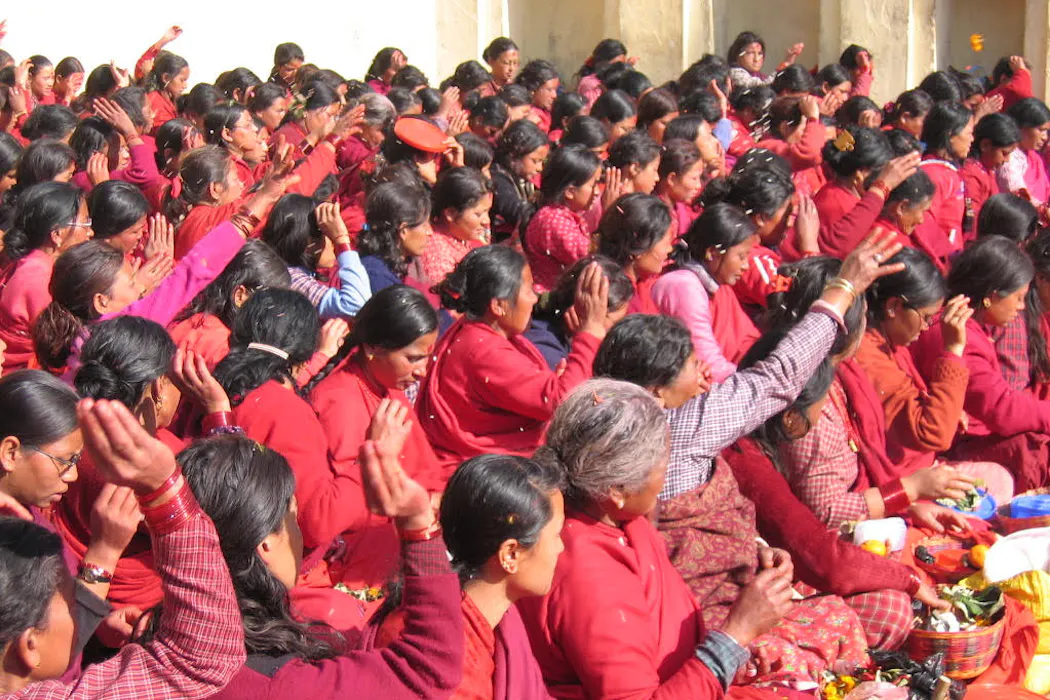 Nepalese women participate in the 'Swasthani Vrata Katha' ritual.Jessica Vantine Birkenholtz, CC BY-SA
I first heard the popular “Swasthani Vrata Katha” – a devotional text – recited in Sankhu, a village on the outskirts of Nepal’s Kathmandu Valley, some 25 years ago.
The text tells the story, or “katha,” of the ritual vow, or “vrata,” that women devotees perform to earn the favor of Swasthani, a local Nepali Hindu goddess.
Every day during the cold lunar month of January-February, 100 to 200 Hindu women, dressed all in red, carry out a ritual that requires them to bathe in the local river, eat only one meal per day, remain singularly focused and worship the Hindu god Shiva at midday. In the evening, they recite the devotional text or listen to it being recited.
 Women taking a ritual bath.Jessica Vantine Birkenholtz, CC BY-SA
This practice dates to the 16th century and continues today. Nepali families gather daily at their home or at a relative’s home to recite one of the 31 chapters of the text. The recitation is done even if no one in the family is participating in the ritual vow. Most devotees observe only a two-day ritual vow at the end of the month’s recitation, but some women perform the ritual vow for the whole month.
At the end of the month, devotees prepare a series of offerings to Swasthani for the concluding ritual. These include ritually specific cooked foods, fruit and flowers. After the ritual offerings are blessed by Swasthani, devotees give a portion to their husband. If there is no husband, then to their son. If there is no son, then to the son of a friend.
I have joined many families in their homes during my archival and ethnographic work over the past two decades. Like many Nepalis, I listened patiently to the Swasthani’s stories while waiting eagerly for the sweet treats that were given at the end of the nightly recitation.
As a scholar of gender and Hinduism in Nepal, I am aware of two readings of the text in Nepal: Some see it reinforcing patriarchal expectations, while many women find strength through the enduring hardships and perseverance of its female characters.
Stories in the text
The Swasthani text has a prominent place in Nepali culture. It is the only locally written work of Hindu literature that is actively read by lay Nepali Hindus. It is their primary source for key Hindu myths.
The first two-thirds of the text explain the creation of the universe and recount the most widely known myths associated with the supreme god Shiva. These are stories familiar to most Hindus.
For Nepalis, it is the last third of the text that is especially meaningful. Here, the focus shifts to the local and relatable stories of three mortals – Goma, Navaraj and Chandravati – and their devotion to the local Nepali Hindu goddess Swasthani.
Goma is married as a 7-year-old to a decrepit 70-year-old man. She dutifully endures marriage, motherhood and, too soon thereafter, widowhood. Her son, Navaraj, is obedient and dutiful. In contrast, his wife, Chandravati, is selfish as a daughter-in-law and disrespects Swasthani, leading to enormous misery for her.
Ultimately, all three experience social and economic transformation through devotion to Swasthani, which culminates in the crowning of Navaraj as a king and Chandravati and Goma becoming queen and queen mother, respectively.
Faithful wives – human and divine
Through its female characters, mortal and divine alike, the text highlights a woman’s principal role and identity as a faithful wife.
In addition to the pious, persevering Goma and flawed Chandravati in the mortal realm, in the divine realm there are the goddesses Sati and her reincarnation as Parvati. Both are known mainly for being devoted wives of Shiva. There are also wives of other lesser gods, semidivine beings and demons. They share in common unwavering devotion to their husbands but also regular subjection to the whims of their husbands or the gods.
Most notable of these other wives is Vrinda, the chaste wife of the demon Jalandhar. It is Vrinda’s chastity that protects her husband and prevents him from being killed by the gods for his brazen effort to seduce Shiva’s wife, Parvati.
To make Jalandhar vulnerable, the god Vishnu assumes Jalandhar’s form and debauches Vrinda. Her husband is immediately killed, and Vrinda is widowed through no fault of her own. She consequently commits sati, or self-immolation, on her husband’s funeral pyre – but curses Vishnu before doing so.
Patriarchy in Nepal
I have observed that in Nepal’s patriarchal culture, many women find strength in Goma’s plight and endurance. But that many Nepali feminists and youths question the treatment of women throughout the text.
Most Nepali women cannot inherit property and do not have equal citizenship rights. Child marriage remains a pervasive practice across Nepal and often results in girls dropping out of school to take on household responsibilities. According to the United Nations, one in three girls are married off before turning 18. Despite updates in Nepal’s 2015 constitution designed to remove gender discrimination, there remains a significant gap between the law and everyday lived experiences.
Marriage in Nepal is widely seen as “a woman’s destiny” and often gives the husband and his family “full authority to rule over a woman,” explains Luna KC, a scholar of global and international studies and gender studies. It is customary practice in Nepal and across South Asia for married couples to reside with the husband’s parents. As anthropologist Lynn Bennett and other researchers have demonstrated, this can be traumatic for the bride, who must leave her family and support system.
These dynamics play out in the Swasthani text and in current debates about its role in contemporary Nepali society.
Critics argue that the stories instill and normalize antiquated ideas and practices that reinforce gender inequality and impede women’s full participation in society and access to equal rights. “Our child marriage is based on this type of story,” according to a gender and human rights advocate I interviewed.
Rameshwori Pant, an independent researcher and journalist, echoes this when she describes how Goma’s story “haunted” her as a child because Pant’s own mother had also been married at age 7.
Finding hope in the text
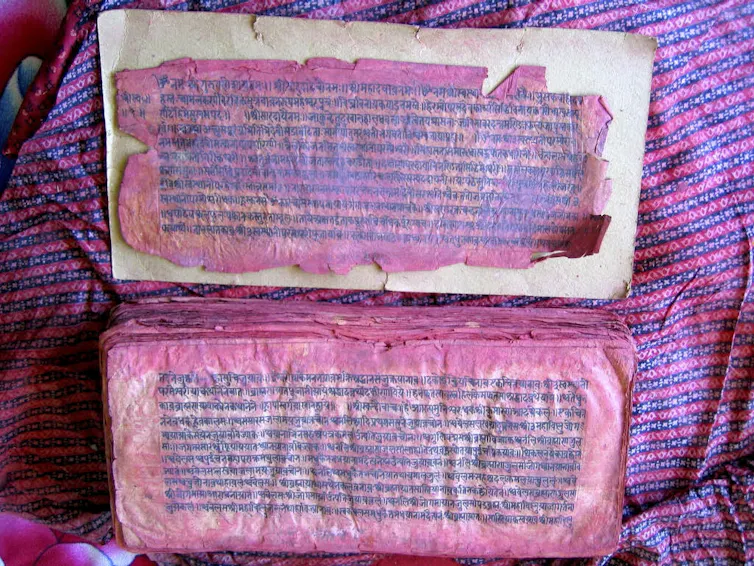 A handwritten Swasthani Vrata Katha manuscript that dates to 1922 and is discolored from being worshipped with red vermillion by devotees.Jessica Vantine Birkenholtz, CC BY-SA
Families often have centuries-old handwritten Swasthani manuscripts that are now family heirlooms. Increasingly, many also have a newly store-bought version. With their distinctive red wraparound cover, stacks of the printed Swasthani text stand out at local bookshops leading up to the annual recitation.
For many Nepali women, the Swasthani stories they learned as young girls linger and endure into their adulthood in complicated ways. As an adult, Pant was moved to write about the sociological, economic and gender aspects of the Swasthani practice. She asks, “Why is there violence against women and gender discrimination in a story written to celebrate women?”
Through my formal interviews and informal conversations over the years with Nepali women and devotees, it is also clear that many women find fortitude in the text’s description of familiar trials the women and goddesses face.
From this perspective, the Swasthani stories teach women that through perseverance, their hardships turn into triumphs and women’s suffering turns into strength. Goma is regularly invoked in popular discourse for her determination as a dutiful child bride, wife and mother who persists in the face of repeated adversity and ongoing lack of resources. These are the daily realities for many Nepali women living in a patriarchal society.
So while the text may not advocate for women’s social, economic or legal autonomy, it still offers encouragement: For some women, it provides a road map for working through life’s difficulties. This, too, can be empowering.
As a Nepali female lawyer explained to me: “The stories of the Swasthani have different life lessons to follow and apply. Just as the Buddha suffered and in the end found enlightenment, so, too, the Swasthani characters suffered but in the end found happiness.”
Staying power in modern times
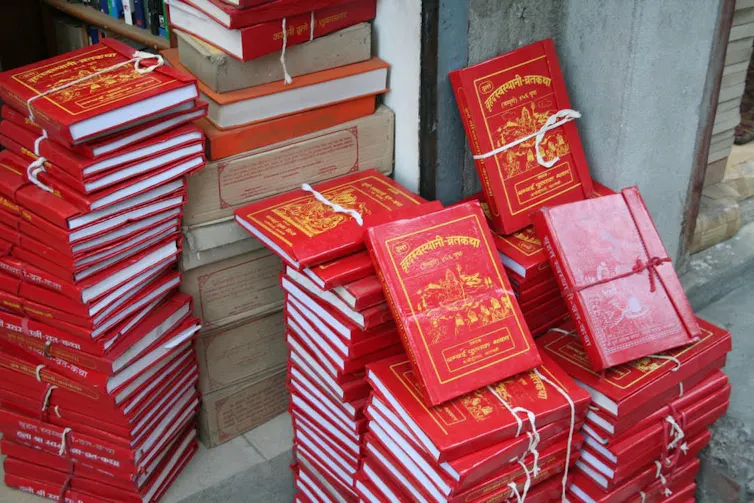 Swasthani books for sale.Jessica Vantine Birkenholtz, CC BY-SA
I see and value both sides of the debates. They reflect the varied experiences, perspectives and concerns among Nepal’s diverse population. They also reflect the challenges of translating ancient and medieval beliefs and practices in the modern period.
What is striking is the text’s staying power. Its stories are centuries old – yet they are recited by many Nepalis every winter, even as the daily recitation now competes with many modern distractions, such as smartphones and social media.
The text remains an important piece of local Nepali heritage and culture. It offers a window into Nepal’s past, while also prompting reflections on Nepali values for the future.
Jessica Vantine Birkenholtz does not work for, consult, own shares in or receive funding from any company or organization that would benefit from this article, and has disclosed no relevant affiliations beyond their academic appointment.
Authors: Jessica Vantine Birkenholtz, Associate Professor of Women's, Gender, and Sexuality Studies and Asian Studies, Penn State
Read more https://theconversation.com/what-an-ancient-devotional-text-means-for-the-women-of-nepal-273901