

1914 Ludlow Massacre took lives of 25 miners and family members during bitter strike for fair wages and conditions
- Written by: Robert Forrant, Professor of U.S. History and Labor Studies, UMass Lowell
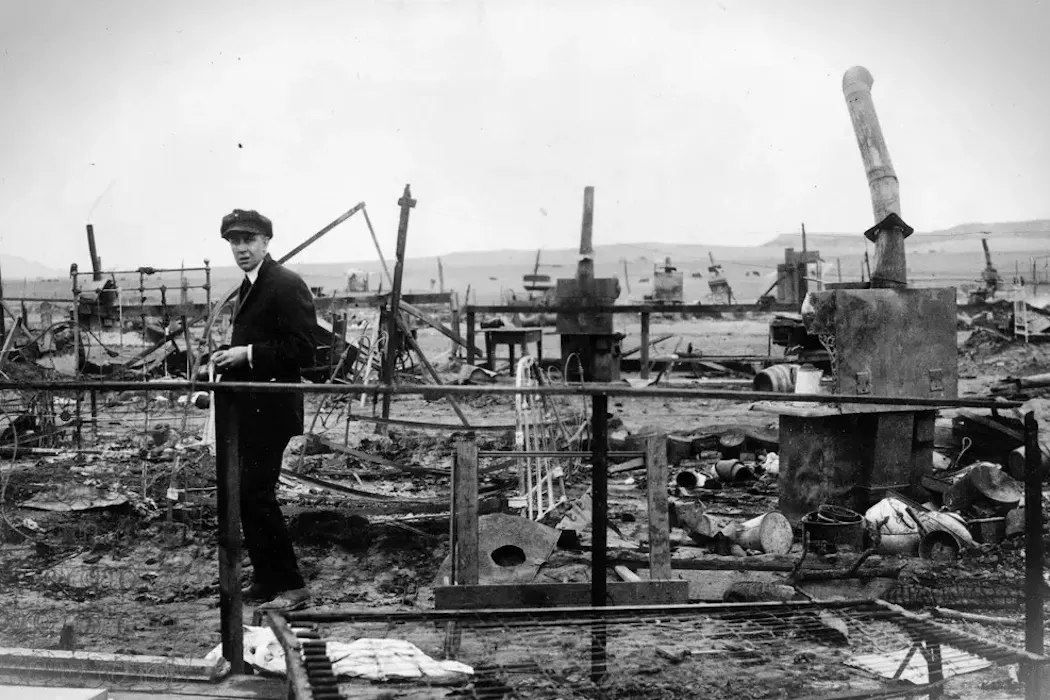 The Ludlow Massacre in 1914 on this site brought congressional attention to miners' labor rights in Colorado.Denver Public Library
On a spring morning in 1914, miners in Ludlow, Colorado, were celebrating Greek Easter when the Colorado National Guard and a private security agency opened fire on their camp with a machine-gun-equipped armored car called the Death Special.
The miners waged a pitched battle with the National Guard for 10 days before President Woodrow Wilson ordered federal soldiers to intervene. An estimated 69 to 199 people were killed. It was the end of one of the most bitter and violent miner strikes in U.S. labor history, which had begun in September 1913. The strike and massacre prompted Congress to take a hard look at labor reform. But significant changes in labor relations and unionization didn’t come until the mid-1930s.
Some state labor laws were on the books, but in 1914 the U.S. House Committee on Mines and Mining reported: “Colorado has good mining laws and such that ought to afford protection to the miners as to safety in the mine if they were enforced, yet in this State the percentage of fatalities is larger than any other, showing there is undoubtedly something wrong in reference to the management of its coal mines.”
Once the initial shock of the violence wore off, the Ludlow strike received little public attention outside of the immediate families affected and some Colorado residents until late in the 20th century. In “Where Are the Workers,” Mary Anne Trasciatti, a professor at Hofstra University, and I edited a collection of essays written by labor historians and archivists that explore nationwide efforts to bring the history of labor and working people into mainstream narratives of U.S. history.
The Ludlow Massacre is one of the most dramatic and deadly of those stories. It rivals the West Virginia Mine Wars of the 1920s.
The Ludlow Massacre
In September 1913, roughly 10,000 mostly immigrant miners who worked for the Colorado Fuel & Iron Co. went on strike. The miners were represented by the United Mine Workers of America, which submitted a list of demands when the strike began, including implementing the eight-hour workday, being compensated for the time miners spent in the shafts, and the right to select their own housing and doctors.
Since national strikes were called in the 1880s demanding the eight-hour day, this had been a goal for workers throughout the U.S. In Colorado, voters had endorsed such an amendment to the state constitution in 1902, but it was not uniformly enforced.
A song by Woody Guthrie about the Ludlow strike and massacre recorded in the 1940s.Coal mining in the early 1900s was labor intensive and dangerous. Death rates were high. Workers had no say in how the mines operated. From 1884 to 1912, more than 1,708 men died in the state’s coal mines, a rate twice the national average. In 1910, explosions at two Colorado Fuel & Iron mines killed 131 people. In 1912, 125 workers lost their lives in mine accidents across Colorado. That year, the annual death rate in Colorado’s mines was 7.06 per 1,000 employees, compared to a national rate of 3.15. Every trip down a shaft was fraught, with workers paid only for the weight of the coal they mined, not for their travel time.
John D. Rockefeller, the nation’s wealthiest man at the time of the strike, was the main owner of the fuel and iron company. With about 10,000 workers and nearly 70,000 acres of land under control, Colorado Fuel and Iron was one of the most powerful mining companies of that era.
Coal companies often owned entire towns, including miners’ homes, which was the case in Ludlow. Worker protests often led to widespread evictions. As a result of the Ludlow strike, 1,200 coal miners and their families were evicted and took refuge in tent colonies around the mines during the winter of 1913-14.
Colorado Fuel & Iron hired and armed 300 members of a private security agency known as Baldwin-Felts when the strike began. The agency was founded in the early 1890s by William Gibbony Baldwin and employed by mining companies in West Virginia and Colorado to repress strikes. Their job was to keep order and – if possible – break the walkout and reopen the mines.
Members of the United Mine Workers of America armed themselves as conflicts with the mining company’s private security force intensified.
Eventually, the Colorado governor, Elias M. Ammons, ordered the Colorado National Guard to join the fray on the corporation’s side, with the Rockefellers paying their wages. The Guard arrested hundreds of strikers.
Then, on April 20, 1914, the National Guard and the private company opened fire on the tent colonies where the miners lived. After several hours of gunfire, with miners defending their camp, 25 people were dead, including two women and eleven children trapped when the camp was intentionally set ablaze.
 A photograph of the United Mine Workers of America camp for coal miners in Las Animas County, Colo.Denver Public Library, Special Collections
Months earlier, miners had dug foxholes under tents so women and children could avoid bullets randomly fired through the camps. When the armored vehicle opened fire, everyone in the camps ducked into the holes. Later, women and children were found by miners huddled together at the bottoms of their burned-out tents.
Many miners’ family members were saved when the engineer on a passing train witnessed what was happening and stopped on the track to shield them from the gunfire.
This violence led to 10 more days of conflict before President Wilson finally ordered federal troops to disarm both sides.
Changes to labor law
In Congress, the House Committee on Mines and Mining conducted an investigation into the events and released a report in 1915. John D. Rockefeller Jr. was summoned before the committee, where he was questioned for several hours on May 20, 1914. There, he admitted that he had not visited the site since the incidents that led to the deaths of workers and their families.
According to a New York Times report, when asked whether he knew that thousands of his employees had been evicted from their homes and were living in tent colonies, and that the striking workers and their families were suffering without work or food, Rockefeller replied that he could not say, but that company officials could provide the facts. None were forthcoming.
A federal Commission on Industrial Relations also held hearings, determined to quell the upsurge in early 20th-century labor violence.
In 1912, the immigrant- and women-led Bread and Roses strike in Lawrence, Massachusetts, also led to a congressional investigation. In its report on the 1914 miners’ strike, the commission described the strike by workers as “against arbitrary power.” It summarized that miners “passionately felt” that they were denied “a voice in fixing working conditions in the mines” and that political democracy had been “repudiated by the owners.”
The commission determined that the strike raised a fundamental question about whether workers had a right to a voice at work. This question would animate labor struggles into the 1930s.
In 1935, Congress passed and President Franklin Roosevelt signed into law the National Labor Relations Act, which provided federal guidelines for labor union formation and stated that workers had a federal right to bargain over wages, hours and conditions of employment, the very things Colorado coal miners sought when they went on strike in 1913.
Commemorating the Ludlow strike and massacre
In 1915, officers of the United Mine Workers of America purchased 40 acres of land north of the Ludlow, Colorado, train depot, on the site where the tent colony had sheltered coal miners and their families during the 1913-14 strike.
Three years later, United Mine Workers officials dedicated a granite monument at the site where the women and children were killed. Labor historian James Green noted that of all the violence against workers at the time, none shocked the nation or troubled its collective conscience more than the Ludlow massacre because of the deaths of children. However, even incidents like the Ludlow Massacre did not become a significant part of the public discourse. This has changed some in the recent past.
Today, the tent colony site is a National Historic Landmark.
The labor movement in the United States remains a bulwark of democracy, and workers have often been a driving force for social and economic equality in their communities. Yet its stories are not widely known, even one so dramatic as this battle in the Colorado coalfields.
The recognition of the Ludlow site as a National Historic Landmark and the recent release of a Library of Congress research guide propel the history of labor and working people into the mainstream. Such place-based labor history promotes our understanding of how and why things we sometimes take for granted – such as the eight-hour workday, paid holidays or workplace safety laws – came about only because people were willing to risk their lives fighting for these rights.
Read more of our stories about Colorado.
Robert Forrant does not work for, consult, own shares in or receive funding from any company or organization that would benefit from this article, and has disclosed no relevant affiliations beyond their academic appointment.
Authors: Robert Forrant, Professor of U.S. History and Labor Studies, UMass Lowell
