

Many churches, synagogues and mosques are built around families – and they’re struggling to respond to rising singles
- Written by: Peter McGraw, Professor of Marketing and Psychology, University of Colorado Boulder
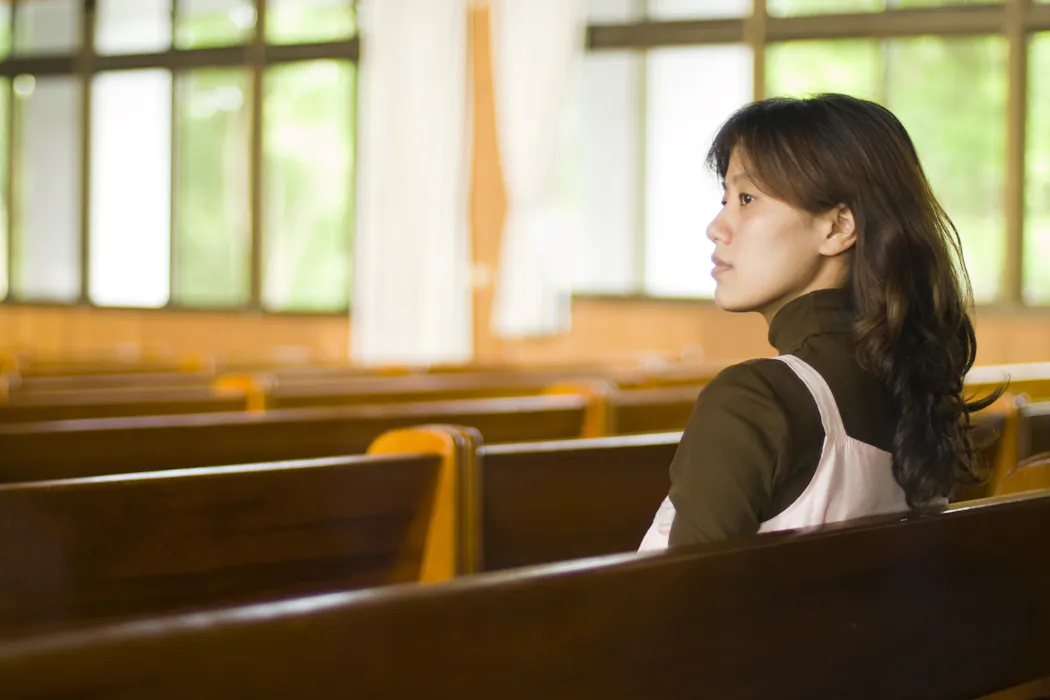 Single women, in particular, often feel overlooked in church.Lawren/Moment via Getty Images
When a couple marry in a church, synagogue or mosque, the ceremony does more than sanctify a union. Often, it binds two families to an institution.
For centuries, marriage and child-rearing have been among the main ways adults are integrated into congregational life. Couples who share the same faith tend to be more observant, and they often raise children within that tradition – bringing the next generation into congregational life. More marriages mean more families in pews and more children raised in the faith.
That helps explain why the rise of single adults is so unsettling for many faith communities today. In the United States, 42% of adults were not married or living with a partner in 2023, up from 38% in 2000. This shift is unlikely to change soon: A quarter of 40-year-olds have never been married, and a third of Gen Z are projected to never marry.
At the same time, the share of unmarried Americans who belong to a religious congregation has fallen well below that of married Americans. According to the Pew Research Center’s 2023–24 Religious Landscape Study, 68% of married adults identify as Christian, compared with about 51% of never-married adults. Twenty-four percent of married Americans are religiously unaffiliated, compared with 39% of Americans who never married.
As a behavioral economist and a business school professor, I study what I call the “solo economy”: how the rise of single adults is reshaping workplaces, taxes and consumer markets. Religious institutions are the latest domain to face the same shift. They are not simply confronting lower marriage rates. Many of them, I contend, are reckoning with the consequences of treating unmarried adults as incomplete members of the community.
Alarm across faiths
According to the Survey Center on American Life, the gap in religious membership between married and unmarried Americans has widened substantially since the 1990s.
At the time, 71% of married Americans said they belonged to a religious congregation, compared with 64% of unmarried Americans. In 2019, those numbers were 59% and 45%, respectively. Barna Group, an evangelical Christian polling firm, found that just 1 in 4 single mothers attend church weekly – the lowest rate of any parent group.
Communities that have historically built their infrastructure around married families are feeling the shift most acutely: couples retreats, small groups organized by life stage, children’s programs, and leadership roles that quietly assume a spouse. The cumulative effect is less about overt exclusion than about whom the institution imagines when it pictures itself.
 People chat during a meeting after a Mass for singles in the Jesuit church in Warsaw, Poland, on Sept. 24, 2013.Wojtek Radwanski/AFP via Getty Image
In an April 2021 address during a churchwide conference, M. Russell Ballard, then one of the top leaders in the Church of Jesus Christ of Latter-day Saints, acknowledged that more than half of adult church members were widowed, divorced or not yet married – and that some “wonder about their opportunities and place in God’s plan and in the Church.” In July 2024, the church expanded its “young single adult” category from ages 18–30 to 18–35.
In evangelical Christianity, sociologist Katie Gaddini’s research for her book “The Struggle to Stay” found that women – especially those over age 35 – often felt overlooked, excluded from leadership and valued less because they had not married.
At a women’s conference in London, one attendee captured the tension: “I’m so tired of fighting Christian church leaders to be treated equally, but I don’t want to leave the church. So, what do I do?”
In Modern Orthodox Judaism, similar patterns of exclusion have emerged. A 2022 Nishma Research survey found that singles reported the lowest sense of community connection of any group studied: 69 on a 100-point scale, compared with 81 for married members. Another 2022 report, by Brandeis University sociologist Sylvia Barack Fishman, described unmarried members feeling “ignored and invisible” in synagogue life, sometimes treated as if they were broken people waiting to be fixed.
On my podcast, sociologist Ari Engelberg, author of “Singlehood and Religion,” described how unmarried adults in Israel’s Religious Zionist community internalize their single status as a religious failing. The community treats marriage as so central to observant life that remaining single can feel like falling short.
Doubling down
Religious institutions’ responses to the rise of singles have split in two directions.
Some have reasserted marriage as the expected path to adulthood, belonging and spiritual maturity. Pope Francis, for example, repeatedly warned about declining birth rates, calling the trend a “tragedy” in a 2021 address. In a 2023 worldwide broadcast, Dallin H. Oaks, who is now the president of the Church of Jesus Christ of Latter-day Saints, urged single adults to date more, marry earlier and not delay having children. And in June 2025, the Southern Baptist Convention passed a resolution lamenting “willful childlessness” and calling for laws that “incentivize family formation.”
In qualitative research with single churchgoers, a consistent theme emerges: Marriage comes up regularly in sermons – in illustrations, examples and applications – while singleness almost never does.
That instinct is understandable. But a strategy built for a society where most adults married young is a poor fit for one where many never will.
 A young Orthodox Jewish couple get married at a banquet hall in the Manhattan Beach neighborhood of Brooklyn, N.Y., in 2019.Andrew Lichtenstein/Corbis via Getty Images
But doubling down carries a real cost. When single adults hear, again and again, that the fullest version of faithful life is married life, many do not feel called upward. They feel pushed outward.
Adapting
Other religious communities are adapting.
In the U.K., the Single Friendly Church Network developed a guided audit to help congregations across denominations assess how welcoming they are to people who come alone. In the U.S., ministries such as Table for One have tried to move singles programming away from matchmaking and toward spiritual community. And Fishman’s 2022 report on Modern Orthodox Judaism urged synagogues to give singles leadership roles, committee seats and ritual honors, regardless of marital status — though whether those recommendations have taken hold remains an open question.
But adaptation raises its own question. Are these efforts designed to support single adults as full members of the community or to manage them toward marriage? There is a difference between welcoming singles and treating singlehood as a problem to solve.
I see several practical steps for religious institutions that want to keep unmarried adults engaged in their communities:
Count who is actually in the pews. Leaders may not realize how many of their members are single, divorced or widowed. The Single Friendly Church Network found that when congregations conducted demographic audits, many were surprised by the results.
Give singles real authority. Inclusion does not mean creating a special ministry and leaving decision-making to married people. It means leadership, voice and visibility.
Rethink the language of belonging. Sermons and announcements that reflexively address “families” and “couples” can make unmarried adults feel peripheral. Small linguistic changes can signal that they are not.
Build community rather than dating pools. The goal should not be to funnel unmarried adults toward coupledom. It should be to treat them as complete people whose spiritual lives matter now.
Religious institutions have joined employers, policymakers and consumer brands in facing the same choice: Adapt to a society with more single adults, or keep building for a world that no longer exists.
Peter McGraw does not work for, consult, own shares in or receive funding from any company or organization that would benefit from this article, and has disclosed no relevant affiliations beyond their academic appointment.
Authors: Peter McGraw, Professor of Marketing and Psychology, University of Colorado Boulder
