

Antonia Bembo fled Venice to escape her abusive husband – over three centuries later, her opera finally takes the stage
- Written by Claire Fontijn, Professor of Music, Wellesley College
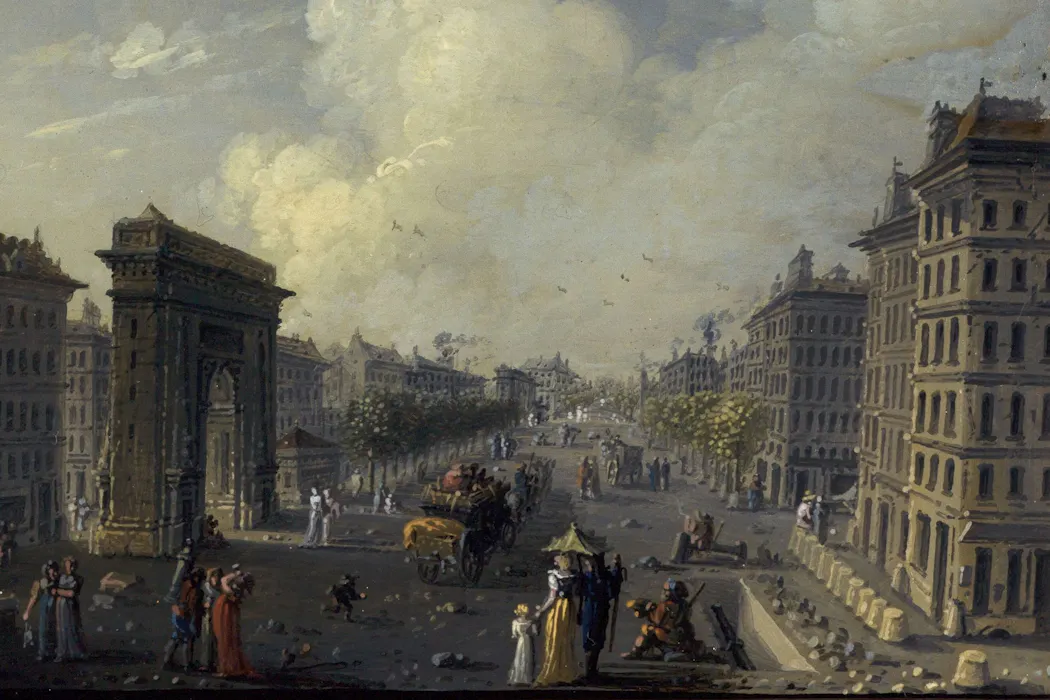 After fleeing Venice, Antonia Bembo lived near the newly constructed Porte Saint-Denis, a triumphal arch in Paris that's depicted in this 19th-century painting by Jean Francois Lebelle.Heritage Art/Heritage Images via Getty Images
The Paris Opera has staged iconic works like “Don Carlos” and “Les Troyens,” along with celebrated ballets such as “Les Indes Galantes” and “The Rite of Spring.”
But you’d be forgiven for not having heard of Antonia Bembo, whose 1707 opera “Ercole Amante” – “Hercules in Love” – will be staged at Paris’ Opéra Bastille for the first time on May 28, 2026. Born around 1640, Bembo and her opera remained obscure for centuries, due to the vagaries of her music manuscripts and the historical neglect of women composers.
I have been studying Bembo since 1990. At the time, scholars knew nothing about her life; she had merely been a name on the title pages to her music manuscripts. Once I confirmed that she was not born into, but had married into, the patrician Bembo family, I was able to not only identify her, but also tell her story in my 2006 biography, “Desperate Measures: The Life and Music of Antonia Padoani Bembo.”
Until recently, interest in Bembo and her music had been relatively modest, her name one among many historical women composers. A European premiere devoted to her work marks a major step forward.
Escape from Venice
Bembo’s obscurity was partly of her own making.
Trained as a musician in Venice, she fled from an abusive husband and settled in Paris in 1677. There, she sang before Louis XIV, who provided the means for her to live in a women’s residential community near the newly constructed Porte Saint-Denis, a triumphal arch along the Boulevard de Bonne-Nouvelle.
She wrote music by hand and gifted it to the king to thank him for his generosity, producing numerous cantatas, arias, celebratory motets and dramatic works. Nevertheless, she must have lived in constant fear of being found in Paris by her husband: Only when he died in 1703 did she feel free to assemble her manuscripts into finished, presentable volumes.
 The coat of arms that appears on the cover of the manuscript for Antonia Bembo’s ‘Ercole Amante.’Courtesy of the Sibley Music Library, Eastman School of Music, University of Rochester, CC BY-SA
By the time of her death around 1720, she’d bound eight volumes of works. Four have lain in France’s National Library for centuries, two have been lost, and the two containing “Ercole Amante” were acquired at auction by the Music Department at the National Library in 1937. That same year, musicologist Yvonne Rokseth published an article in The Musical Quarterly in which she wrote about the contents of the opera, as well as the compositions in Bembo’s other volumes.
I was a graduate student at Duke University in search of a dissertation topic in 1990 when I came across Rokseth’s article. It was the first time I had heard Bembo’s name. I obtained the microfilms of Bembo’s music, and my adviser gave me the go-ahead to pursue a study of her life and works.
For months I searched for documents mentioning the composer at the Paris National Archives and came up empty-handed. During a short trip to Venice in 1991, I found a book of names of women who married into noble families. From its contents, I posited that she had been born Antonia Padoani and had married into the Bembo family. The following year, I had a breakthrough: I found an envelope of documents at the State Archives of Venice that revealed she had left most of her belongings at the Convent of San Bernardo in Murano. She’d also left her 14-year-old daughter, Diana, at the convent in order to protect her from her father.
With these hints, I was able to find more information about Bembo’s life in documents located at the Patriarchal Archive, the Correr Museum and the Marciana Library in Venice.
Over time, I was able to flesh out enough details from Bembo’s life and works to write my biography.
A life comes into focus
The only child of medical doctor and amateur poet Giacomo Padoani and his wife, Diana Paresco, Antonia Padoani received an education in music and grammar in Venice.
Giacomo Padoani arranged to have Francesco Cavalli, the foremost Venetian composer of the day, teach his daughter.
Famously, Cavalli had been called to Paris in 1660 to write an opera for the wedding of Louis XIV and the Spanish infanta, María Teresa. That opera, “Ercole Amante,” was based on a libretto, or script, by Francesco Buti.
 Antonia Bembo lived in this home in Venice’s Santa Maria Nova neighborhood with her husband and three children.Courtesy Patricia Fortini Brown, CC BY-SA
Giacomo Padoani’s Venetian contemporary, poet Giulio Strozzi, also hired Cavalli to teach his daughter, Barbara. But whereas Barbara would go on to publish a series of her compositions, Antonia took a different path that likely disappointed her father. Instead of pursuing a career as a musician or a poet, she married Lorenzo Bembo. He gave her noble status and three children, but it came with a great deal of trouble.
In 1672, Antonia Bembo – then living in the back part of a house known as Cà Bembo in the neighborhood of Santa Maria Nova – sued for divorce, citing Lorenzo’s infidelity along with mental and physical abuse. The lawsuit was unsuccessful, so five years later, she slipped out of town to start her new life in Paris, leaving her husband and children behind.
In 1707, Bembo completed her composition of a new musical score for Buti’s opera libretto. Like Cavalli’s opera, it follows Hercules, who becomes obsessed with Iole, the daughter of a man he has killed. Iole happens to also be in a relationship with Hercules’ son, and Hercules’ pursuit ends up setting off a chain of rivalries among gods and mortals.
In some ways, Bembo improved upon Cavalli’s original opera. A story about an aging Hercules in the 1700s better coincided with Louis XIV’s life arc than when Cavalli had composed the opera for the 22-year-old king’s wedding. And whereas the French public had objected to the Italian language Cavalli used in his opera, Bembo’s union of Italian and French musical styles – reflecting what she had heard and learned in Venice and Paris – made it more accessible.
The time has come
So why is Bembo’s opera only reaching the stage in 2026?
First, her handwritten score was difficult to decipher. Unlike Barbara Strozzi’s scores, which were printed and published during her lifetime, Bembo’s manuscripts have presented challenges for performers. The Opéra de Paris created a performance score of “Ercole Amante” by employing an editorial team that corrected mistakes and rectified inconsistencies.
Second, women composers of early music operas – traditionally excluded from the operatic canon – have only recently started having their works staged. In 2023, for example, “Céphale et Procris,” an opera written by Bembo’s French contemporary Élisabeth-Claude Jacquet de La Guerre, along with Francesca Caccini’s “Alcina,” were performed at the Boston Early Music Festival.
With a star-studded cast and a large Baroque orchestra under the baton of Leonardo García-Alarcón, the staging of Bembo’s manuscript, which has lain dormant for centuries, is an occasion to rejoice.
Now, Bembo’s operatic masterpiece can claim its place alongside the legacy of her teacher, Francesco Cavalli. It also places her alongside Jean-Baptiste Lully, Marc-Antoine Charpentier and Michel-Richard de Lalande as one of Louis XIV’s “artisans of glory” – the group of artists, architects, composers and performers who helped construct the image of the “Sun King” as a divinely ordained monarch.
Claire Fontijn does not work for, consult, own shares in or receive funding from any company or organization that would benefit from this article, and has disclosed no relevant affiliations beyond their academic appointment.
Authors: Claire Fontijn, Professor of Music, Wellesley College