

SpaceX is poised to go public and test the latest version of its massive Starship rocket amidst criticism about its environmental impact
- Written by Scott Solomon, Teaching Professor of BioSciences, Rice University
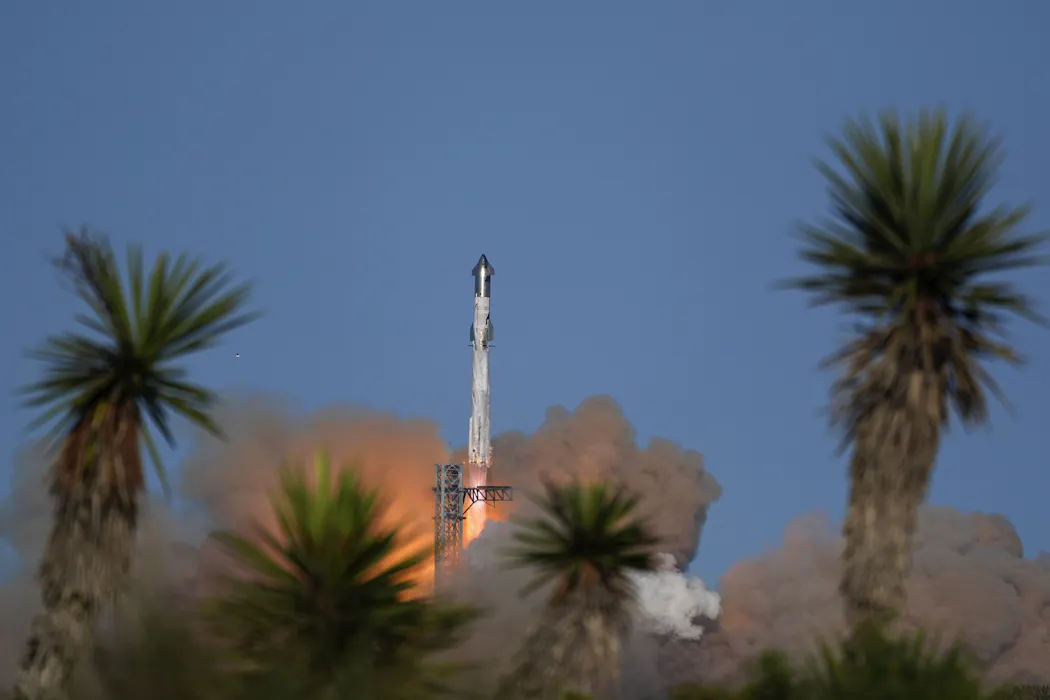 An earlier version of SpaceX's Starship rocket launched from the Starbase facility in Boca Chica, Texas during a test in November 2024. AP Photo/Eric Gay
SpaceX is proceeding with two major milestones with consequences that could be, at a minimum, global. The company, owned by Elon Musk and valued at upwards of US$1.5 trillion, released its financial details on May 20, 2026 in advance of an IPO scheduled for June 12 and anticipated to be the largest in history. Meanwhile, as soon as this evening, May 21, SpaceX plans to test the latest version of its Starship rocket – also the largest of its kind in history – and designed to facilitate a human migration to the Moon and Mars.
But underlying SpaceX’s surges forward are tensions between the company’s activities and concerns about the effects they may be having on the environment.
These tensions were on display in April 2026 as protests by environmental activists took place outside Starbase, its development and testing facility in South Texas, while SpaceX was courting investors.
The Starbase facility is located in a sensitive wetland area along the Gulf Coast that serves as a habitat for birds and a nesting site for sea turtles. Concerned about pollution and launch debris damaging these species and others, environmental groups have filed multiple lawsuits against the company. Federal and state agencies have also fined SpaceX for polluting local waterways.
This conflict is a microcosm of a larger issue: whether the space ambitions of Silicon Valley and Wall Street are fundamentally at odds with the concerns of environmental activists.
Activists protested outside SpaceX’s Starbase facility ahead of the company’s IPO.Space and conservation at odds?
On the one hand, technologies developed for space often have benefits on Earth. And Musk has argued that SpaceX’s long-term goal of building a city on Mars would help protect life, including humans and other species, by ensuring their survival in the event of an Earthly disaster. But space exploration can also do environmental harm, from space debris causing damage to marine or terrestrial ecosystems to rockets producing pollutants and greenhouse gases, which can contribute to climate change.
As an evolutionary ecologist who spent years studying rainforest insects and more than a decade considering the consequences of space settlement, I can understand both sides of this argument.
I’ve been to Starbase to watch a Starship launch and seen the sensitive wetlands surrounding the launch pad. But I’ve also studied the fossil record and understand how events like the asteroid impact 66 million years ago devastated many of the dominant life forms alive at the time, like most dinosaurs. So I understand the motivation to become a multiplanetary species to help avoid that fate.
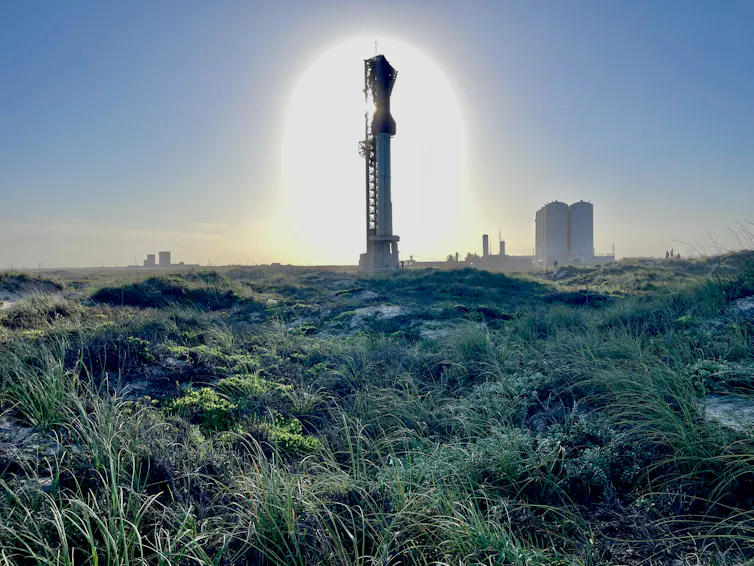 SpaceX’s Starbase facility, where its Starship rockets are built and where test launches occur, is surrounded by coastal wetlands that provide habitat for animals including birds and sea turtles.Scott Solomon
Environmental costs of space travel
But does the very act of going to space cause more environmental harm than good?
Depending on the type of fuel used, rocket launches can release pollutantssuch as black carbon, chlorine gas, methane and carbon dioxide that can contribute to ozone depletion and climate change. However, some liquid fuels like methane – which is what SpaceX uses for its massive Starship rocket – are cleaner-burning, producing mainly water and carbon dioxide as byproducts.
There can also be local ecological impacts, including damage to nearby vegetation or harm to wildlife, such as the destruction of bird nests. Noise pollution from the sound of a launch can stress some animals or interfere with their natural behaviors.
As the frequency of rocket launches increases, these potential impacts are becoming a greater concern. In 2025, there were a total of 324 launches worldwide, which sent a staggering 4,510 objects into space. Both were new records. And these numbers don’t include suborbital launches – those that involve a shorter, up-and-down trajectory – or test launches, such as those for SpaceX’s Starship.
Benefits of space exploration
But there can also be ways in which space exploration directly benefits people back on Earth.
Technological innovations created for living in space have already directly benefited some sustainability efforts on Earth. These include methods for recycling water and managing waste.
Space technologies such as satellites have also become essential tools for researchers who study and monitor our planet’s ecosystems and how they are changing.
NASA is working with SpaceX and other commercial space companies to build a base on the Moonwithin the next decade. Having people live on the Moon will require further technological developments that could have helpful spinoffs to use back on Earth.
For example, finding ways to grow food in such an austere environment could lead to new ways to feed people in regions on Earth where agriculture has traditionally been limited by environmental constraints.
Looking back at the Earth
Another way space exploration could benefit conservation efforts is by motivating people to be more environmentally minded.
The environmental movement that began in the 1970s was inspired in part by the perspective offered by the Earthrise photo taken during the Apollo 8 mission in 1968. Seeing the Earth with your own eyes can be even more moving, according to those who have experienced it. They point out that borders between nations are largely invisible, but that human impacts on the planet like deforestation, wildfires and the bright lights of cities at night can be quite evident.
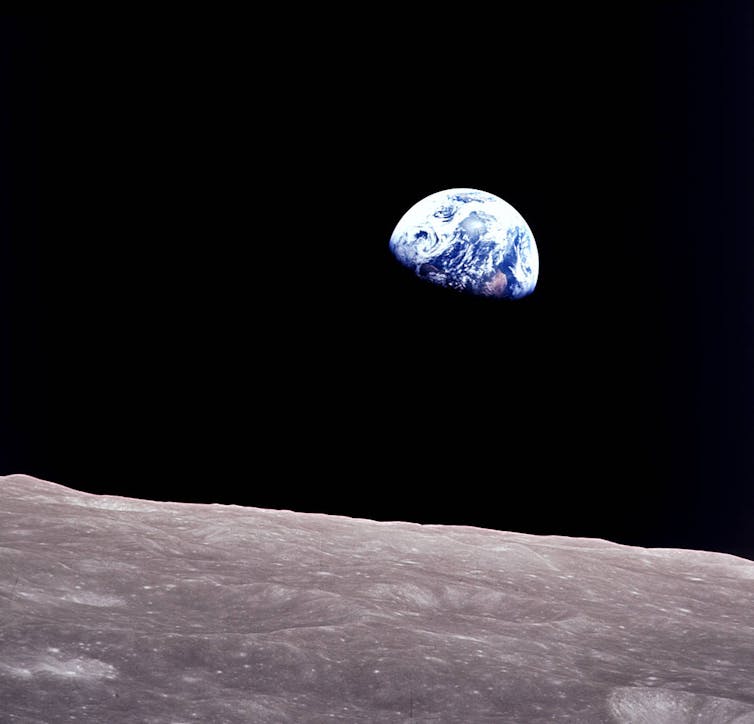 The Apollo 8 ‘Earthrise’ image, showing the Earth over the horizon from the Moon. This image, acquired by William Anders, became famous for its portrayal of the Earth in its planetary context.NASA
Also visible from space is a thin, blue line that seems to hover just above our planet’s surface: the atmosphere. It’s a reminder that there is only a narrow zone that allows life on Earth to flourish, and that we must protect it.
Astronauts frequently come back to Earth more motivated to protect the environment. Some, like Scott Kelly and Nicole Stott, became dedicated environmentalists after the experience of being in space. As space becomes more accessible and a greater number of people have these transformative experiences, there could be more support for conservation and sustainability.
Do these benefits outweigh the environmental costs? Ultimately, whether going to space is a net benefit or a cost to the environment may come down to individual choices. The choice of rocket fuel matters. But so does the location of launch sites. Those near the coast are better for human safety because falling debris is more likely to come down over the ocean than a city. But some coastal locations host more significant wildlife habitats than others.
What goes up…
Decisions about what to send to space are also important. After all, what goes up must come down. Debris from space, such as defunct satellites, can burn up during reentry, but occasionally piecesreach the ground intact. When they do they can create litter, not to mention the potential for causing damage to people, property and wildlife.
Objects that remain in orbit also contribute to concerns about polluting the space environment, potentially making it more dangerous to travel into space because of the risk of high speed collisions.
Perhaps new technologies to help advance human pursuits in space, like living on the Moon, will help solve some of our environmental challenges. The increasing number of people who get the opportunity to travel to space may be so profoundly affected by the experience that they take actions with environmental benefits.
As the space economy continues to develop, the balance between expanding humanity’s presence beyond our home planet and concerns about protecting it will only intensify.
Scott Solomon has received funding from the National Science Foundation. He is the author of the book "Becoming Martian: How Living in Space Will Change Our Bodies and Minds" published by MIT Press.
Authors: Scott Solomon, Teaching Professor of BioSciences, Rice University