

The US Constitution and laws do not protect oil companies from being sued over the harm they cause to the climate
- Written by Alejandro E. Camacho, Professor of Law, University of California, Los Angeles
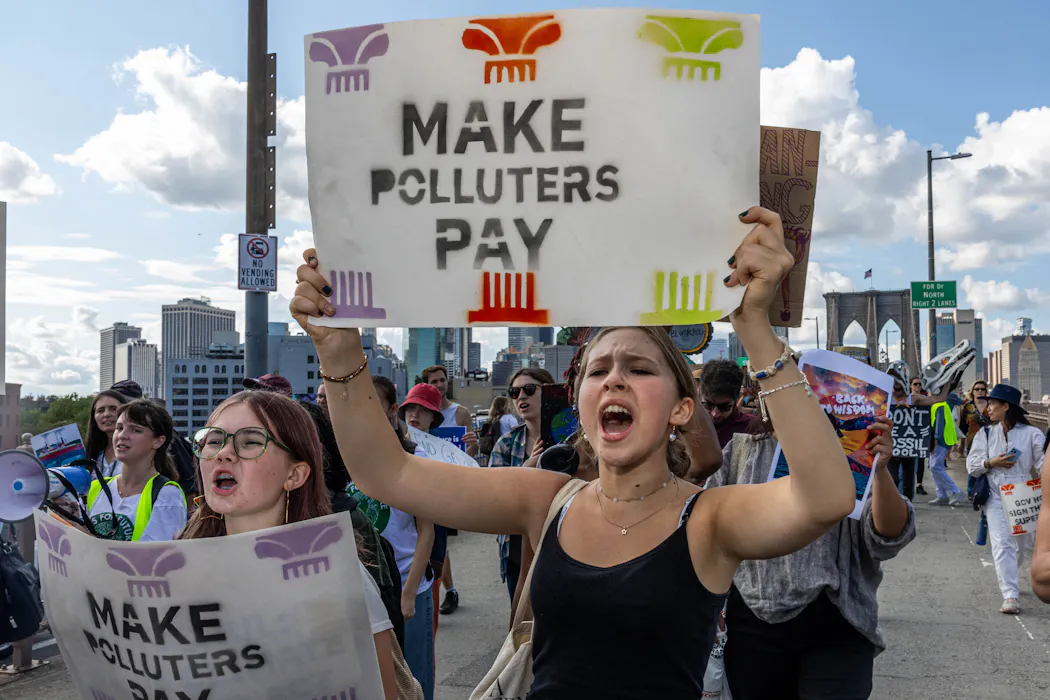 Across the U.S., people are calling for companies to pay for the damage they have done to the environment.Alex Kent/AFP via Getty Images
In recent years, at least two dozen local and state governments have sued petroleum companies to recover the billions in costs they have incurred responding to and rebuilding after flooding, storms and wildfires – all of which have been worsened by changes to the climate resulting from burning fossil fuels.
Most of these lawsuits, often filed in state courts, make a simple claim: Fossil fuel companies knew for decades that their products were harmful but concealed that fact to protect their profits. The lawsuits ask judges to order companies that have profited from the extraction and sale of fossil fuels to pay for the costs their products have imposed on the taxpaying public.
Recently, the U.S. Supreme Court agreed to hear one of these cases, Suncor Energy v. Boulder County, in the term beginning in October 2026. In their appeal to the Supreme Court, the oil companies are asking the nation’s highest court to block state courts from even considering holding the companies liable for climate-related damages.
The effort to block liability is part of a decades-long strategy by the conservative legal movement to limit victims’ ability to seek reimbursement for damage caused by corporate irresponsibility. In fact, this type of orchestrated campaign to abuse corporate power goes back well over a century in U.S. environmental legal history.
As professors with decades of experience analyzing environmentallaw, we believe this effort misreads the U.S. Constitution, misunderstands judicial precedent and misrepresents the role of courts in a federal system.
 In a lawsuit, Boulder County, Colo., claims petroleum companies’ actions contributed to the climate change that exacerbated heavy rains and flooding. The lawsuit also alleges that the companies knew their products were dangerous to the environment, and sold them anyway.Matt Jonas/Digital First Media/Boulder Daily Camera via Getty Images
Foreign relations and national security justifications
One type of argument companies are using to try to limit their liability involves the federal government’s authority to conduct foreign affairs and protect national security. Federal courts have long applied a “customary policy of deference to the President” in matters of foreign affairs because the Constitution gives the president powers to enter treaties, appoint ambassadors, and the like.
Some prominent conservative legal scholars have tried to extend this concept by claiming that allowing lawsuits seeking compensation for climate-related damages to proceed would penalize multinational corporations doing business in the United States. They say such cases would interfere with the federal government’s ability to conduct the nation’s foreign affairs.
The Office of the Solicitor General – the government’s top litigation attorney – is making that argument to the Supreme Court in the Suncor case. It claims that by lodging authority over the nation’s foreign affairs in the federal government, the Constitution limits local governments’ ability to sue multinational corporations. Some legal academics support this claim by relying on a 2015 Supreme Court decision that states the nation must “speak with one voice” on foreign affairs.
But that case concerned the president’s narrow power to formally recognize foreign governments, which differs from corporate liability in state court for harms occurring in the U.S. As scholars at the Transnational Litigation Blog have noted, elimination of state law based on the federal government’s power to determine the nation’s foreign affairs is a “controversial and mostly moribund” doctrine. Applying it to suits in which defendants caused harm within the state is a stretch.
More troubling, the argument could prevent any lawsuit against energy, asbestos, pharmaceutical, or other multinational corporations. Unsurprisingly, both the Colorado and Hawaii Supreme Courts have rejected this reasoning. The Colorado court stated that Boulder’s suit involves areas of traditional state responsibility. It denied that Boulder was “seeking to implement foreign policy” or that its claims “intrude(d) on any power over foreign policy … reserved to the federal government.”
The Trump administration and its energy company allies have also tried to invoke national security as a a reason to dismiss these suits. The administration and the companies claim that forcing oil companies to defend these suits would reduce production of needed energy supplies. But that claim is completely unsubstantiated.
 Wildfires like the one in Fourmile Canyon, Colo., in 2010, have been made more likely and worse by greenhouse gas emissions, which increase air temperatures and dry out vegetation.AP Photo/Jae C. Hong
Clean Air Act preemption
The oil companies also argue that the federal Clean Air Act preempts local claims in state courts like those made by Boulder County.
Many local claims are based on longstanding doctrines that allow court-ordered remedies for infringements like “nuisance,” which involve interfering with the public’s interest in health, safety, and welfare or enjoyment of private property.
In 2011, the Supreme Court found that the Clean Air Act blocks federal claims that air pollution is a nuisance. But it left open whether the act would also prevent similar state law cases. Numerous other Supreme Court decisions have declared that courts should presume that federal laws do not block claims in areas of traditional state authority. Since the nation’s founding, state courts have had jurisdiction over cases, like Suncor, that deal with liability for damage caused by a defendant’s wrongdoing.
In fact, the Clean Air Act includes a provision that explicitly preserves rights and remedies created and administered by state courts. Rather than seeking to regulate pollution, lawsuits like Suncor claim that the oil industry knew for decades that its product was dangerous but concealed that fact to protect its profits. The Clean Air Act does not regulate corporate fraud or deception, and no federal statute has ever preempted state law deception claims.
Even if the Supreme Court were to find that liability for fraudulent marketing is functionally equivalent to regulating emissions, that should not block state-level lawsuits. In 1984, the Supreme Court found that even the Atomic Energy Act – which comprehensively regulates management of nuclear materials and facilities, a matter of recognized federal concern – did not prevent state lawsuits to recover damages caused by a company with a federal license to operate a nuclear plant. The court stated it was “inconceivable that Congress intended to leave victims” without a remedy.
The same logic applies in these climate-damage cases. The Clean Air Act provides no compensation to communities that bear wildfire, flood, and infrastructure costs due to climate change. Preventing local governments from suing would leave local governments and the constituents they represent with no way to seek compensation for harms they have suffered. As the Supreme Court said in 2005, “If Congress had wanted to deprive injured parties of a long available form of compensation, it surely would have expressed that intent more clearly.” It did not do so in the Clean Air Act.
More generally, federal environmental laws protect wide-ranging public interests by regulating future behavior. State court damage claims seek to compensate specific victims for past harms. In building the modern environmental regulatory framework, Congress undeniably assumed that longstanding state laws that impose civil liability for irresponsible behavior would continue to be available to compensate those harmed by such actions.
 Climate-related natural disasters have caused billions of dollars in damage in the U.S. alone.Marc Piscotty/Getty Images
A back-up plan
The energy industry and its political allies are already planning for the possibility that the Supreme Court will reject their pleas for immunity. U.S. Rep. Harriet Hageman, a Wyoming Republican, and Sen. Ted Cruz, a Republican from Texas, have introduced legislation that would block any lawsuits in state or federal courts based on state laws requiring energy businesses to pay for climate-related damage.
The bills are in the early stages in Congress. However, they are also based on the flawed idea that the federal government’s power over national security and foreign affairs bars the rights of local communities and individuals to seek redress for harms they have experienced.
Conservative legal scholars and practitioners have long sought to shield irresponsible corporations from answering for the harms they cause.
We believe people and communities who have suffered harm from companies deserve their day in court. Claiming that the Constitution requires local taxpayers to endure these harms without a chance to prove their case is not a defense of national security. It is a defense of corporate impunity.
The authors do not work for, consult, own shares in or receive funding from any company or organization that would benefit from this article, and have disclosed no relevant affiliations beyond their academic appointment.
Authors: Alejandro E. Camacho, Professor of Law, University of California, Los Angeles