

Timber Decking: How to Choose, Plan, and Build a Deck That Lasts
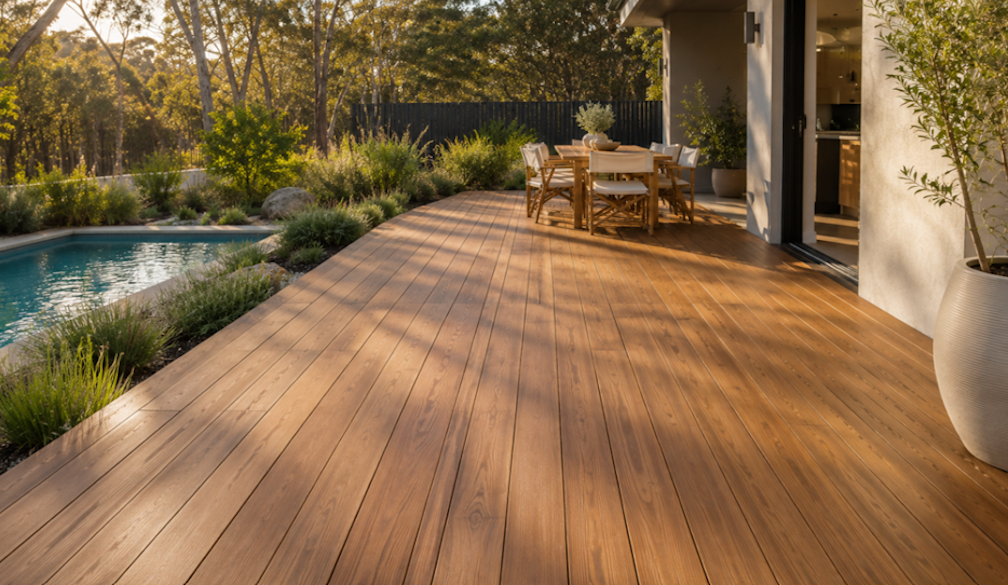
The enduring appeal of timber decking
There's a reason timber decking has remained the preferred outdoor living surface for Australian homeowners for generations. No composite material, no concrete, and no pavers replicate the warmth, texture, and natural character of real timber underfoot. Whether it's a wraparound verandah on a Queensland cottage, a poolside deck in Perth, or a rooftop terrace in inner-city Sydney, well-chosen and well-installed timber decking creates an outdoor space that genuinely extends a home's liveable area — and its resale value.
But not all timber decking is created equal. The species you choose, the way you install it, and the maintenance regime you commit to will all determine whether your deck looks beautiful at year twenty or needs replacing at year eight. This guide cuts through the noise and gives you what you actually need to make a smart decision.
Choosing the right timber species for your deck
Species selection is the single most important decision in any timber decking project. Get it right, and your deck will be a feature of your home for decades. Get it wrong, and you'll face premature wear, cupping, checking, or in worst cases, structural failure.
In Australia, the most commonly used decking timbers fall into two broad categories: hardwoods and softwoods. Each has distinct characteristics, and the right choice depends on your climate, intended use, aesthetic preferences, and budget.
Australian hardwoods
Australian hardwood species like blackbutt, spotted gum, merbau, tallowwood, and ironbark are among the most durable decking timbers in the world. They're dense, naturally resistant to insects and decay, and capable of withstanding Australia's intense UV and moisture extremes with appropriate maintenance.
- Blackbutt — pale golden-brown, excellent durability, suitable for most Australian climates
- Spotted gum — rich brown tones with distinctive gum veins, outstanding hardness and wear resistance
- Merbau — deep reddish-brown, imported from South-East Asia, good durability, cost-effective
- Tallowwood — warm honey tones, high natural oil content, particularly good in wet or coastal conditions
- Ironbark — extremely hard and dense, excellent longevity, particularly suited to high-traffic areas
Hardwoods generally come at a higher upfront cost than softwoods, but their longevity means the lifecycle cost is often comparable or better. They also develop a beautiful silver-grey patina if left uncoated, which many homeowners find preferable to constant oiling.
Softwoods and modified timbers
Not every deck requires the density of a hardwood. For low-to-ground or sheltered decks, radiata pine, particularly treated to H3 or H4 standard, offers a cost-effective and readily available option. It takes stains and oils readily, making it easy to achieve a consistent finish, and is widely used on coastal properties where regular maintenance is already part of the homeowner's routine.
Modified timbers, particularly Accoya (acetylated radiata pine), represent a growing category. Accoya undergoes a chemical modification process that dramatically improves its dimensional stability, durability, and resistance to rot and insects. It offers the workability and weight of a softwood with performance that rivals or exceeds many hardwoods, a genuine option for architects and designers who need a premium product with predictable behaviour.
For those designing outdoor spaces and wanting to explore the full range of timber decking solutions available in Australia, working with a supplier that offers multiple species and profiles means you can match the right timber to the specific demands of your project.
Board profiles: the details that define the finish
Beyond species selection, the profile of your decking boards influences both the aesthetics and the practical performance of your deck.
The most common residential decking profile is a square-edged board with a slightly rounded or chamfered top corner, typically in widths between 86mm and 140mm. Wider boards give a contemporary, expansive look. Narrower boards suit heritage homes or spaces where you want the eye to travel along the length of the deck.
Grooved boards designed for use with hidden fasteners are becoming increasingly popular on higher-end projects where a clean, fastener-free surface is part of the design intent. They require slightly more labour to install but produce a noticeably more refined result. The absence of visible screw heads also eliminates the water pooling and corrosion that can occur around surface-fixed fasteners over time.
Ribbed undersides (anti-slip grooves) are worth considering on decks that are exposed to rain or near a pool. The grooves break the surface tension between the board and water, reducing slip risk in wet conditions, an important consideration in a country where outdoor decks see significant rainfall.
Structural requirements: what goes under your deck matters as much as what goes on top
A beautiful deck surface is only as good as the structure supporting it. The framing posts, bearers, and joists must be appropriately specified for the span, load, and environmental exposure.
Treated pine remains the industry standard for decking framing due to its combination of structural performance, availability, and cost. The treatment level required depends on the ground contact and exposure conditions:
- H2 treatment — protected above-ground in sheltered conditions
- H3 treatment — above-ground but exposed to weather
- H4 treatment — in-ground contact or well-ventilated subfloor environments
- H5 treatment — in-ground in wet conditions or with ongoing moisture exposure
Post centres, joist spacing, and bearer sizing all need to be calculated based on the span tables in AS1720.1, or specified by an engineer for larger or elevated decks. A common failure point on DIY decks is under-specified joist spacing. 450 mm centres are standard for most residential decking, but using 600mm centres with wide boards can lead to deflection and bounce underfoot.
Ventilation under a low-to-ground deck is also critical. Poor airflow accelerates decay in the framing timbers and in the decking itself. Perimeter gaps, ventilation holes in bearer blocks, and avoiding the accumulation of debris beneath the deck all contribute to longevity.
Installation best practices
Even premium timber, properly specified, can underperform if the installation doesn't follow best practice. A few key principles make a significant difference to the long-term result.
Firstly, correct the gap between boards. Most timber decking requires a gap of approximately 5mm between boards to allow for seasonal movement and drainage. Too tight, and boards can buckle or cup in summer. Too wide, and the deck becomes a heel-catching hazard and allows excessive debris accumulation.
Secondly, fastener choice. For hardwood decking, stainless steel screws (Grade 316 for coastal environments) are the non-negotiable choice. Galvanised fasteners will corrode in the tannins present in many hardwoods, leaving rust staining and structural weakness. Pre-drilling is essential in dense species to prevent splitting.
Thirdly, end sealing. The cut ends of decking boards are the most vulnerable point for moisture ingress. Sealing all cut ends, particularly those near ground level or water features, with a quality end-grain sealer significantly reduces the risk of checking, splitting, and decay starting at board ends.
Finally, allow new timber to acclimatise on site before installation. Delivering timber directly from the supplier and installing immediately can lead to significant movement as the boards adjust to your site's specific humidity and temperature. A few days' acclimatisation under cover on site gives the timber a chance to stabilise before it's fixed down.
Maintaining your timber deck
Consistent maintenance is what separates a deck that looks tired at year five from one that looks better at year fifteen. Fortunately, timber deck maintenance doesn't have to be arduous; it just needs to be regular.
The core maintenance task is periodic cleaning and re-oiling or re-sealing, depending on the finish you've chosen:
- Decking oils — penetrate into the timber surface, feeding the wood and providing water resistance; typically need reapplication every one to two years
- Decking stains — provide colour while also offering UV protection; lifespan of two to four years between applications
- Clear coatings — form a surface film that can look striking when new but tends to peel and require more intensive stripping before reapplication
For many Australian homeowners with hardwood decks, allowing the timber to silver naturally and simply cleaning it once a year with a quality deck wash is a perfectly legitimate approach. The silver-grey colour of weathered hardwood has its own quiet beauty, and the maintenance burden drops to near zero.
Regardless of finish type, keeping the deck free of leaf litter, soil buildup, and standing water in shaded areas will significantly reduce the risk of mould, lichen, and premature surface deterioration.
Decking and bushfire attack levels
For homes in bushfire-prone zones, the Bushfire Attack Level (BAL) rating of your property determines what materials can be used in the construction and renovation of decks. In BAL-12.5 and BAL-19 zones, many standard hardwood and treated pine decking products remain suitable. In higher BAL zones (BAL-29, BAL-40, and BAL-FZ), decking specification becomes more complex and often requires the use of fire-rated or non-combustible materials or design strategies that separate the deck from the main structure.
If you're building in a bushfire-prone zone, confirm your property's BAL rating early in the design process and check product compliance before specifying. Some suppliers offer decking products with tested BAL ratings, which simplifies the compliance pathway considerably.
Conclusion
Timber decking is one of the highest-value additions you can make to an Australian home, both in terms of liveable space and resale appeal. The key to a deck that performs and looks beautiful for the long term is making informed decisions at every stage: the right species for your climate and use case, a properly engineered structure, quality installation, and a maintenance approach you'll actually stick to.
When you take the time to get those fundamentals right, a timber deck stops being a maintenance burden and becomes exactly what it should be: the best room in the house, open to the sky.