

Battleground state with few combatants – why Pennsylvania’s primaries lack competition
- Written by Kristin Kanthak, Associate Professor of Political Science, University of Pittsburgh
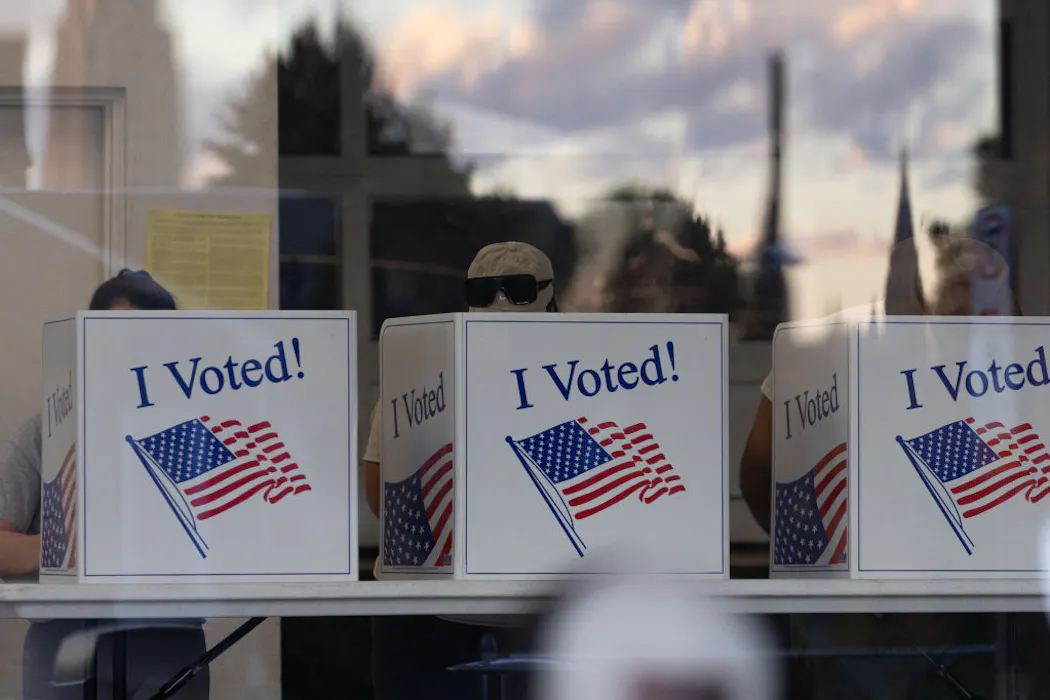 Pennsylvania is only 1 of 13 American states that holds closed primary elections.REBECCA DROKE/AFP Collection via Getty Images
At a time when hard-fought primary elections in Georgia, Kentucky and Indiana and Ohio are making national news, perennial battleground Pennsylvania seems to be nodding through one of the sleepiest primary seasons in a long time.
I’m an associate professor of political science at the University of Pittsburgh. My research focuses on how political institutions like political parties and state and local governments affect political representation.
In statewide races, only the Republican lieutenant governor slot is contested, a race between GOP-endorsed attorney Jason Richey and newcomer John Ventre. In the state Senate, less than a third of incumbents drew a challenger. Only 21 of the 203 state Assembly seats see an incumbent facing an in-party challenge. So why does Pennsylvania, usually a hotbed of political strife, appear to be sitting this midterm primary season out?
Uncontested primaries are normal
According to political scientists Shigeo Hirano and James M. Snyder Jr., uncontested primaries, and uncontested elections in general, are normal – and can even be a good thing. They argue it’s because high quality candidates do not tend to draw a challenge. This means that an uncontested primary signifies the district has no potential candidates who both want the job and think they can win against the incumbent.
The biggest reason challengers stay home is because of a well-dug-in incumbent, and Pennsylvania had plenty of those this cycle. Unlike in Indiana, no wave of anti-establishment energy is giving long-shot challengers a fighting chance.
 Pennsylvania Rep. Brian Fitzpatrick, a Republican, protested against the government shutdown in January 2026.Mark Makela/Stringer Collection via Getty Images
Interestingly, the moderate Trump foe and incumbent Brian Fitzpatrick, a Republican state representative from Bucks County, managed to avoid a primary challenge this year. Fitzpatrick was one of only two Republicans to vote against the H.R. 1 Act – also known as President Donald J. Trump’s “One Big Beautiful Bill.”
The only other dissenting vote came from Kentucky’s Thomas Massie — and the President responded by personally recruiting a primary challenger to run against him.
Why Pennsylvania’s Fitzpatrick got a pass
So how did Fitzpatrick manage to avoid Trump’s notice? It helps to compare his political fortunes with Massie’s.
Massie’s district is solidly red. He typically wins at least 60% of his general election vote. In 2024, no Democrat even ran against him.
Fitzpatrick, on the other hand, hails from a decidedly “purple” district where the vote could go in either party’s direction. He rarely wins more than 55% of the vote, and is perennially on the list of the most at-risk Republican incumbents.
In other words, in a midterm election in which Republicans face strong competition and fear losing the House of Representatives, Republicans need Fitzpatrick more than they need Massie. Without Fitzpatrick, his district is much more likely to fall in the Democratic column. Without Massie, Republicans can still expect to keep the seat red.
Pennsylvania parties hold the key
Pennsylvania incumbents have mostly been able to avoid finding themselves part of a larger conflict.
Some of the most contested primaries this election cycle stem from disputes centered on President Trump’s push for Republican-led states to redraw their congressional district lines. But the Commonwealth of Pennsylvania, with its closely divided state legislature, is not going to change its electoral map anytime soon. So the Commonwealth was left out of partisan gerrymandering disputes.
Pennsylvania remains one of only 13 American states that holds closed primary elections. That means voters must already be registered as party members to vote in that party’s primary. In an open, or even semi-open, primary state like Michigan and Iowa, potential challengers can try to win a primary election by relying on new voters choosing to align with the party only for that election day, or even for that specific election.
 In order to vote in Pennsylvania’s primary on May 19, 2026, voters must already be registered as members within their party.ANGELA WEISS/AFP Collection via Getty Images
A closed party system gives party regulars, and the party organization itself, enormous sway over who gets nominated. Potential candidates in closed-party states are much better off working within the party organization and waiting for an incumbent to step down before throwing their hats in the ring.
Pennsylvania is a closed-party state and a swing state. In an election cycle in which political parties from West Virginia’s Republicans to California’s Democrats seem to be turning on their own members, Democrats and Republicans in the Commonwealth of Pennsylvania have managed to keep their parties more unified.
The desire for party fealty is strong, but not as strong as the need to win in the general election. Pennsylvania parties are powerful, and they are staying cautious until November. An uncontested primary, in other words, isn’t a sign of apathy. In Pennsylvania, it’s strategy.
Kristin Kanthak does not work for, consult, own shares in or receive funding from any company or organization that would benefit from this article, and has disclosed no relevant affiliations beyond their academic appointment.
Authors: Kristin Kanthak, Associate Professor of Political Science, University of Pittsburgh