

More universities are disinviting commencement speakers who might challenge students’ ideas, unraveling an apolitical tradition
- Written by Austin Sarat, William Nelson Cromwell Professor of Jurisprudence and Political Science, Amherst College
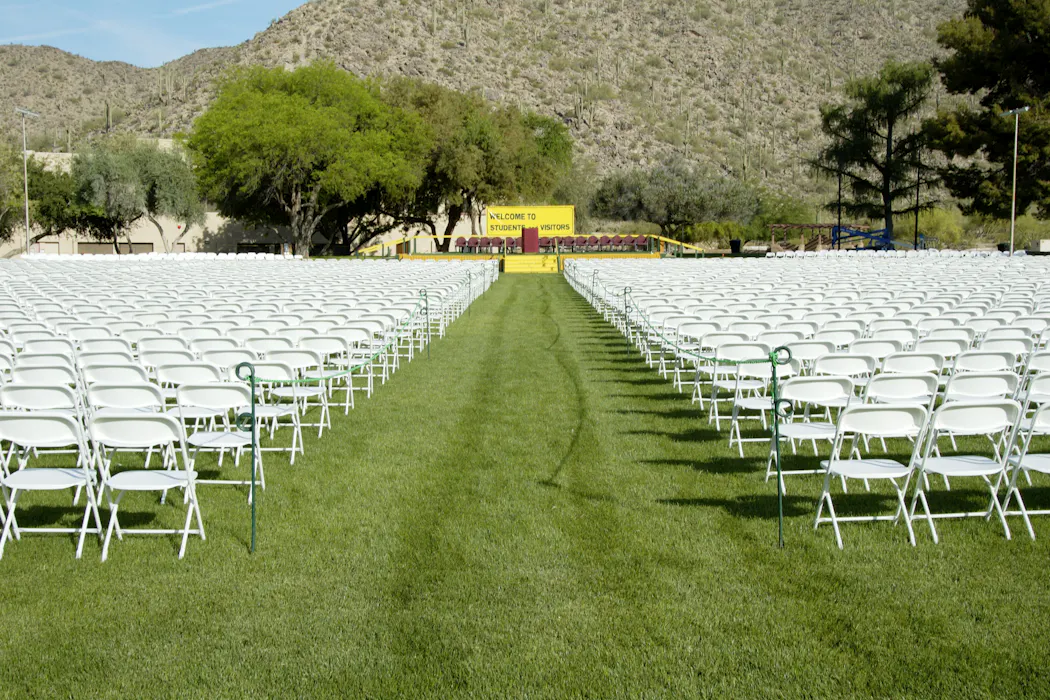 College commencement ceremonies celebrate students' achievements, but also have become occasionally fraught with politics. photosbyjim/iStock/Getty Images Plus
 Delivering a university commencement address used to simply be a unique kind of honor. Speakers stand before a podium, wearing a traditional graduation cap and robe, and offer graduates life lessons and inspirational words as they enter the next phase of life.
But today, speaking at a university commencement ceremony carries considerable risk, as Morton Schapiro, former president of Northwestern University, recently found out. Schapiro was scheduled to speak at Georgetown University Law Center’s graduation on May 17, 2026, but announced on May 6 that he would no longer appear at the event.
Some Georgetown law students had protested and petitioned to have Schapiro’s invitation rescinded, citing what they said were Schapiro’s “controversial, Zionist, and harmful opinions.” The students pointed to an op-ed that Schapiro wrote expressing support for Israel and Jewish people a few days after the Hamas attacks on Oct. 7, 2023, which killed 1,200 people.
Schapiro is in good company. There’s a reason why the free speech advocacy group FIRE calls the lead-up to college commencementsdisinvitation season.
Over the past two decades, colleges and universities across the country have withdrawn invitations to various commencement speakers after students protested their scheduled appearance. Or, in some cases, invited speakers have said they will no longer participate after students spoke out against their upcoming speeches.
As a political scientist who has written about the First Amendment and free speech on college campuses, I think Schapiro’s ill-fated Georgetown commencement invitation – and other instances like this one – show that intolerance for dissenting viewpoints lasts until the last diploma is handed out at graduation.
Some students only want people who hold similar views to address them at their graduation. They exercise what free speech law experts call a “heckler’s veto,” meaning when an audience’s reaction, or anticipated response, stops someone from speaking. Free speech then takes a back seat, and a graduation becomes just a performative moment of political correctness.
 The comedian Seth Meyers, left, attends the Northwestern University graduation with Morton Schapiro, the school’s then-president, in June 2016 in Evanston, Ill.Timothy Hiatt/Getty Images
It wasn’t always this way
The first university commencement in the U.S. took place in 1642, when Harvard College held a ceremony to honor its nine graduates. The students were joined by some of the Massachusetts Bay Colony’s most distinguished citizens, including Governor John Winthrop and his deputy, John Endicott, who observed the proceedings.
No one delivered a commencement address.
Instead, each graduate delivered an address and displayed the fruits of their classical education by speaking in Latin and English.
By the middle of the 19th century, university commencements drew well-known outsiders to college campuses to speak.
In 1837, for example, the poet and essayist Ralph Waldo Emerson addressed Harvard’s Phi Beta Kappa graduates and issued a stirring call for American students and scholars to end what he called “our long apprenticeship to the learning of other lands.”
In 1881, James Garfield became the first sitting American president to deliver a commencement address, when he spoke at the United States Naval Academy in Annapolis, Maryland.
Twenty-four years later, President Theodore Roosevelt spoke at the first graduation ceremony at Clark University, in Worcester, Massachusetts. He told his audience there, “I have always felt most strongly that it is true of a nation as of the individual that the greatest doer must also be a great dreamer.”
Since then, other presidents have used commencement speeches to announce major policy initiatives and agreements, including on foreign policy.
In 1963, President John F. Kennedy told the graduating seniors at American University that the U.S., the United Kingdom and the Soviet Union would start negotiations to ban the testing of nuclear weapons.
Two years later, President Lyndon Johnson announced at Howard University’s commencement that he would launch a major initiative to address socioeconomic disparities that disadvantaged Black people.
There was no controversy or protest about Kennedy, Johnson or other prominent speakers who delivered commencement addresses before a few decades ago.
 President John F. Kennedy delivers his commencement speech at American University in June 1963.Bettmann/Contributor/Getty Images
The commencement speaker as a lightning rod
But that was then. Times have changed.
FIRE estimates that between 2000 and 2024, there were 345 attempts to disinvite commencement speakers. Many of the scheduled speakers who faced pressure to not appear at the ceremonies backed out.
Examples of commencement speaker disinvitations have happened at small, private liberal arts colleges, as well as big public universities. Being uninvited from speaking at a graduation is often precipitated by petitions and protests, from both conservative and progressive activists.
For example, in 2019, former Nebraska Senator Bob Kerrey, a Democrat, withdrew as the scheduled commencement speaker at Creighton University. This followed the Nebraska Republican Party objecting to Kerry’s pro-abortion rights voting record.
In 2024, Dickinson College rescinded a commencement invitation for Michael Smerconish, an author and television commentator who focuses on politics. This decision came after a student wrote an opinion piece that showed that 20 years earlier, Smerconish said, “in order to keep America safe, the TSA should deliberately target Arabs and Muslims for searches because they look like the perpetrators of past terrorist attacks.”
“Does someone like Mike Smerconish in any way represent the achievements and ambitions of its students? If Dickinson truly loves and values its students, shouldn’t it honor them with someone who reflects that love?” the student asked in the opinion piece.
Protests ensued, and the college president gave in.
In 2025, the noted author Salman Rushdie withdrew as commencement speaker at Claremont McKenna College in Claremont, California, after members of its Muslim Student Association urged the school to revoke his invitation. They accused Rushdie, a self-described “hardline atheist,” of “disparaging a global religious community” in his writing and public appearances. In a 2015 commencement address at Emory University, he said: “I sometimes think we live in a very credulous age. People seem ready to believe almost anything. God, for example.”
Over the past few years, the Israel-Hamas war in the Gaza Strip has led to various commencement controversies and rescinded invitations, based on scheduled speakers’ politics around the conflict.
There have also been various commencement speakers who have delivered controversial addresses that some graduates – and outside observers – found offensive. Kansas City Chiefs kicker Harrison Butker, for example, spoke at Benedictine College’s commencement in 2024 and encouraged women to become homemakers.
 The author Salman Rushdie delivers a commencement address at Emory University in Atlanta in May 2015.Marcus Ingram/Getty Images
Commencement and free speech
That brings us back to Schapiro.
“I have presided over 28 commencements as a president and dean,” Schapiro wrote in a note to Georgetown’s law students, “and those ceremonies are about celebrating the graduates and their supporters. I was looking forward to giving a talk about humility and gratitude, but I don’t want my presence to distract from the day’s festivities.”
Humility and gratitude are often missing in disinvitation season.
In 2017, Drew Gilpin Faust, then the president of Harvard University, seemed to understand this absence when she issued a free speech message to graduates in her commencement address. “Silencing ideas or basking in intellectual orthodoxy independent of facts and evidence impedes our access to new and better ideas, and it inhibits a full and considered rejection of bad ones,” Faust warned.
Commencement season puts Faust’s admonitions to the test. “Universities,” she said, “must model a commitment to the notion that truth cannot simply be claimed, but must be established – established through reasoned argument, assessment and even sometimes uncomfortable challenges that provide the foundation for truth.”
Austin Sarat does not work for, consult, own shares in or receive funding from any company or organization that would benefit from this article, and has disclosed no relevant affiliations beyond their academic appointment.
Authors: Austin Sarat, William Nelson Cromwell Professor of Jurisprudence and Political Science, Amherst College